PDFTests Originals

Use of English C2 – Test 1

C2 Maestría GramáticaInglés

Este test de Use of English de nivel C2 tiene cuatro partes con formato de examen: un texto con huecos de opción múltiple (multiple-choice cloze), un texto con huecos gramaticales (open cloze) en formato de opción múltiple, formación de palabras (word formation) y transformaciones con palabra clave (key word transformations). Está pensado para alumnos de nivel avanzado que preparan exámenes de nivel Proficiency y para profesores que necesitan una prueba imprimible de gramática y vocabulario con soluciones y explicaciones.
Preguntas
36
Tiempo
45 min
PDF
6 páginas
Soluciones
Incluidas
  • 100 % gratis
  • Sin registro
  • PDF A4 listo para imprimir
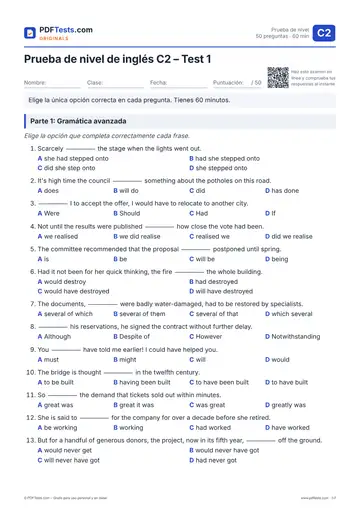
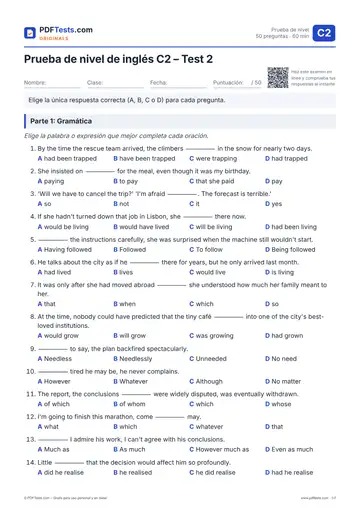
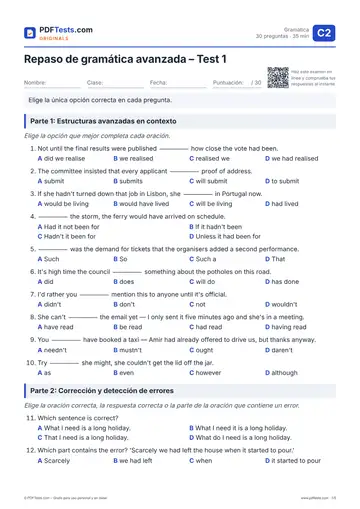
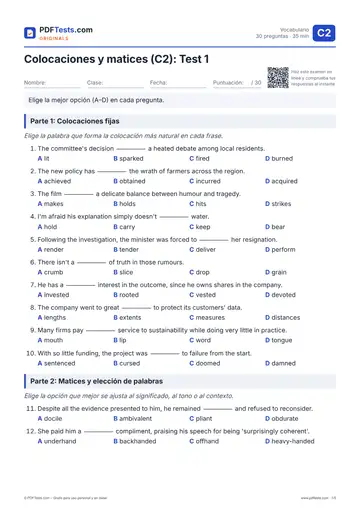
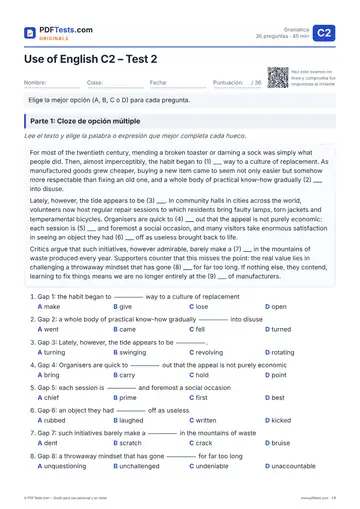
Vista previa de la página 1: Use of English C2 – Test 1 Abrir PDF
Use of English B1–C2 · todos los exámenes con formato de examen, tipos de tarea y consejos

Haz el examen en línea

Lee cada pregunta con atención y elige la única opción correcta (A, B, C o D) en cada caso. Elige tus respuestas y pulsa «Comprobar respuestas».

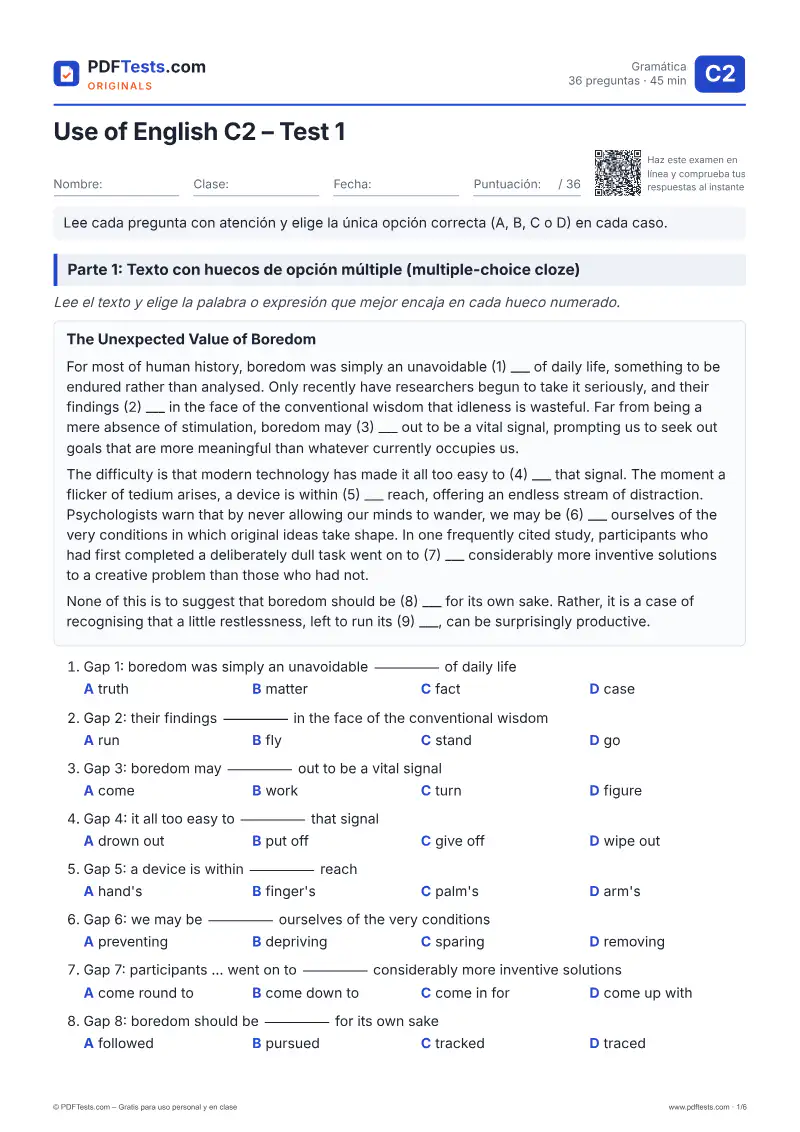
Parte 1: Texto con huecos de opción múltiple (multiple-choice cloze)

Lee el texto y elige la palabra o expresión que mejor encaja en cada hueco numerado.

The Unexpected Value of Boredom

For most of human history, boredom was simply an unavoidable (1) ___ of daily life, something to be endured rather than analysed. Only recently have researchers begun to take it seriously, and their findings (2) ___ in the face of the conventional wisdom that idleness is wasteful. Far from being a mere absence of stimulation, boredom may (3) ___ out to be a vital signal, prompting us to seek out goals that are more meaningful than whatever currently occupies us.

The difficulty is that modern technology has made it all too easy to (4) ___ that signal. The moment a flicker of tedium arises, a device is within (5) ___ reach, offering an endless stream of distraction. Psychologists warn that by never allowing our minds to wander, we may be (6) ___ ourselves of the very conditions in which original ideas take shape. In one frequently cited study, participants who had first completed a deliberately dull task went on to (7) ___ considerably more inventive solutions to a creative problem than those who had not.

None of this is to suggest that boredom should be (8) ___ for its own sake. Rather, it is a case of recognising that a little restlessness, left to run its (9) ___, can be surprisingly productive.

  1. Gap 1: boredom was simply an unavoidable _____ of daily life

  2. Gap 2: their findings _____ in the face of the conventional wisdom

  3. Gap 3: boredom may _____ out to be a vital signal

  4. Gap 4: it all too easy to _____ that signal

  5. Gap 5: a device is within _____ reach

  6. Gap 6: we may be _____ ourselves of the very conditions

  7. Gap 7: participants ... went on to _____ considerably more inventive solutions

  8. Gap 8: boredom should be _____ for its own sake

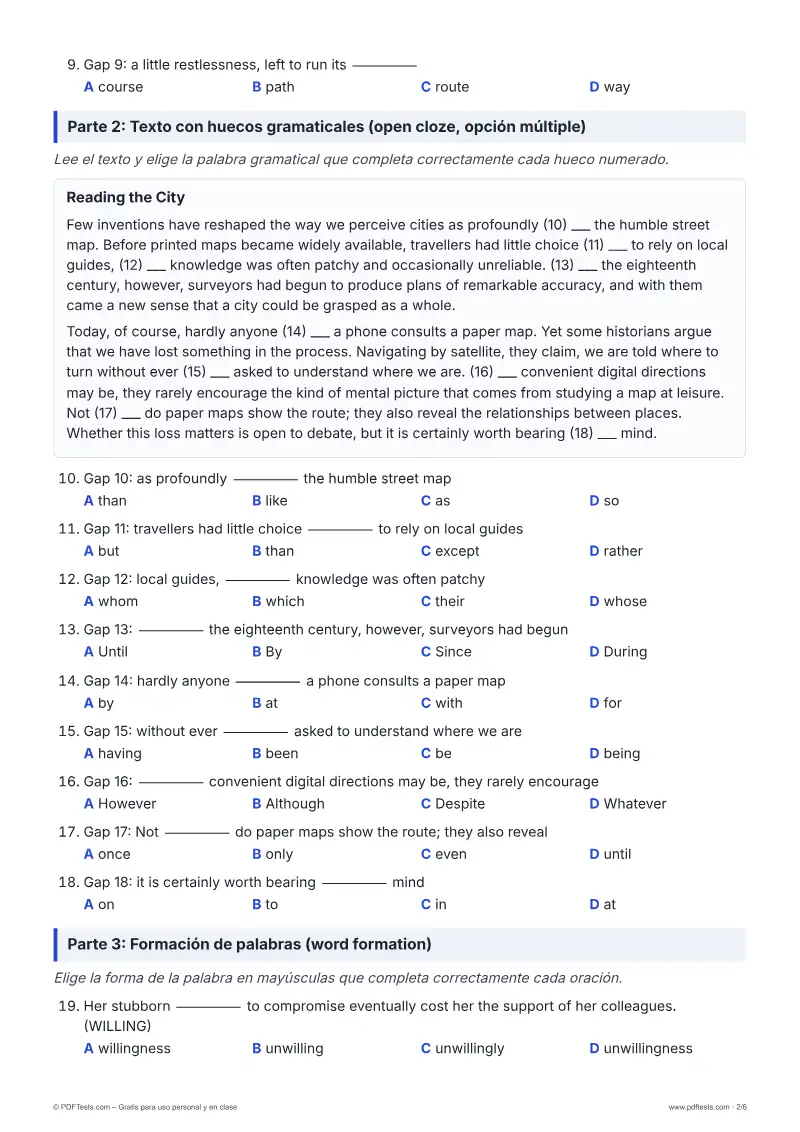
  9. Gap 9: a little restlessness, left to run its _____

Parte 2: Texto con huecos gramaticales (open cloze, opción múltiple)

Lee el texto y elige la palabra gramatical que completa correctamente cada hueco numerado.

Reading the City

Few inventions have reshaped the way we perceive cities as profoundly (10) ___ the humble street map. Before printed maps became widely available, travellers had little choice (11) ___ to rely on local guides, (12) ___ knowledge was often patchy and occasionally unreliable. (13) ___ the eighteenth century, however, surveyors had begun to produce plans of remarkable accuracy, and with them came a new sense that a city could be grasped as a whole.

Today, of course, hardly anyone (14) ___ a phone consults a paper map. Yet some historians argue that we have lost something in the process. Navigating by satellite, they claim, we are told where to turn without ever (15) ___ asked to understand where we are. (16) ___ convenient digital directions may be, they rarely encourage the kind of mental picture that comes from studying a map at leisure. Not (17) ___ do paper maps show the route; they also reveal the relationships between places. Whether this loss matters is open to debate, but it is certainly worth bearing (18) ___ mind.

  1. Gap 10: as profoundly _____ the humble street map

  2. Gap 11: travellers had little choice _____ to rely on local guides

  3. Gap 12: local guides, _____ knowledge was often patchy

  4. Gap 13: _____ the eighteenth century, however, surveyors had begun

  5. Gap 14: hardly anyone _____ a phone consults a paper map

  6. Gap 15: without ever _____ asked to understand where we are

  7. Gap 16: _____ convenient digital directions may be, they rarely encourage

  8. Gap 17: Not _____ do paper maps show the route; they also reveal

  9. Gap 18: it is certainly worth bearing _____ mind

Parte 3: Formación de palabras (word formation)

Elige la forma de la palabra en mayúsculas que completa correctamente cada oración.

  1. Her stubborn _____ to compromise eventually cost her the support of her colleagues. (WILLING)

  2. The new evidence casts doubt on the _____ of the original witness statements. (RELY)

  3. The plot is so _____ that I gave up trying to follow it halfway through. (CONVOLUTE)

  4. Despite repeated warnings, the problem remained largely _____ for years. (ADDRESS)

  5. The two accounts of the incident are virtually _____; there is no meaningful difference between them. (DISTINGUISH)

  6. The minister's remarks were widely seen as _____ and deeply unhelpful. (PROVOKE)

  7. The importance of early diagnosis is impossible to _____; it can quite literally save lives. (STATE)

  8. There was a wide _____ of opinion on the matter, with hardly any two experts agreeing. (DIVERGE)

  9. He was so _____ by the sheer scale of the task that he seriously considered giving up. (DAUNT)

Parte 4: Transformaciones con palabra clave (key word transformations)

Elige la oración que utiliza la palabra clave en mayúsculas, mantiene el significado de la oración original y es gramaticalmente correcta.

  1. I'd never have found the house if you hadn't given me directions. (FOR)

  2. The moment she arrived, the meeting started. (SOONER)

  3. People believe that the painting was stolen during the war. (BELIEVED)

  4. It's pointless to complain about the decision now. (POINT)

  5. I didn't realise how serious the situation was until I read the report. (DID)

  6. She is extremely unlikely to accept the offer. (CHANCE)

  7. Although I'd like to help you, I'm afraid I can't. (MUCH)

  8. You were wrong to lend him money. (OUGHT)

  9. Nobody expected the plan to succeed, but it did. (CONTRARY)

¿Te ha resultado útil esta página?

Informar de un error

¿Has visto una respuesta incorrecta, una errata o una explicación poco clara? Avísanos y lo corregiremos.

Practica con una ficha: Use of English C2 – Ficha 1

Vista previa

Sobre este examen

Este test de Use of English de nivel C2 tiene cuatro partes con formato de examen: un texto con huecos de opción múltiple (multiple-choice cloze), un texto con huecos gramaticales (open cloze) en formato de opción múltiple, formación de palabras (word formation) y transformaciones con palabra clave (key word transformations). Está pensado para alumnos de nivel avanzado que preparan exámenes de nivel Proficiency y para profesores que necesitan una prueba imprimible de gramática y vocabulario con soluciones y explicaciones.

Temas

Colocaciones y expresiones fijasPhrasal verbsPronombres relativos y preposicionesInversión (inversion)Formación de palabras (word formation)Estructuras pasivas de opinión (passive reporting structures)Oraciones condicionales y modales perfectosTransformaciones con palabra clave (key word transformations)

Cómo usar este examen

  1. Descarga el PDF e imprímelo, o haz el examen en línea más abajo.
  2. Responde todas las preguntas sin diccionario y sin prisas.
  3. Comprueba tus respuestas y apunta los temas que debes repasar.

Notas para el profesor

Puede utilizar el test como simulacro cronometrado o dividirlo en sus cuatro partes para trabajarlas en sesiones distintas. Se centra en errores típicos del nivel C2: colocaciones con casi sinónimos (act/serve, easy/arm's reach), el orden de palabras con inversión tras 'No sooner' y 'Only when', 'no point in' + -ing, las oraciones concesivas con 'Much as' y la confusión entre overstate y understate. Como actividad de seguimiento, pida a los alumnos que justifiquen por qué cada distractor es incorrecto o que redacten sus propias transformaciones con las mismas palabras clave.