PDFTests Originals

Les modaux de déduction au passé (must have, might have) – Test 1

B2 Intermédiaire avancé GrammaireAnglais

Ce test de grammaire anglaise de niveau B2 permet de vérifier si les apprenants savent former et employer les modaux de déduction au passé, comme must have, might have, may have, could have et can't have. Il porte sur la construction, la forme négative, la forme interrogative, les formes progressive et passive, le sens en contexte et les erreurs les plus fréquentes, et se termine par une courte compréhension écrite. Il convient aux élèves de niveau intermédiaire avancé qui préparent un examen ou révisent les verbes modaux.
Questions
30
Durée
30 min
PDF
5 pages
Corrigé
Inclus
  • 100 % gratuit
  • Sans inscription
  • PDF A4 prêt à imprimer
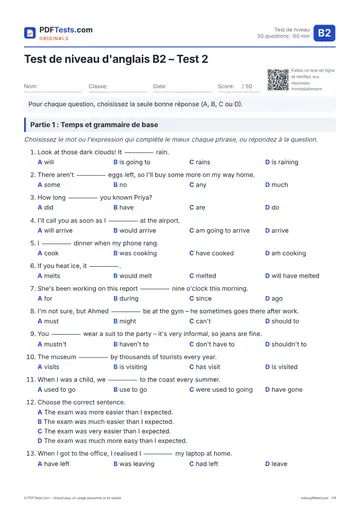
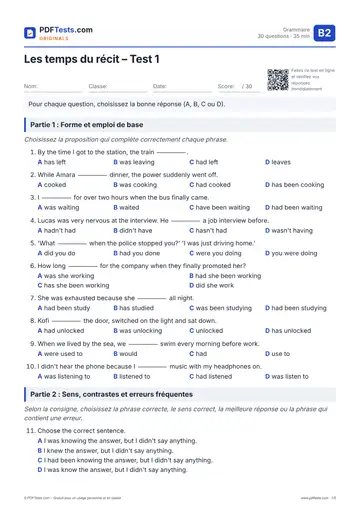
Aperçu de la page 1 : Les modaux de déduction au passé (must have, might have) – Test 1 Ouvrir le PDF

Faire le test en ligne

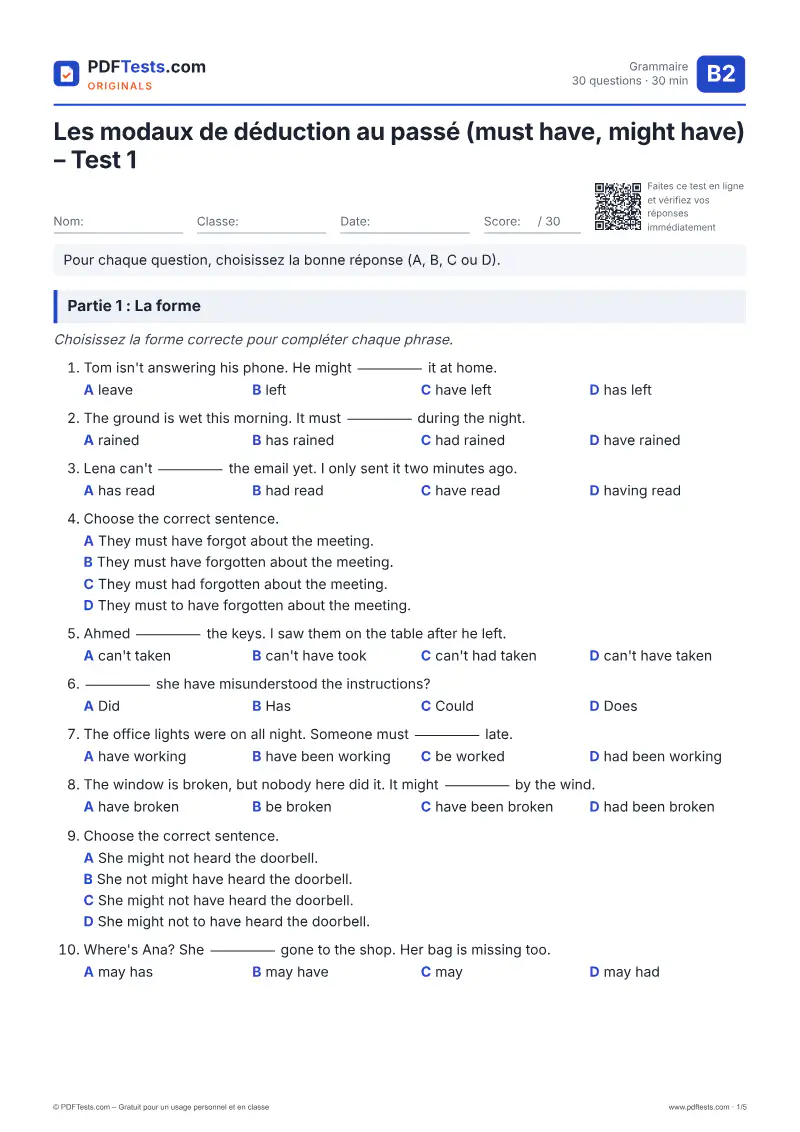
Pour chaque question, choisissez la bonne réponse (A, B, C ou D). Choisissez vos réponses, puis cliquez sur « Vérifier mes réponses ».

Partie 1 : La forme

Choisissez la forme correcte pour compléter chaque phrase.

  1. Tom isn't answering his phone. He might _____ it at home.

  2. The ground is wet this morning. It must _____ during the night.

  3. Lena can't _____ the email yet. I only sent it two minutes ago.

  4. Choose the correct sentence.

  5. Ahmed _____ the keys. I saw them on the table after he left.

  6. _____ she have misunderstood the instructions?

  7. The office lights were on all night. Someone must _____ late.

  8. The window is broken, but nobody here did it. It might _____ by the wind.

  9. Choose the correct sentence.

  10. Where's Ana? She _____ gone to the shop. Her bag is missing too.

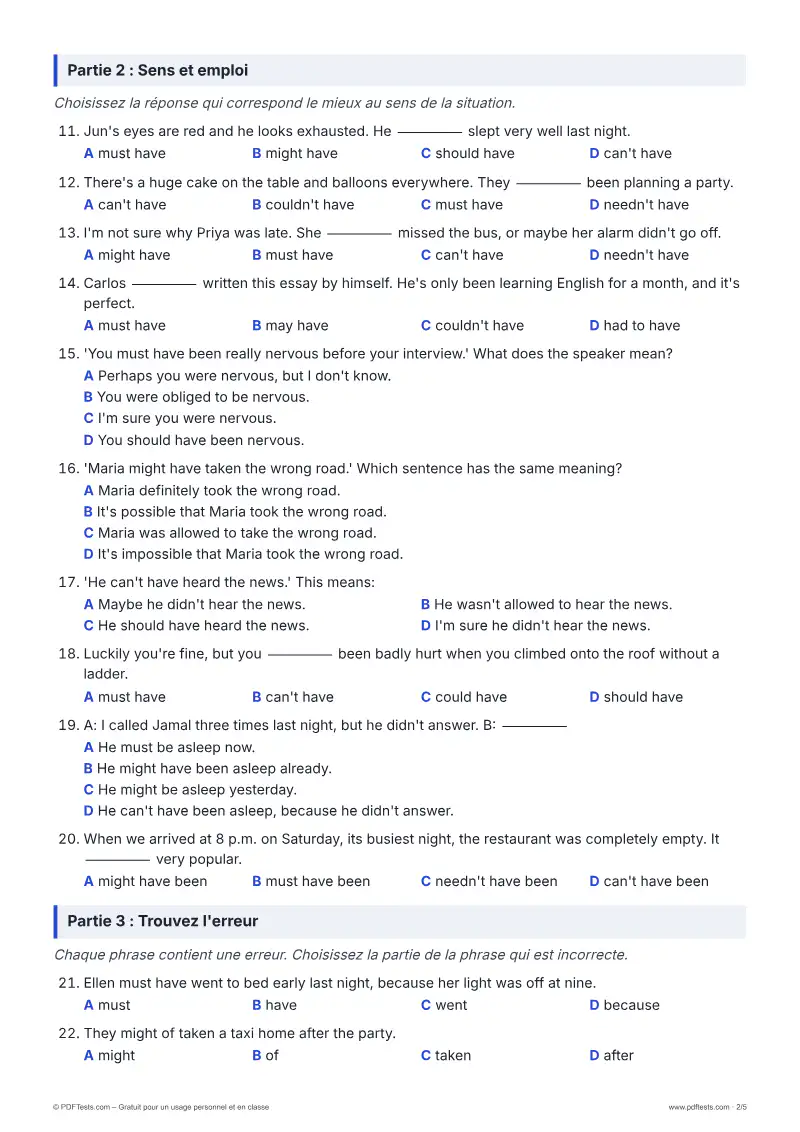
Partie 2 : Sens et emploi

Choisissez la réponse qui correspond le mieux au sens de la situation.

  1. Jun's eyes are red and he looks exhausted. He _____ slept very well last night.

  2. There's a huge cake on the table and balloons everywhere. They _____ been planning a party.

  3. I'm not sure why Priya was late. She _____ missed the bus, or maybe her alarm didn't go off.

  4. Carlos _____ written this essay by himself. He's only been learning English for a month, and it's perfect.

  5. 'You must have been really nervous before your interview.' What does the speaker mean?

  6. 'Maria might have taken the wrong road.' Which sentence has the same meaning?

  7. 'He can't have heard the news.' This means:

  8. Luckily you're fine, but you _____ been badly hurt when you climbed onto the roof without a ladder.

  9. A: I called Jamal three times last night, but he didn't answer. B: _____

  10. When we arrived at 8 p.m. on Saturday, its busiest night, the restaurant was completely empty. It _____ very popular.

Partie 3 : Trouvez l'erreur

Chaque phrase contient une erreur. Choisissez la partie de la phrase qui est incorrecte.

  1. Ellen must have went to bed early last night, because her light was off at nine.

  2. They might of taken a taxi home after the party.

  3. He started the report an hour ago, so he can't has finished it already.

  4. Sara didn't look shocked at all, so she must have been knowing about the surprise.

  5. Someone must have been stolen my bike while I was in the library.

Partie 4 : Compréhension écrite et déduction

Lisez le texte. Choisissez ensuite la meilleure réponse pour compléter chaque phrase ou répondre à chaque question.

When Mei got home from work on Friday, she knew immediately that something was different. The front door was unlocked, although she was certain she had locked it that morning. In the kitchen, there were two dirty cups in the sink and a plate with a few crumbs on it. Her cat, Biscuit, was asleep on the sofa and didn't seem worried at all.

Mei checked the living room. Her laptop and her jewellery were exactly where she had left them, so it was clear that nothing valuable was missing. Then she noticed a small bag on the table. Inside was a jar of homemade jam and a card that said "Thanks for the spare key!" in her brother's handwriting.

Mei smiled. Her brother, Daniel, lived two hours away, and she hadn't seen him for months. She remembered giving him a key at New Year, but she had completely forgotten about it. She tried to call him, but his phone went straight to voicemail. She decided he was probably already on his way home.

  1. Mei had locked the door, but it was unlocked when she came home. Someone with a key _____ opened it.

  2. Nothing valuable was missing, so a burglar _____ been in the flat.

  3. There were two dirty cups in the sink. Daniel _____ come with another person.

  4. Mei had completely forgotten about the key, so she _____ been surprised when she read the card.

  5. Daniel's phone went straight to voicemail. Which deduction is most logical according to the text?

Aperçu

À propos de ce test

Ce test de grammaire anglaise de niveau B2 permet de vérifier si les apprenants savent former et employer les modaux de déduction au passé, comme must have, might have, may have, could have et can't have. Il porte sur la construction, la forme négative, la forme interrogative, les formes progressive et passive, le sens en contexte et les erreurs les plus fréquentes, et se termine par une courte compréhension écrite. Il convient aux élèves de niveau intermédiaire avancé qui préparent un examen ou révisent les verbes modaux.

Thèmes abordés

Les modaux de déductionmust have + participe passémight / may / could havecan't / couldn't haveModaux au passé : formes progressive et passiveErreurs fréquentes des apprenants

Comment utiliser ce test

  1. Téléchargez le PDF et imprimez-le, ou faites le test en ligne ci-dessous.
  2. Répondez à toutes les questions sans dictionnaire et sans vous presser.
  3. Vérifiez vos réponses et notez les points à revoir.

Notes pour l’enseignant

Utilisez la partie 1 pour vérifier la construction avant de passer au sens dans les parties 2 et 4. Le test cible des erreurs fréquentes : prétérit employé à la place du participe passé (must have went), orthographe « might of », verbes d'état à la forme progressive (must have been knowing) et confusion entre déduction au passé, déduction au présent et obligation. En prolongement, proposez aux élèves de courtes situations « mystère » et demandez-leur de formuler leurs propres déductions avec must have, might have et can't have.