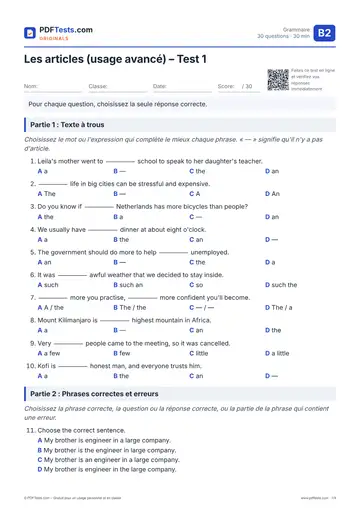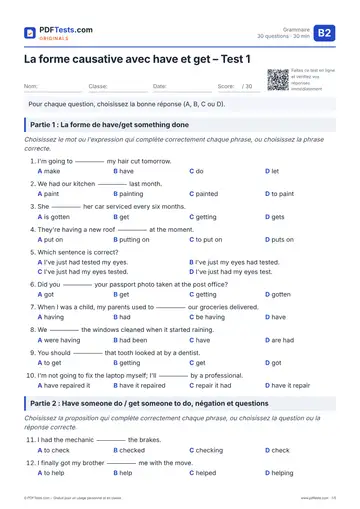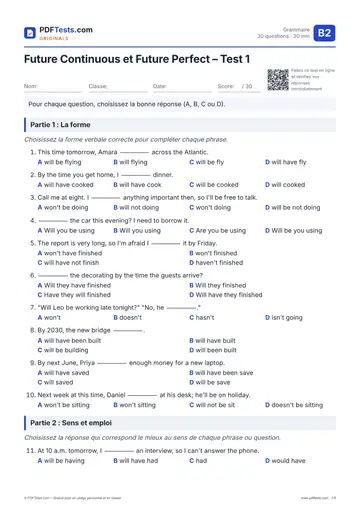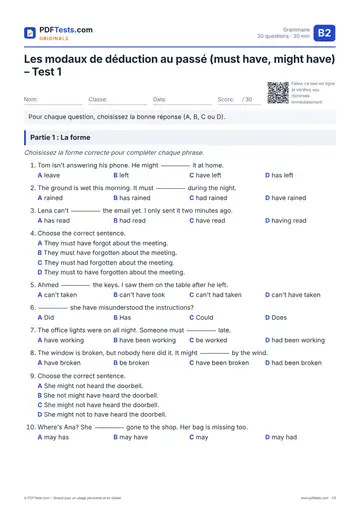
PDFTests Originals

Test de niveau d'anglais B2 – Test 2

B2 Intermédiaire avancé Test de niveauAnglais

Ce test de positionnement B2 couvre un large éventail de points de grammaire et de vocabulaire du niveau intermédiaire avancé : temps et verbes modaux, formation des mots, verbes à particule (phrasal verbs) et structures complexes. Il se termine par un court texte suivi de six questions de compréhension. Il s'adresse aux enseignants comme aux apprenants en autonomie qui souhaitent savoir si le niveau B2 est solidement acquis.
Questions
50
Durée
60 min
PDF
6 pages
Corrigé
Inclus
  • 100 % gratuit
  • Sans inscription
  • PDF A4 prêt à imprimer
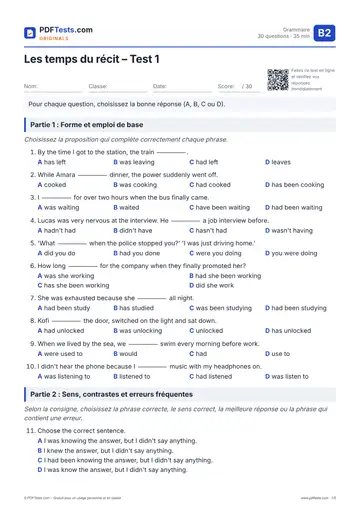
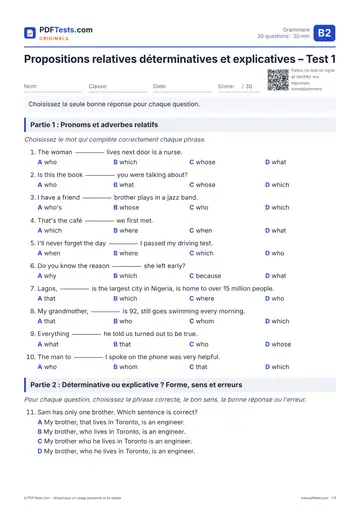
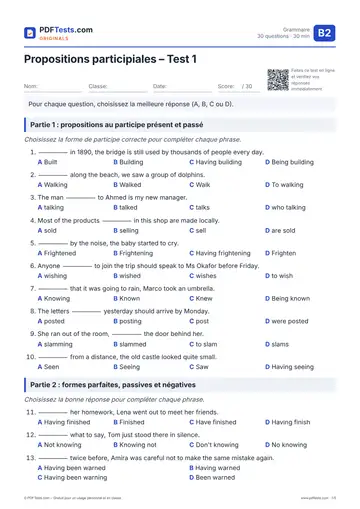
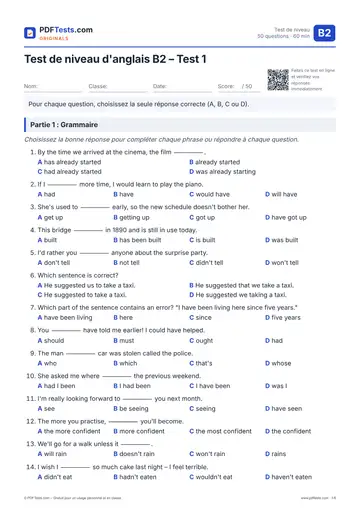
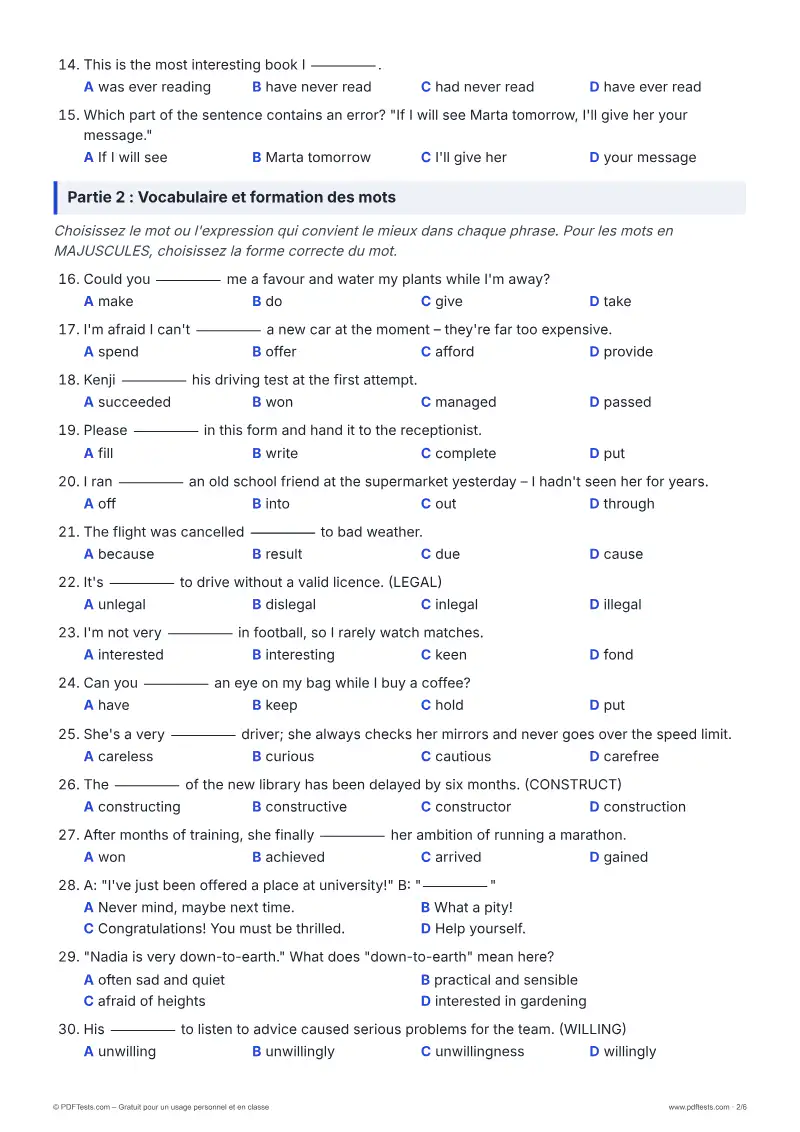
Aperçu de la page 1 : Test de niveau d'anglais B2 – Test 2 Ouvrir le PDF

Faire le test en ligne

Pour chaque question, choisissez la seule bonne réponse (A, B, C ou D). Choisissez vos réponses, puis cliquez sur « Vérifier mes réponses ».

Partie 1 : Temps et grammaire de base

Choisissez le mot ou l'expression qui complète le mieux chaque phrase, ou répondez à la question.

  1. Look at those dark clouds! It _____ rain.

  2. There aren't _____ eggs left, so I'll buy some more on my way home.

  3. How long _____ you known Priya?

  4. I'll call you as soon as I _____ at the airport.

  5. I _____ dinner when my phone rang.

  6. If you heat ice, it _____.

  7. She's been working on this report _____ nine o'clock this morning.

  8. I'm not sure, but Ahmed _____ be at the gym – he sometimes goes there after work.

  9. You _____ wear a suit to the party – it's very informal, so jeans are fine.

  10. The museum _____ by thousands of tourists every year.

  11. When I was a child, we _____ to the coast every summer.

  12. Choose the correct sentence.

  13. When I got to the office, I realised I _____ my laptop at home.

  14. This is the most interesting book I _____.

  15. Which part of the sentence contains an error? "If I will see Marta tomorrow, I'll give her your message."

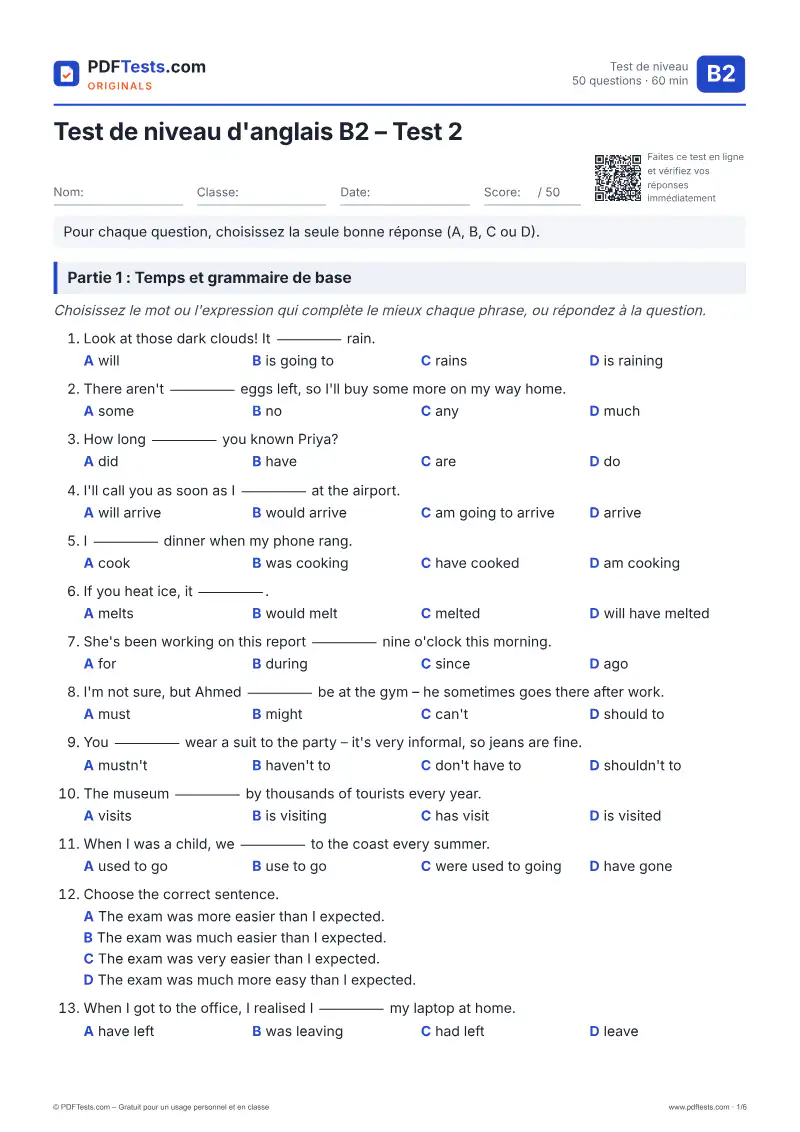
Partie 2 : Vocabulaire et formation des mots

Choisissez le mot ou l'expression qui convient le mieux dans chaque phrase. Pour les mots en MAJUSCULES, choisissez la forme correcte du mot.

  1. Could you _____ me a favour and water my plants while I'm away?

  2. I'm afraid I can't _____ a new car at the moment – they're far too expensive.

  3. Kenji _____ his driving test at the first attempt.

  4. Please _____ in this form and hand it to the receptionist.

  5. I ran _____ an old school friend at the supermarket yesterday – I hadn't seen her for years.

  6. The flight was cancelled _____ to bad weather.

  7. It's _____ to drive without a valid licence. (LEGAL)

  8. I'm not very _____ in football, so I rarely watch matches.

  9. Can you _____ an eye on my bag while I buy a coffee?

  10. She's a very _____ driver; she always checks her mirrors and never goes over the speed limit.

  11. The _____ of the new library has been delayed by six months. (CONSTRUCT)

  12. After months of training, she finally _____ her ambition of running a marathon.

  13. A: "I've just been offered a place at university!" B: "_____"

  14. "Nadia is very down-to-earth." What does "down-to-earth" mean here?

  15. His _____ to listen to advice caused serious problems for the team. (WILLING)

Partie 3 : Structures grammaticales avancées

Choisissez l'option qui complète correctement chaque phrase, ou répondez à la question.

  1. She suggested _____ a taxi because it was raining heavily.

  2. I remember _____ this film before, but I can't remember how it ends.

  3. He apologised _____ late for the meeting.

  4. I'm going to get my hair _____ before the wedding.

  5. The children _____ be playing in the garden – I can hear them laughing.

  6. I'll lend you my car _____ you promise to drive carefully.

  7. Which part of the sentence contains an error? "Despite of the rain, we really enjoyed our day at the beach."

  8. If it hadn't been for your advice, I _____ the wrong decision.

  9. It's no use _____ about it now – the decision has already been made.

  10. Ravi said, "I'll finish it tomorrow." Which is the correct reported version?

  11. I wish my neighbours _____ so much noise late at night – it's really annoying.

  12. _____ finished her homework, Aisha went out to meet her friends.

  13. The singer _____ to be planning a world tour next year.

  14. Under no circumstances _____ this door while the machine is running.

Partie 4 : Compréhension écrite

Lisez le texte et choisissez la meilleure réponse à chaque question.

A Summer Above the Clouds

Last summer, instead of looking for an office internship like most of my classmates, I spent three months working at a mountain hut high in the Alps. The hut offers meals and beds to hikers walking a long-distance trail, and it can only be reached on foot – a steep two-hour climb from the nearest village. Supplies arrive by helicopter once a fortnight, so nothing can be wasted.

I'll admit I had doubts before I went. I had never worked in a kitchen, and I wasn't sure how I would cope with sharing a tiny room with three other staff members. My parents, meanwhile, were worried that I was wasting a summer that could have helped my career.

The work was harder than I had imagined. We got up at five to prepare breakfast, and on busy days we served over a hundred dinners. But what surprised me most was how quickly the team became close. With no phone signal and no internet, we spent our free evenings playing cards, telling stories and watching the sun set over the glaciers. I had expected to feel isolated; in fact, I have rarely felt less lonely.

I also learned skills that no classroom could have taught me. When a storm cut off the water supply for two days, we had to find solutions together, quickly and calmly. Guests who arrived exhausted, wet or frustrated taught me a great deal about patience.

Back home, I was nervous about how employers would view my summer. To my relief, at my first job interview, the manager spent most of the time asking about the hut. She said that solving problems under pressure was exactly what she was looking for. I got the job – and I'm already planning to go back next summer, even if only for a few weeks.

  1. Why can nothing be wasted at the hut?

  2. What were the writer's parents worried about?

  3. What does the writer say about having no phone signal or internet?

  4. The phrase "cut off" in paragraph 4 is closest in meaning to:

  5. According to the writer, what did tired or frustrated guests teach her?

  6. What is the main message of the text?

Aperçu

À propos de ce test

Ce test de positionnement B2 couvre un large éventail de points de grammaire et de vocabulaire du niveau intermédiaire avancé : temps et verbes modaux, formation des mots, verbes à particule (phrasal verbs) et structures complexes. Il se termine par un court texte suivi de six questions de compréhension. Il s'adresse aux enseignants comme aux apprenants en autonomie qui souhaitent savoir si le niveau B2 est solidement acquis.

Thèmes abordés

Temps et expressions de tempsVerbes modaux et déductionConditionnel et souhaits (wish)Gérondif et infinitifVoix passive et forme causativeFormation des mots et collocationsVerbes à particule (phrasal verbs) et expressions idiomatiquesCompréhension écrite

Comment utiliser ce test

  1. Téléchargez le PDF et imprimez-le, ou faites le test en ligne ci-dessous.
  2. Répondez à toutes les questions sans dictionnaire et sans vous presser.
  3. Vérifiez vos réponses et notez les points à revoir.

Notes pour l’enseignant

Faites passer le test complet en une seule séance d'environ 60 minutes. Un score de 38/50 ou plus indique que le niveau B2 est bien acquis ; entre 30 et 37, certaines lacunes méritent d'être travaillées avant de passer au niveau supérieur. Les parties 1 à 3 ciblent les erreurs typiques du B2 : « will » après une conjonction de temps, « despite of », mauvaise construction après suggest/remember/apologise, ou confusion entre des collocations proches. Corrigez les explications avec les apprenants et réinvestissez les points faibles, par exemple en leur demandant de rédiger leurs propres phrases avec les structures sur lesquelles ils se sont trompés.