PDFTests Originals

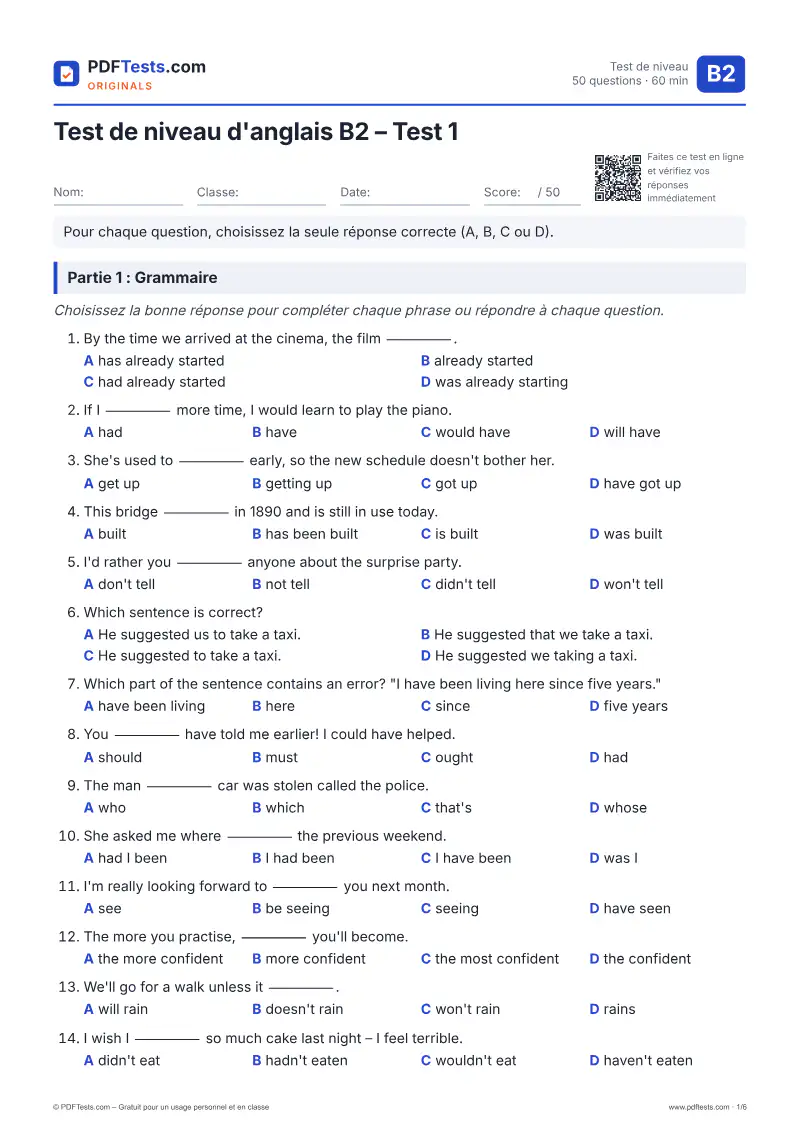
Test de niveau d'anglais B2 – Test 1

B2 Intermédiaire avancé Test de niveauAnglais

Ce test de positionnement B2 permet de vérifier si un apprenant maîtrise solidement le niveau intermédiaire avancé. Il couvre l'essentiel de la grammaire et du vocabulaire du B2, les phrasal verbs, la formation des mots et les collocations, et se termine par un court texte de compréhension écrite. Il s'adresse aux enseignants qui doivent répartir leurs élèves en groupes de niveau comme aux apprenants autonomes qui souhaitent évaluer leur niveau.
Questions
50
Durée
60 min
PDF
6 pages
Corrigé
Inclus
  • 100 % gratuit
  • Sans inscription
  • PDF A4 prêt à imprimer
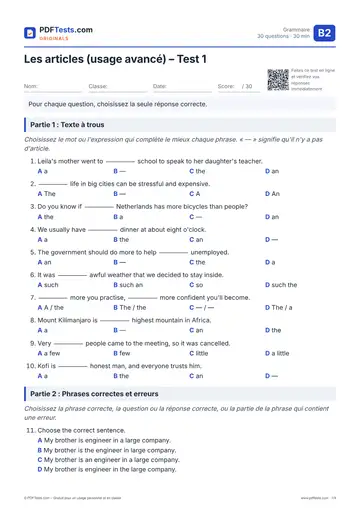
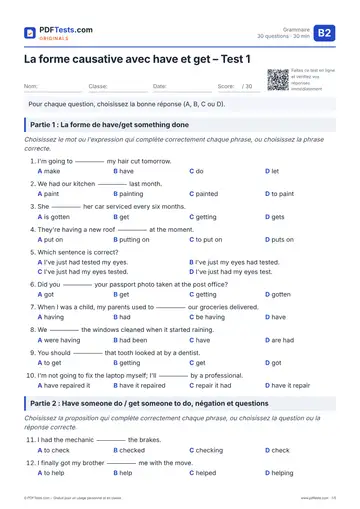
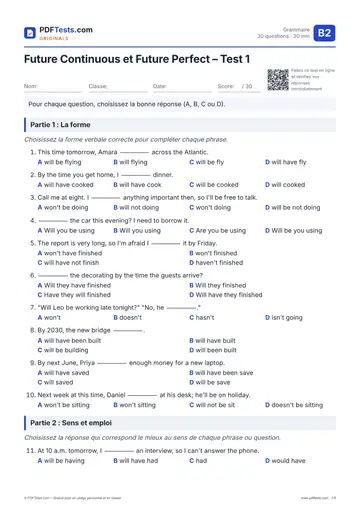
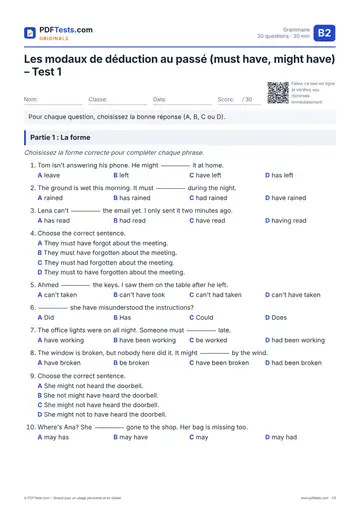
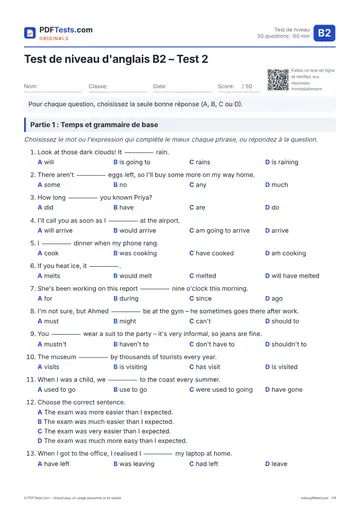
Aperçu de la page 1 : Test de niveau d'anglais B2 – Test 1 Ouvrir le PDF

Faire le test en ligne

Pour chaque question, choisissez la seule réponse correcte (A, B, C ou D). Choisissez vos réponses, puis cliquez sur « Vérifier mes réponses ».

Partie 1 : Grammaire

Choisissez la bonne réponse pour compléter chaque phrase ou répondre à chaque question.

  1. By the time we arrived at the cinema, the film _____.

  2. If I _____ more time, I would learn to play the piano.

  3. She's used to _____ early, so the new schedule doesn't bother her.

  4. This bridge _____ in 1890 and is still in use today.

  5. I'd rather you _____ anyone about the surprise party.

  6. Which sentence is correct?

  7. Which part of the sentence contains an error? "I have been living here since five years."

  8. You _____ have told me earlier! I could have helped.

  9. The man _____ car was stolen called the police.

  10. She asked me where _____ the previous weekend.

  11. I'm really looking forward to _____ you next month.

  12. The more you practise, _____ you'll become.

  13. We'll go for a walk unless it _____.

  14. I wish I _____ so much cake last night – I feel terrible.

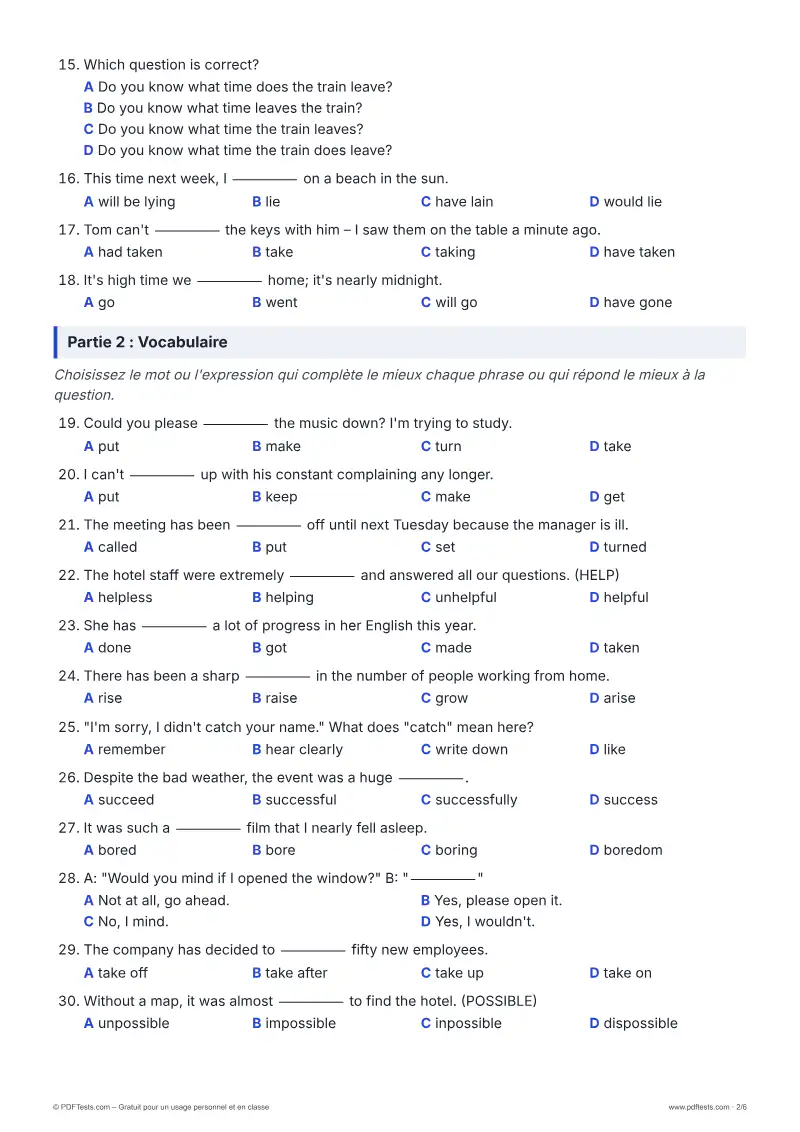
  15. Which question is correct?

  16. This time next week, I _____ on a beach in the sun.

  17. Tom can't _____ the keys with him – I saw them on the table a minute ago.

  18. It's high time we _____ home; it's nearly midnight.

Partie 2 : Vocabulaire

Choisissez le mot ou l'expression qui complète le mieux chaque phrase ou qui répond le mieux à la question.

  1. Could you please _____ the music down? I'm trying to study.

  2. I can't _____ up with his constant complaining any longer.

  3. The meeting has been _____ off until next Tuesday because the manager is ill.

  4. The hotel staff were extremely _____ and answered all our questions. (HELP)

  5. She has _____ a lot of progress in her English this year.

  6. There has been a sharp _____ in the number of people working from home.

  7. "I'm sorry, I didn't catch your name." What does "catch" mean here?

  8. Despite the bad weather, the event was a huge _____.

  9. It was such a _____ film that I nearly fell asleep.

  10. A: "Would you mind if I opened the window?" B: "_____"

  11. The company has decided to _____ fifty new employees.

  12. Without a map, it was almost _____ to find the hotel. (POSSIBLE)

  13. My sister and I _____ after our father – we both have dark hair and green eyes.

  14. "The new manager is very approachable." This means the manager is:

Partie 3 : Grammaire et usage avancés

Choisissez la bonne réponse. Ces questions sont plus difficiles.

  1. Not only _____ late, but he also forgot his notes.

  2. If she had taken the job in London, she _____ in a big city now.

  3. Hardly _____ sat down when the phone rang.

  4. The project _____ by the end of next month.

  5. Which part of the sentence contains an error? "Neither the teacher nor the students was aware of the change."

  6. Which sentence is correct?

  7. _____ the train was delayed, we still arrived on time.

  8. She denied _____ the documents.

  9. He spoke so quietly that hardly _____ could hear him.

  10. Supposing you _____ the lottery, what would you do first?

  11. The report, _____ was published yesterday, has caused a lot of debate.

  12. "You needn't have brought a gift." What does this mean?

Partie 4 : Compréhension écrite

Lisez le texte et choisissez la meilleure réponse à chaque question.

When Lena Hoffmann's coffee machine stopped working last winter, her first thought was to buy a new one. Instead, a neighbour suggested she take it to the repair café that meets once a month in the local library. 'I was sceptical,' Lena admits. 'I assumed it would be a waste of time, but a retired engineer fixed it in twenty minutes, and he showed me how to do it myself next time.'

Repair cafés are free events where volunteers with practical skills help visitors mend broken household items, from lamps and toasters to clothes and bicycles. The idea is simple: rather than throwing things away, people are encouraged to give them a second life. Organisers say the events reduce waste, save money and, perhaps just as importantly, bring people together.

Daniel Osei, who has run the local café for three years, believes the social side is often underestimated. 'People come for the repair, but they stay for the conversation,' he explains. 'We have students sitting next to pensioners, sharing tools and stories. For some older visitors, it's the only time in the month they really talk to anyone.'

However, the movement faces challenges. Many modern products are designed in ways that make them difficult to open, and spare parts can be expensive or simply unavailable. Some volunteers also worry about safety, particularly when dealing with electrical items. To address this, Daniel's group now requires every electrical repair to be checked by a qualified electrician before it leaves the room.

Despite these obstacles, interest is growing. Last year the café repaired more than 400 items, and Daniel hopes to open a second location soon. 'Every object we fix is one less thing in a landfill,' he says. 'That may sound small, but it adds up.'

  1. Why did Lena first go to the repair café?

  2. How did Lena feel before her visit?

  3. According to Daniel, what is often underestimated?

  4. The word "mend" in paragraph 2 is closest in meaning to:

  5. What has Daniel's group done to deal with safety concerns?

  6. What is Daniel's attitude to the future of the café?

Aperçu

À propos de ce test

Ce test de positionnement B2 permet de vérifier si un apprenant maîtrise solidement le niveau intermédiaire avancé. Il couvre l'essentiel de la grammaire et du vocabulaire du B2, les phrasal verbs, la formation des mots et les collocations, et se termine par un court texte de compréhension écrite. Il s'adresse aux enseignants qui doivent répartir leurs élèves en groupes de niveau comme aux apprenants autonomes qui souhaitent évaluer leur niveau.

Thèmes abordés

Temps verbaux et expression du futurConditionnel et souhaits (wish)Verbes modauxVoix passive et forme causativeInversion et propositions relativesPhrasal verbs et collocationsFormation des motsCompréhension écrite

Comment utiliser ce test

  1. Téléchargez le PDF et imprimez-le, ou faites le test en ligne ci-dessous.
  2. Répondez à toutes les questions sans dictionnaire et sans vous presser.
  3. Vérifiez vos réponses et notez les points à revoir.

Notes pour l’enseignant

Prévoyez environ 60 minutes, sans dictionnaire. À titre indicatif, un score de 40 ou plus indique que l'apprenant maîtrise bien le niveau B2, un score de 30 à 39 qu'il est en voie d'acquisition du B2, et un score inférieur à 30 qu'un cours de niveau B1 serait sans doute plus adapté. Le test cible des erreurs fréquentes comme la confusion entre 'since' et 'for', 'suggest + to-infinitive', le mauvais temps après 'wish' et 'it's high time', ou encore les paires souvent confondues comme 'rise/raise'. Appuyez-vous sur les erreurs de la partie 3 pour construire des séances de remédiation sur l'inversion, les conditionnels mixtes et les propositions relatives non déterminatives.