PDFTests Originals

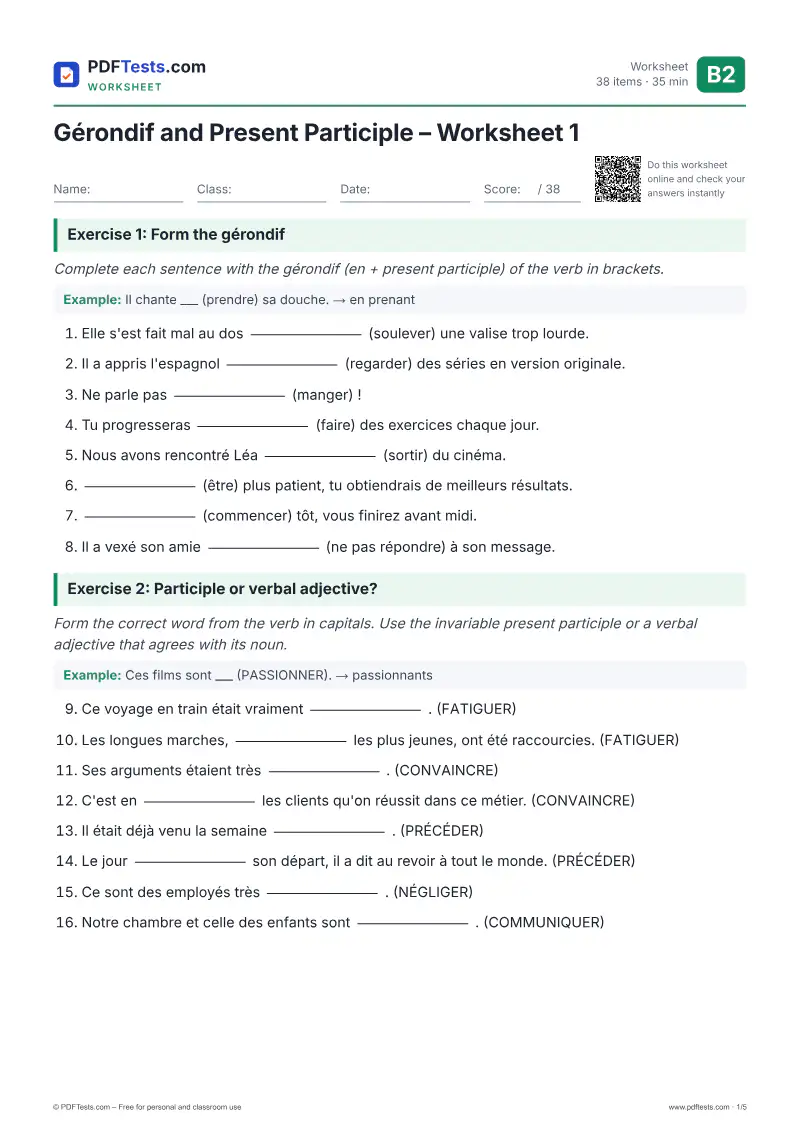
Gérondif and Present Participle – Worksheet 1

B2 Upper-intermediate WorksheetFrench

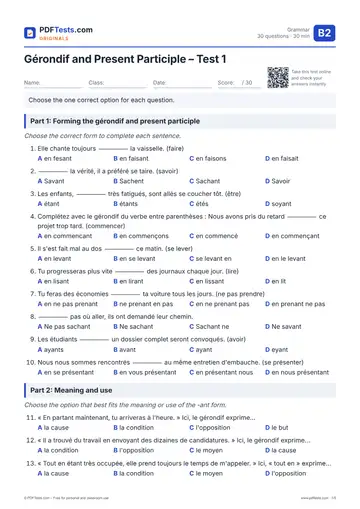
This B2 French worksheet practises the gérondif (en + -ant) and the present participle. It covers form, irregular stems, negative forms, compound participles and the difference between present participles and verbal adjectives. It suits upper-intermediate learners who want to write more concise, natural French.
items
38
Time
35 min
PDF
5 pages
Answer key
Included
  • 100% free
  • No sign-up or email
  • Print-ready A4 PDF
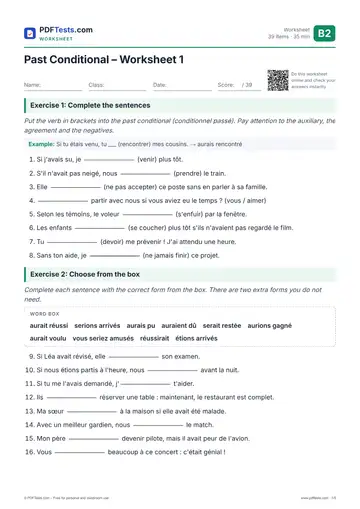
Preview of page 1 of Gérondif and Present Participle – Worksheet 1 Open PDF
New to this topic? Read the guide first: Gérondif and Present Participle in French: Forms, Uses and Common Mistakes

Do the worksheet online

Type your answers, then press “Check my answers”. Alternative correct answers are accepted.

Exercise 1: Form the gérondif

Complete each sentence with the gérondif (en + present participle) of the verb in brackets.

Example: Il chante ___ (prendre) sa douche. → en prenant

  1. Elle s'est fait mal au dos (soulever) une valise trop lourde.

  2. Il a appris l'espagnol (regarder) des séries en version originale.

  3. Ne parle pas (manger) !

  4. Tu progresseras (faire) des exercices chaque jour.

  5. Nous avons rencontré Léa (sortir) du cinéma.

  6. (être) plus patient, tu obtiendrais de meilleurs résultats.

  7. (commencer) tôt, vous finirez avant midi.

  8. Il a vexé son amie (ne pas répondre) à son message.

Exercise 2: Participle or verbal adjective?

Form the correct word from the verb in capitals. Use the invariable present participle or a verbal adjective that agrees with its noun.

Example: Ces films sont ___ (PASSIONNER). → passionnants

  1. Ce voyage en train était vraiment . (FATIGUER)

  2. Les longues marches, les plus jeunes, ont été raccourcies. (FATIGUER)

  3. Ses arguments étaient très . (CONVAINCRE)

  4. C'est en les clients qu'on réussit dans ce métier. (CONVAINCRE)

  5. Il était déjà venu la semaine . (PRÉCÉDER)

  6. Le jour son départ, il a dit au revoir à tout le monde. (PRÉCÉDER)

  7. Ce sont des employés très . (NÉGLIGER)

  8. Notre chambre et celle des enfants sont . (COMMUNIQUER)

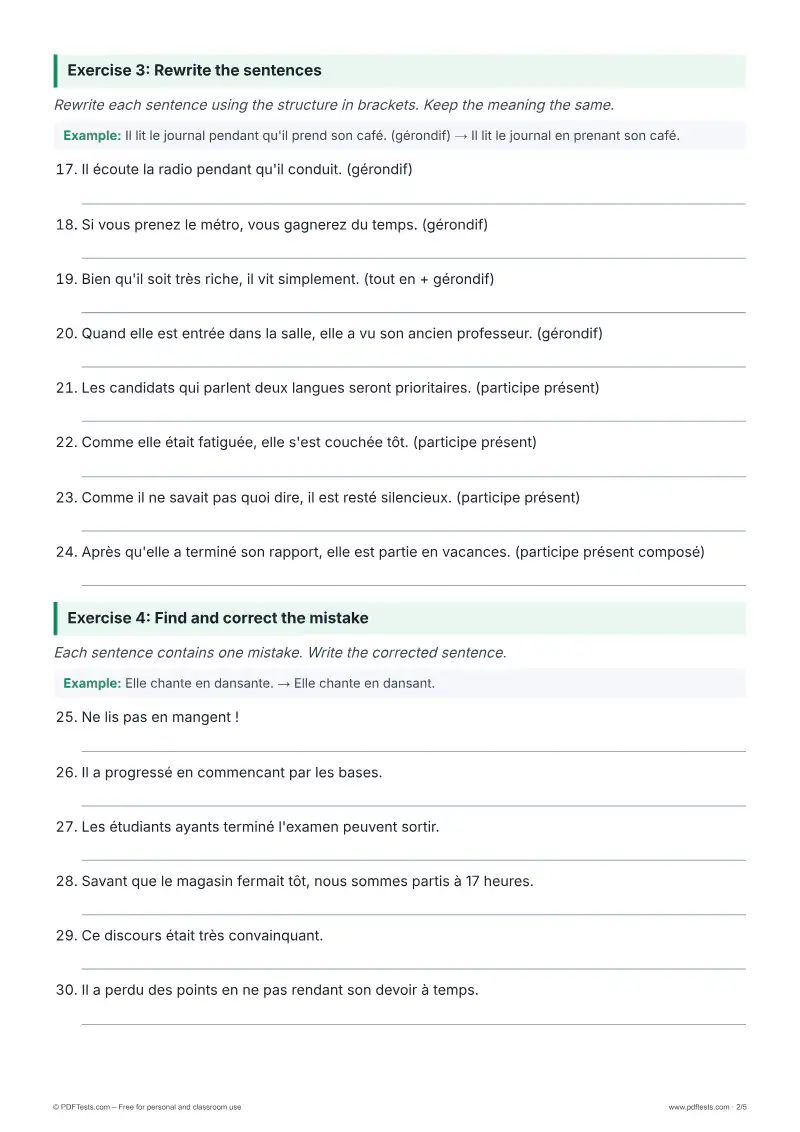
Exercise 3: Rewrite the sentences

Rewrite each sentence using the structure in brackets. Keep the meaning the same.

Example: Il lit le journal pendant qu'il prend son café. (gérondif) → Il lit le journal en prenant son café.

  1. Il écoute la radio pendant qu'il conduit. (gérondif)

  2. Si vous prenez le métro, vous gagnerez du temps. (gérondif)

  3. Bien qu'il soit très riche, il vit simplement. (tout en + gérondif)

  4. Quand elle est entrée dans la salle, elle a vu son ancien professeur. (gérondif)

  5. Les candidats qui parlent deux langues seront prioritaires. (participe présent)

  6. Comme elle était fatiguée, elle s'est couchée tôt. (participe présent)

  7. Comme il ne savait pas quoi dire, il est resté silencieux. (participe présent)

  8. Après qu'elle a terminé son rapport, elle est partie en vacances. (participe présent composé)

Exercise 4: Find and correct the mistake

Each sentence contains one mistake. Write the corrected sentence.

Example: Elle chante en dansante. → Elle chante en dansant.

  1. Ne lis pas en mangent !

  2. Il a progressé en commencant par les bases.

  3. Les étudiants ayants terminé l'examen peuvent sortir.

  4. Savant que le magasin fermait tôt, nous sommes partis à 17 heures.

  5. Ce discours était très convainquant.

  6. Il a perdu des points en ne pas rendant son devoir à temps.

  7. Les personnes désirantes participer doivent s'inscrire avant vendredi.

Exercise 5: Match the sentence halves

Match each beginning with the correct ending from the box. One ending is not needed.

Word box en descendant une piste noire.en révisant régulièrement.en nettoyant sa voiture.tout en sachant qu'il le regretterait.elle a rappelé l'entreprise.doivent s'adresser au guichet.en regardant un film.en ne disant rien.

  1. Elle s'est cassé la jambe

  2. Tu réussiras ton examen

  3. Il a trouvé un vieux billet de banque

  4. Il a refusé l'offre

  5. N'ayant pas reçu de réponse,

  6. Les voyageurs ayant perdu leurs bagages

  7. Il s'est endormi

Was this page helpful?

Report a mistake

Spotted a wrong answer, a typo or an unclear explanation? Tell us and we will fix it.

Preview

About this test

French B2 worksheet on the gérondif and present participle: forms, meanings, negatives, verbal adjectives and error correction, with answers.

Topics covered

Gérondif (en + -ant)Present participleVerbal adjective vs participleNegative gérondif and participleCompound participle (ayant/étant + past participle)Tout en + gérondif

Notes for teachers

Start by eliciting the rule: take the nous form of the present, drop -ons and add -ant. Highlight the three irregulars: étant, ayant, sachant. Typical mistakes include forgetting the spelling changes in mangeant and commençant, making the participle agree (ayants, désirants), and confusing participles with verbal adjectives (fatiguant/fatigant, convainquant/convaincant). As a follow-up, ask students to describe their morning routine using at least five gérondifs, then rewrite a short formal notice with present participles instead of relative clauses.

All French B2 tests →