The present participle (participe présent) is the French verb form ending in -ant: parlant, finissant, prenant. Put en in front of it and you get the gérondif (en parlant), which describes a second action done by the subject of the sentence, usually to show simultaneity, manner, means or condition. Without en, the present participle belongs mostly to written and formal French, where it replaces a relative clause or expresses cause.
How to form the present participle
Take the nous form of the present tense, remove -ons and add -ant. The rule works for almost every verb, including most irregular ones.
| Infinitive | nous form | Present participle |
|---|---|---|
| parler | nous parlons | parlant |
| finir | nous finissons | finissant |
| prendre | nous prenons | prenant |
| faire | nous faisons | faisant |
| boire | nous buvons | buvant |
| voir | nous voyons | voyant |
| manger | nous mangeons | mangeant |
| commencer | nous commençons | commençant |
The three exceptions
| Infinitive | Present participle |
|---|---|
| être | étant |
| avoir | ayant |
| savoir | sachant |
Spelling notes
- Verbs in -ger keep the e: mangeant, voyageant, nageant.
- Verbs in -cer keep the ç: commençant, lançant, avançant.
- The present participle is invariable: it never takes -e or -s.
Compound form
To show that one action was completed before another, use ayant or étant + past participle. With étant, the past participle agrees with the subject.
- Ayant terminé son rapport, elle est rentrée chez elle. — Having finished her report, she went home.
- Étant arrivées en retard, elles ont raté le début du film. — Having arrived late, they missed the start of the film.
Negatives and pronouns
Negation surrounds the participle, and object or reflexive pronouns go directly before it. With pronominal verbs, the reflexive pronoun matches the subject (see our guide to pronominal verbs).
- Ne sachant pas quoi dire, il s’est tu. — Not knowing what to say, he stayed silent.
- En me levant, j’ai entendu un bruit. — As I got up, I heard a noise.
- En le voyant, elle a souri. — When she saw him, she smiled.
The gérondif: en + present participle
The gérondif is very common in both speech and writing. Its key rule: the subject of the gérondif is the same as the subject of the main verb.
- Je chante en prenant ma douche. — I sing while taking a shower. (I sing, I take a shower.)
1. Simultaneity: two actions at the same time
- Il écoute des podcasts en courant. — He listens to podcasts while running.
- En rentrant du travail, j’ai croisé ma voisine. — On my way home from work, I bumped into my neighbour.
2. Manner: how something is done
- Elle est entrée en souriant. — She came in smiling.
- Les enfants sont partis en courant. — The children ran off.
3. Means: by doing something
- On apprend une langue en la pratiquant. — You learn a language by practising it.
- C’est en forgeant qu’on devient forgeron. — Practice makes perfect. (literally It is by forging that you become a blacksmith.)
4. Condition: if you do something
- En partant maintenant, tu arriveras à l’heure. — If you leave now, you’ll arrive on time.
- En réservant en ligne, vous paierez moins cher. — If you book online, you’ll pay less.
5. Cause or circumstance
- Il s’est cassé le bras en tombant de vélo. — He broke his arm falling off his bike.
Tout en: emphasis and contrast
Adding tout before the gérondif either stresses that two actions happen together, or introduces a contrast (similar to bien que).
- Elle travaille tout en écoutant de la musique. — She works while listening to music.
- Tout en étant très fatigué, il a terminé le marathon. — Although he was very tired, he finished the marathon.
The present participle without en
On its own, the present participle sounds formal. You’ll meet it in news articles, official notices, emails and essays.
1. Replacing qui + verb
It can replace a relative clause with qui (compare our guide to relative pronouns).
- Les étudiants souhaitant s’inscrire doivent remplir ce formulaire. — Students wishing to enrol must fill in this form. (= qui souhaitent)
- On cherche une personne parlant espagnol. — We are looking for someone who speaks Spanish.
2. Expressing cause
At the start of a sentence, it often means comme or parce que.
- Étant malade, elle n’est pas venue. — Being ill, she didn’t come.
- N’ayant pas reçu de réponse, j’ai rappelé le service client. — Not having received a reply, I called customer service again.
3. Referring to a noun that is not the subject
Unlike the gérondif, the present participle can describe the noun just before it. This creates an important difference in meaning:
- J’ai vu Paul sortant du cinéma. — I saw Paul (as he was) coming out of the cinema. (Paul is leaving.)
- J’ai vu Paul en sortant du cinéma. — I saw Paul as I was coming out of the cinema. (I am leaving.)
Gérondif vs present participle at a glance
| Gérondif | Present participle | |
|---|---|---|
| Form | en + -ant | -ant alone |
| Subject | Always the subject of the main verb | Subject or the noun just before |
| Register | Everyday and formal | Mainly written, formal |
| Typical meanings | Simultaneity, manner, means, condition | Relative clause (qui), cause, prior action |
| Example | Il lit en mangeant. — He reads while eating. | Un homme portant un chapeau. — A man wearing a hat. |
Present participle vs verbal adjective
Many -ant forms are also used as adjectives (adjectifs verbaux). These describe a quality and agree with the noun. The present participle expresses an action and stays invariable.
- Des enfants obéissants. — Obedient children. (adjective, agrees)
- Des enfants obéissant à leurs parents. — Children obeying their parents. (participle, invariable)
Two tests help: if the word has a complement (an object, an adverb after it) or can be replaced by qui + verb, it is a participle. If you can put très in front, it is an adjective.
Different spellings
Some pairs are spelled differently, a frequent trap in written exams.
| Present participle (invariable) | Verbal adjective (agrees) |
|---|---|
| fatiguant | fatigant |
| convainquant | convaincant |
| provoquant | provocant |
| communiquant | communicant |
| naviguant | navigant |
| différant | différent |
| précédant | précédent |
| négligeant | négligent |
| excellant | excellent |
- Un trajet fatigant. — A tiring journey.
- En fatiguant ses muscles, on les renforce. — By tiring your muscles, you strengthen them.
- Des arguments convaincants. — Convincing arguments.
Common mistakes
✗ En sortant du bureau, la pluie a commencé. → ✓ Quand je suis sorti du bureau, il a commencé à pleuvoir. — When I left the office, it started raining. The gérondif must share the subject of the main verb; rain does not leave the office.
✗ Elles sont parties en courantes. → ✓ Elles sont parties en courant. — They ran off. The gérondif and present participle never agree.
✗ Savant la vérité, il s’est tu. → ✓ Sachant la vérité, il s’est tu. — Knowing the truth, he said nothing. Savoir has the irregular form sachant.
✗ En se réveillant, j’ai bu un café. → ✓ En me réveillant, j’ai bu un café. — When I woke up, I had a coffee. The reflexive pronoun matches the subject.
✗ Il est parti en disant pas au revoir. → ✓ Il est parti sans dire au revoir. — He left without saying goodbye. Ne cannot be dropped here, and sans + infinitive is the natural choice.
✗ J’aime lisant le soir. → ✓ J’aime lire le soir. — I like reading in the evening. English -ing after verbs and most prepositions becomes an infinitive in French.
✗ Après en mangeant, on est sortis. → ✓ Après avoir mangé, on est sortis. — After eating, we went out. Après takes the past infinitive, not the gérondif.
✗ Un film très intriguant. → ✓ Un film très intrigant. — A very intriguing film. The adjective has a different spelling from the participle.
✗ Les personnes ayantes un billet peuvent entrer. → ✓ Les personnes ayant un billet peuvent entrer. — People who have a ticket may enter. The participle is invariable.
Quick check
- Give the present participle of savoir.
- Complete with a gérondif: Elle s’est fait mal ___ (tomber).
- Correct or wrong? En ouvrant la porte, le chat s’est échappé.
- Choose: des arguments (convaincants / convainquants).
- Rewrite with a present participle: Comme il n’avait pas d’argent, il est resté chez lui.
Answers
- sachant
- en tombant — She hurt herself falling.
- Wrong: the cat did not open the door. ✓ Quand j’ai ouvert la porte, le chat s’est échappé. — When I opened the door, the cat escaped.
- convaincants (verbal adjective, agrees) — convincing arguments
- N’ayant pas d’argent, il est resté chez lui. — Having no money, he stayed at home.
Next step
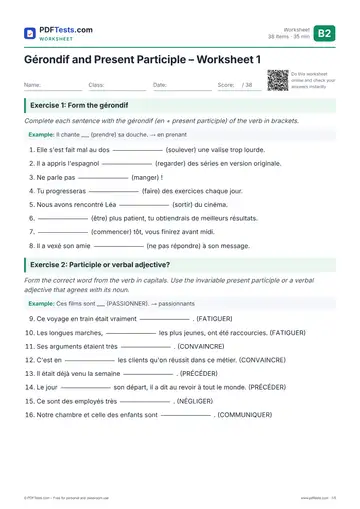
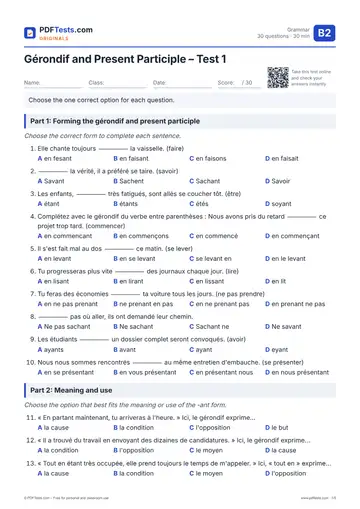
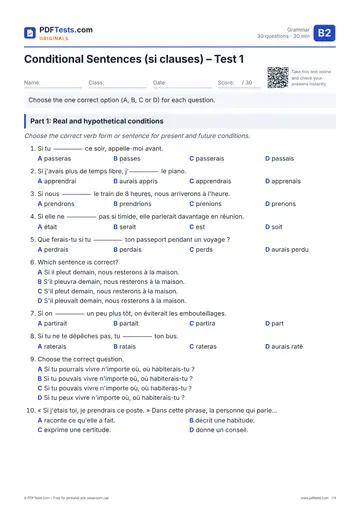
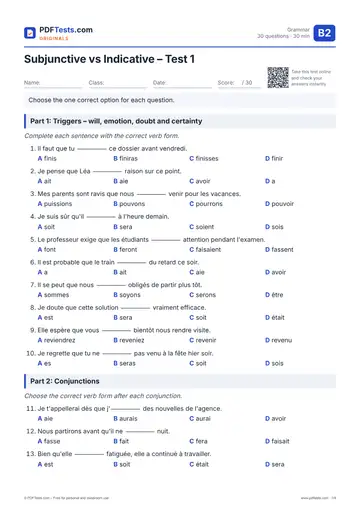
Now put the rules into practice: test yourself with our B2 Gérondif and Present Participle test, paying special attention to the same-subject rule and the adjective spellings. Because participles often replace comme, quand or si, our guide to logical connectors is a useful follow-up, and you can find more practice at the same level among our French B2 tests.
Was this page helpful?
What was the problem?
Thank you for your feedback!