The conditionnel passé (past conditional) expresses what would have happened but did not. It is formed with the present conditional of avoir or être plus a past participle: Si j’avais su, je serais venu (If I had known, I would have come).
You use it for unreal situations in the past, for regrets and reproaches, and for unconfirmed information, especially in the news.
How to form the conditionnel passé
The conditionnel passé has two parts:
auxiliary (avoir or être) in the conditionnel présent + past participle
If you already know the conditionnel présent and the passé composé, you know everything you need. The auxiliary and the agreement rules are the same as in the passé composé.
With avoir
| Person | Avoir (conditionnel présent) | + past participle |
|---|---|---|
| je / j’ | aurais | parlé, fini, pris |
| tu | aurais | parlé, fini, pris |
| il / elle / on | aurait | parlé, fini, pris |
| nous | aurions | parlé, fini, pris |
| vous | auriez | parlé, fini, pris |
| ils / elles | auraient | parlé, fini, pris |
J’aurais pris le train. — I would have taken the train.
With être
Verbs that take être in the passé composé (aller, venir, partir, arriver, naître, mourir, rester, tomber, etc.) and all pronominal verbs take être here too. The past participle agrees with the subject.
| Person | Être (conditionnel présent) | + past participle |
|---|---|---|
| je | serais | allé(e) |
| tu | serais | allé(e) |
| il / elle / on | serait | allé / allée |
| nous | serions | allé(e)s |
| vous | seriez | allé(e)(s) |
| ils / elles | seraient | allés / allées |
Elles seraient arrivées plus tôt. — They would have arrived earlier.
Pronominal verbs
The reflexive pronoun comes before the auxiliary, which is always être:
Je me serais levée à six heures. — I would have got up at six.
Vous vous seriez ennuyés. — You would have been bored.
Affirmative, negative and question forms
| Form | Structure | Example |
|---|---|---|
| Affirmative | subject + aurais/serais + participle | Tu aurais aimé ce film. — You would have liked this film. |
| Negative | subject + ne + auxiliary + pas + participle | Tu n’aurais pas aimé ce film. — You wouldn’t have liked this film. |
| Question (inversion) | auxiliary + subject + participle | Aurais-tu aimé ce film ? — Would you have liked this film? |
| Question (spoken) | est-ce que / intonation | Est-ce que tu aurais aimé ce film ? — Would you have liked this film? |
Object pronouns go before the auxiliary, and ne … pas surrounds the pronoun and the auxiliary together:
Je ne l’aurais jamais fait. — I would never have done it.
With avoir, the participle agrees with a direct object placed before the verb: Tes lettres ? Je les aurais gardées. — Your letters? I would have kept them. For the full rules, see our guide to past participle agreement.
When to use the conditionnel passé
1. Unreal conditions in the past
The most common use is in the result clause of a past hypothesis. The pattern is fixed:
si + plus-que-parfait → conditionnel passé
Si j’avais su, je ne serais pas venu. — If I had known, I wouldn’t have come.
Si nous étions partis à l’heure, nous n’aurions pas raté l’avion. — If we had left on time, we wouldn’t have missed the plane.
The clauses can swap order: Elle t’aurait aidé si tu lui avais demandé. — She would have helped you if you had asked her.
The si clause never takes the conditional. It takes the plus-que-parfait. For all three types of conditional sentence, see our guide to si clauses.
2. Conditions without si
The condition is often implied by another expression:
À ta place, j’aurais refusé. — In your position, I would have refused.
Sans ton aide, je n’aurais jamais réussi. — Without your help, I would never have succeeded.
Heureusement qu’il a freiné, sinon il aurait renversé le cycliste. — Luckily he braked, otherwise he would have hit the cyclist.
3. Regrets and reproaches
With devoir, pouvoir, vouloir, aimer and préférer, the conditionnel passé expresses regret or criticism. Each verb is followed by an infinitive.
| Structure | Meaning | Example |
|---|---|---|
| aurais dû + infinitive | should have | J’aurais dû t’écouter. — I should have listened to you. |
| aurais pu + infinitive | could have / might have | Tu aurais pu me prévenir. — You could have warned me. |
| aurais aimé / voulu + infinitive | would have liked / wanted | J’aurais aimé voir ce concert. — I would have liked to see that concert. |
| aurais préféré + infinitive | would have preferred | Il aurait préféré rester chez lui. — He would have preferred to stay at home. |
Note the circumflex on dû, the past participle of devoir. Tu aurais pu can sound like a strong reproach depending on tone: Tu aurais pu me le dire. — You could have told me.
4. Unconfirmed information
Journalists use the conditionnel passé to report past events that have not been officially confirmed. English uses reportedly, allegedly or is said to have.
L’incendie aurait fait trois blessés. — The fire reportedly injured three people.
Selon la presse, le ministre aurait démissionné. — According to the press, the minister has allegedly resigned.
This use is common after selon and d’après. It distances the speaker from the information.
5. The future perfect in reported speech
When a sentence in the futur antérieur is reported after a past verb, it becomes conditionnel passé.
Direct: « J’aurai fini le rapport avant vendredi. » — “I will have finished the report before Friday.”
Reported: Il a dit qu’il aurait fini le rapport avant vendredi. — He said he would have finished the report before Friday.
For all tense changes, see our guide to reported speech.
6. After au cas où
Au cas où (in case) is followed by the conditional. With a completed action, use the conditionnel passé:
Au cas où tu l’aurais oublié, la réunion est à neuf heures. — In case you have forgotten, the meeting is at nine.
Signal words
These words and structures often point to the conditionnel passé:
- si + plus-que-parfait: si j’avais pu…, si elle était venue…
- à ta / sa / votre place: in your / his / her position
- sans + noun: sans toi, sans cette erreur
- sinon, autrement: otherwise
- selon, d’après: in news reports
- au cas où: in case
- dû, pu: aurait dû, aurait pu
Conditionnel passé vs conditionnel présent
The present conditional talks about now or the future. The past conditional talks about the past.
| Conditionnel présent | Conditionnel passé |
|---|---|
| Je devrais partir. — I should leave. | J’aurais dû partir. — I should have left. |
| Tu pourrais m’aider. — You could help me. | Tu aurais pu m’aider. — You could have helped me. |
| Si j’avais le temps, je viendrais. — If I had time, I would come. | Si j’avais eu le temps, je serais venu. — If I had had time, I would have come. |
Mixed conditionals
You can combine times when a past condition has a present result, or the reverse:
Si tu avais pris ton parapluie, tu ne serais pas trempé maintenant. — If you had taken your umbrella, you wouldn’t be soaked now. (past condition → present result: conditionnel présent)
Si elle parlait mieux anglais, elle aurait obtenu le poste. — If she spoke better English, she would have got the job. (general condition → past result: conditionnel passé)
Conditionnel passé vs plus-que-parfait
English uses had + participle in the if clause and would have in the result clause. French follows the same split: plus-que-parfait after si, conditionnel passé in the result.
| Clause | Tense | Example |
|---|---|---|
| si clause | plus-que-parfait | Si tu m’avais appelé… — If you had called me… |
| result clause | conditionnel passé | …je serais venu. — …I would have come. |
A useful test: if you could put would have in English, use the conditionnel passé. If you would say had, use the plus-que-parfait.
A note on the literary form
In formal literature you may meet the conditionnel passé deuxième forme, which looks like the pluperfect subjunctive: Il eût fallu partir plus tôt. — It would have been necessary to leave earlier. You only need to recognise it. In speech and normal writing, use il aurait fallu.
Common mistakes
- ✗ Si j’aurais su, je serais venu. → ✓ Si j’avais su, je serais venu. — Never use the conditional directly after si meaning if.
- ✗ J’aurais allé au cinéma. → ✓ Je serais allé au cinéma. — Aller takes être, just as in the passé composé.
- ✗ Elle serait parti avec lui. → ✓ Elle serait partie avec lui. — With être, the participle agrees with the subject.
- ✗ J’ai dû t’appeler (meaning I should have called you). → ✓ J’aurais dû t’appeler. — J’ai dû means I had to; regret needs the conditional.
- ✗ Je me aurais trompé. → ✓ Je me serais trompé. — Pronominal verbs always take être.
- ✗ Je n’aurais su pas quoi dire. → ✓ Je n’aurais pas su quoi dire. — Pas goes between the auxiliary and the participle.
- ✗ Tu aurais dû de me le dire. → ✓ Tu aurais dû me le dire. — Devoir and pouvoir take a bare infinitive.
Quick check
- Si tu m’avais appelé, je ___ (venir).
- You’re annoyed with a friend: Tu ___ (devoir) me le dire plus tôt.
- Correct the error: Si nous aurions su, nous serions restés.
- Selon la police, le suspect ___ (s’enfuir) par la fenêtre.
- Translate: I would have liked to see that film.
Answers
- serais venu(e) — venir takes être.
- aurais dû — regret or reproach with devoir.
- Si nous avions su, nous serions restés. — plus-que-parfait after si.
- se serait enfui — unconfirmed information; pronominal verb with être.
- J’aurais aimé voir ce film.
Next step
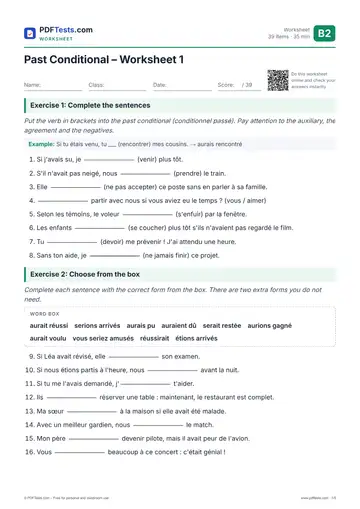
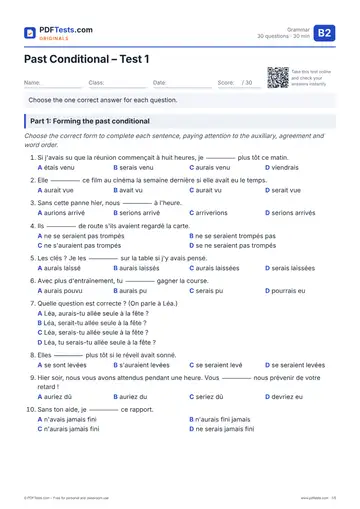
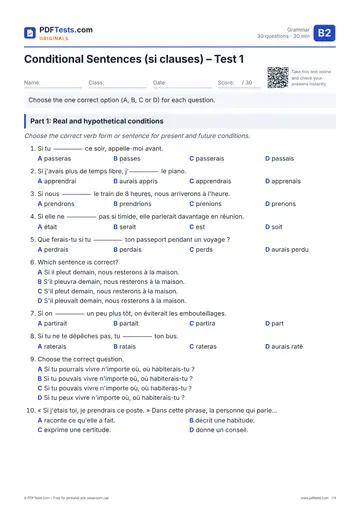
Once you can form the conditionnel passé with both auxiliaries and choose it correctly over the plus-que-parfait, practise under test conditions. Test yourself with our B2 Past Conditional test, and pay close attention to si clauses, être verbs and participle agreement, as these are where most errors appear.
Was this page helpful?
What was the problem?
Thank you for your feedback!