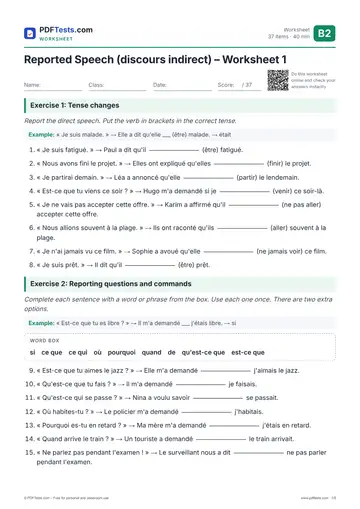
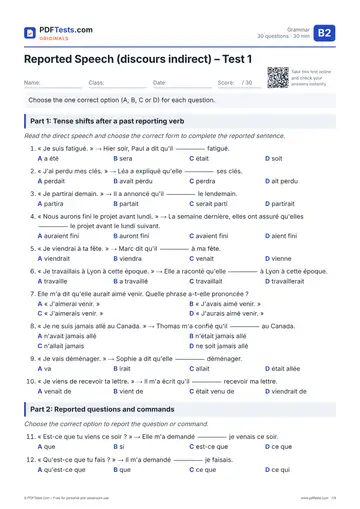
Reported speech (le discours indirect) lets you tell someone what another person said, asked or ordered without quoting their exact words. In French it means adding a linking word (que, si, ce que, de…) and adjusting pronouns. When the reporting verb is in the past, you also shift tenses and time expressions.
Direct speech vs indirect speech
In direct speech you quote the words exactly, with a colon and guillemets (« … »). In indirect speech the quotation becomes a subordinate clause.
- Direct: Léa dit : « Je suis fatiguée. »
Léa says: “I’m tired.” - Indirect: Léa dit **qu’**elle est fatiguée.
Léa says (that) she’s tired.
When you move from direct to indirect speech, check five things:
- Punctuation: no colon, no guillemets, no question mark.
- Linking word: que, si, ce que, ce qui, où, de, and so on.
- Pronouns and possessives: je may become il/elle, mon may become son.
- Tenses: these change only if the reporting verb is in a past tense.
- Time and place words: demain may become le lendemain.
Useful reporting verbs
| Statements | Questions | Commands and requests |
|---|---|---|
| dire, affirmer, déclarer | demander | dire de |
| expliquer, annoncer | vouloir savoir | demander de |
| répondre, ajouter | se demander | ordonner de, conseiller de |
| prétendre, avouer, promettre | supplier de, interdire de |
Varying the verb makes your French sound more precise: Il a avoué qu’il avait menti (He admitted he had lied) says much more than Il a dit que….
Reporting statements with que
Statements are introduced by que (qu’ before a vowel). Unlike English that, que cannot be left out, and it is repeated before each new clause.
- Il dit **qu’**il viendra et **qu’**il apportera du vin.
He says he’ll come and (that he’ll) bring some wine.
Reporting verb in the present or future: no tense change
If the reporting verb is in the present (dit), the future (dira) or the passé récent (vient de dire), keep the original tense.
- Paul : « J’ai raté le train. » → Paul dit qu’il a raté le train.
Paul says he missed the train. - Elle : « Je partirai tôt. » → Elle dit qu’elle partira tôt.
She says she’ll leave early.
Reporting verb in the past: the tenses shift
When the reporting verb is in the passé composé, imparfait or plus-que-parfait (a dit, disait, avait dit), the tense of the reported clause moves one step back into the past.
| Direct speech | Indirect speech (after a past verb) | Example |
|---|---|---|
| présent | imparfait | « Je travaille. » → Il a dit qu’il travaillait. |
| passé composé | plus-que-parfait | « J’ai fini. » → Il a dit qu’il avait fini. |
| futur simple | conditionnel présent | « Je viendrai. » → Il a dit qu’il viendrait. |
| futur antérieur | conditionnel passé | « J’aurai fini à 6 h. » → Il a dit qu’il aurait fini à 6 h. |
| futur proche | aller (imparfait) + infinitif | « Je vais déménager. » → Il a dit qu’il allait déménager. |
| passé récent | venir (imparfait) + de + infinitif | « Je viens d’arriver. » → Il a dit qu’il venait d’arriver. |
| imparfait, plus-que-parfait, conditionnel | no change | « J’aimerais partir. » → Il a dit qu’il aimerait partir. |
| subjonctif présent | usually no change in modern French | « Il faut que tu partes. » → Il a dit qu’il fallait que je parte. |
Translations of the examples: He said he was working / had finished / would come / would have finished by 6 / was going to move / had just arrived / would like to leave / said I had to leave.
If you need to revise the forms, see our guides to the plus-que-parfait and the past conditional. The full system is covered in Sequence of Tenses (concordance des temps).
Note on general truths: if the statement is still true now, you may keep the present.
- Le prof a expliqué que l’eau bout à 100 degrés.
The teacher explained that water boils at 100 degrees.
Pronouns and possessives
Think about who is speaking to whom, and change pronouns and possessives logically.
- Marc m’a dit : « Je te prête ma voiture. »
→ Marc m’a dit qu’il me prêtait sa voiture.
Marc told me he was lending me his car. - Mes parents ont dit : « Nous vendons notre maison. »
→ Mes parents ont dit qu’ils vendaient leur maison.
My parents said they were selling their house.
Time and place expressions
After a past reporting verb, words that point to the moment of speaking usually change. The original “now” is no longer now.
| Direct speech | Indirect speech |
|---|---|
| aujourd’hui | ce jour-là |
| hier | la veille |
| demain | le lendemain |
| après-demain | le surlendemain |
| maintenant | à ce moment-là, alors |
| ce matin / ce soir | ce matin-là / ce soir-là |
| la semaine dernière | la semaine précédente, la semaine d’avant |
| la semaine prochaine | la semaine suivante, la semaine d’après |
| il y a deux jours | deux jours plus tôt, deux jours avant |
| dans deux jours | deux jours plus tard, deux jours après |
| ici | là |
- Elle a dit : « Je pars demain. » → Elle a dit qu’elle partait le lendemain.
She said she was leaving the next day.
If you report something on the same day, it is fine to keep demain: Elle m’a dit ce matin qu’elle partait demain.
Reporting questions
In indirect questions, the word order becomes subject + verb. Est-ce que and inversion disappear, and there is no question mark. For a refresher on how direct questions are formed, see our guide to asking questions.
Yes/no questions: si
- « Tu viens ce soir ? » → Il m’a demandé si je venais ce soir-là.
He asked me if I was coming that evening. - « Est-ce qu’il pleut ? » → Elle se demandait s’il pleuvait.
She wondered whether it was raining.
Si becomes s’ only before il and ils. Si elle and si on stay as they are.
Questions with a question word
Question words (où, quand, comment, pourquoi, combien, qui, quel) stay the same.
- « Où habites-tu ? » → Elle m’a demandé où j’habitais.
She asked me where I lived. - « Quel âge as-tu ? » → Il voulait savoir quel âge j’avais.
He wanted to know how old I was.
With a noun subject, stylistic inversion is possible after où, quand, comment and similar words: Je me demande où habite Paul. (I wonder where Paul lives.)
What: ce que and ce qui
| Direct question | Indirect question | Example |
|---|---|---|
| Qu’est-ce que… ? / Que… ? / … quoi ? | ce que (object) | « Qu’est-ce que tu fais ? » → Il m’a demandé ce que je faisais. |
| Qu’est-ce qui… ? | ce qui (subject) | « Qu’est-ce qui se passe ? » → Elle a demandé ce qui se passait. |
He asked me what I was doing. / She asked what was happening.
With a preposition, quoi stays: « De quoi parles-tu ? » → Il m’a demandé de quoi je parlais. (He asked me what I was talking about.)
Reporting commands and requests
An imperative becomes de + infinitive after verbs like dire à quelqu’un de, demander à quelqu’un de and conseiller à quelqu’un de. No tense change is needed, because the infinitive has no tense.
- « Ferme la porte. » → Elle m’a dit de fermer la porte.
She told me to close the door. - « Ne touchez à rien. » → Il nous a demandé de ne rien toucher.
He asked us not to touch anything. - « Aide-moi ! » → Mon frère m’a demandé de l’aider.
My brother asked me to help him.
In the negative, both parts of the negation go before the infinitive: de ne pas partir, de ne jamais mentir.
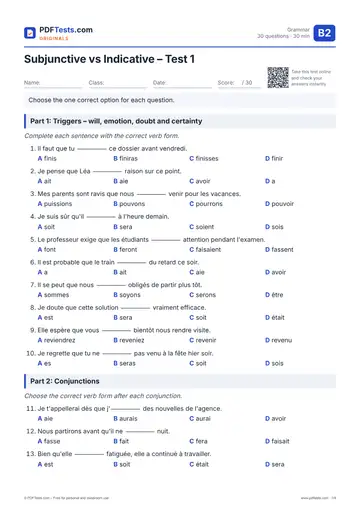
You can also use que + subjunctive, especially after exiger, vouloir or ordonner. See our guide to the present subjunctive if you need the forms.
- Le directeur a exigé que nous finissions le rapport.
The director demanded that we finish the report.
French vs English: key differences
- Que is compulsory. English often drops that; French never drops que.
- “Ask someone to” is demander à quelqu’un de. It is not demander quelqu’un à.
- “If/whether” is si. French does not use est-ce que or a question mark in indirect questions.
- “What” has two forms. Use ce que or ce qui, never qu’est-ce que, inside a reported question.
- Tense shift is more systematic. French applies it more consistently than English after a past reporting verb.
Common mistakes
- ✗ Il a dit il était malade. → ✓ Il a dit **qu’**il était malade.
Que can never be omitted. - ✗ Il a dit qu’il viendra demain. (reporting last week) → ✓ Il a dit qu’il viendrait le lendemain.
A past reporting verb turns the future into the conditional. - ✗ Elle m’a demandé est-ce que je venais. → ✓ Elle m’a demandé si je venais.
Est-ce que disappears in indirect questions. - ✗ Il m’a demandé qu’est-ce que je voulais. → ✓ Il m’a demandé ce que je voulais.
Qu’est-ce que becomes ce que. - ✗ Je me demande si il est là. → ✓ Je me demande s’il est là.
Si elides before il/ils. - ✗ Elle m’a dit de ne fermer pas la fenêtre. → ✓ Elle m’a dit de ne pas fermer la fenêtre.
Ne pas goes together before an infinitive. - ✗ Il a demandé où est-ce que j’habitais. → ✓ Il a demandé où j’habitais.
Use normal subject + verb order.
Quick check
Put each sentence into indirect speech.
- Sophie a dit : « J’ai perdu mes clés. »
- Il m’a demandé : « Tu as faim ? »
- Ma mère m’a dit : « Range ta chambre. »
- Le guide a annoncé : « Nous partirons demain. »
- Elle m’a demandé : « Qu’est-ce qui t’inquiète ? »
Answers
- Sophie a dit qu’elle avait perdu ses clés. (Sophie said she had lost her keys.)
- Il m’a demandé si j’avais faim. (He asked me if I was hungry.)
- Ma mère m’a dit de ranger ma chambre. (My mother told me to tidy my room.)
- Le guide a annoncé que nous partirions le lendemain. (The guide announced that we would leave the next day.)
- Elle m’a demandé ce qui m’inquiétait. (She asked me what was worrying me.)
Next step
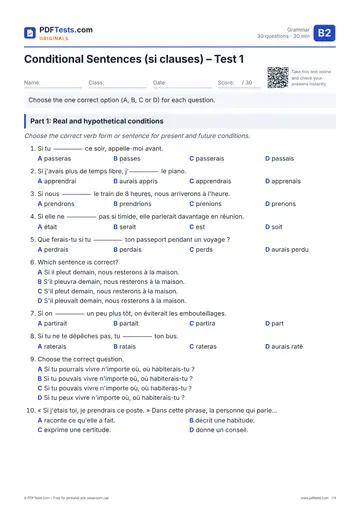
Practise the rules while they are fresh: take our B2 Reported Speech test and pay attention to three decisions in every item. Is the reporting verb past or present? Which linking word fits (que, si, ce que, ce qui or de)? Do the time expressions need to change? If the tense shifts still feel shaky, review the plus-que-parfait and conditional forms first, then come back and try the test again.
Was this page helpful?
What was the problem?
Thank you for your feedback!