The conditionnel présent is the French verb form that usually corresponds to English would + verb: je voudrais (I would like), nous irions (we would go), ce serait (it would be). You use it to make polite requests, express wishes, give advice, imagine situations (usually with si + imparfait) and report what someone said would happen.
The good news is that you already know both parts if you know the futur simple and the imparfait. The conditional takes the future stem and adds the imparfait endings.
When to use the conditionnel présent
1. Polite requests and questions
The conditional softens a request. It sounds more polite than the present tense, especially with vouloir, pouvoir and avoir.
- Je voudrais un café, s’il vous plaît. — I’d like a coffee, please.
- Pourriez-vous m’aider ? — Could you help me?
- Vous auriez cinq minutes ? — Would you have five minutes?
2. Wishes and desires
Use aimer, vouloir, préférer or plaire in the conditional to talk about what you would like.
- J’aimerais vivre à la campagne. — I’d like to live in the countryside.
- Ça me plairait de travailler à l’étranger. — I’d like to work abroad.
3. Advice and suggestions
Devoir in the conditional means should; pouvoir means could. À ta place / à votre place (if I were you) is always followed by the conditional.
- Tu devrais te reposer. — You should rest.
- À ta place, je prendrais le train. — If I were you, I’d take the train.
- Il vaudrait mieux partir tôt. — It would be better to leave early.
- On pourrait aller au cinéma ce soir. — We could go to the cinema tonight.
4. Imaginary situations with si
To talk about something unlikely or unreal now, French uses si + imparfait in one clause and the conditional in the other. The conditional never goes directly after this hypothetical si.
- Si j’avais plus de temps, j’apprendrais le japonais. — If I had more time, I would learn Japanese.
- Nous achèterions une maison si nous gagnions au loto. — We would buy a house if we won the lottery.
The conditional can also express an imaginary situation without si:
- Avec un peu plus d’argent, je changerais de voiture. — With a bit more money, I’d change my car.
5. The future seen from the past
After a reporting verb in the past (dire, promettre, penser, savoir…), the conditional expresses what was then in the future.
- Il m’a dit qu’il viendrait samedi. — He told me he would come on Saturday.
- Je pensais que tu serais content. — I thought you would be happy.
6. Unconfirmed information
Newspapers and the radio use the conditional to report facts that are not yet confirmed. English often uses reportedly or allegedly.
- Selon la police, le suspect serait encore en France. — According to the police, the suspect is reportedly still in France.
How to form the conditionnel présent
Regular verbs
Take the infinitive (drop the final -e of -re verbs) and add the endings -ais, -ais, -ait, -ions, -iez, -aient.
| Person | parler (to speak) | finir (to finish) | prendre (to take) |
|---|---|---|---|
| je | parlerais | finirais | prendrais |
| tu | parlerais | finirais | prendrais |
| il / elle / on | parlerait | finirait | prendrait |
| nous | parlerions | finirions | prendrions |
| vous | parleriez | finiriez | prendriez |
| ils / elles | parleraient | finiraient | prendraient |
Useful check: every conditional form has an r just before the ending.
Irregular stems
Verbs with an irregular future stem use exactly the same stem in the conditional. The endings never change.
| Infinitive | Stem | Example |
|---|---|---|
| être | ser- | Ce serait génial. — It would be great. |
| avoir | aur- | J’aurais besoin d’aide. — I would need help. |
| aller | ir- | Nous irions en Italie. — We would go to Italy. |
| faire | fer- | Tu ferais quoi ? — What would you do? |
| venir | viendr- | Elle viendrait avec nous. — She would come with us. |
| tenir | tiendr- | Il tiendrait sa promesse. — He would keep his promise. |
| voir | verr- | On verrait la mer. — We would see the sea. |
| pouvoir | pourr- | Vous pourriez fermer la porte ? — Could you close the door? |
| vouloir | voudr- | Je voudrais partir. — I would like to leave. |
| devoir | devr- | Ils devraient étudier. — They should study. |
| savoir | saur- | Je ne saurais pas quoi dire. — I wouldn’t know what to say. |
| falloir | faudr- | Il faudrait réserver. — We would need to book. |
| envoyer | enverr- | J’enverrais un message. — I would send a message. |
| recevoir | recevr- | Tu recevrais un cadeau. — You would receive a present. |
| courir | courr- | Je courrais plus vite. — I would run faster. |
| valoir | vaudr- | Il vaudrait mieux attendre. — It would be better to wait. |
Spelling changes in -er verbs
Some -er verbs change their stem, just as in the future:
- acheter → j’achèterais — I would buy
- appeler → j’appellerais — I would call
- jeter → je jetterais — I would throw
- payer → je paierais or je payerais — I would pay (both are correct)
- nettoyer → je nettoierais — I would clean
- préférer → je préférerais (traditional) or je préfèrerais (reformed spelling) — I would prefer
Negatives and questions
The conditional works like any simple tense: ne … pas goes around the verb, and object pronouns go before it.
| Type | French | English |
|---|---|---|
| Affirmative | Il viendrait. | He would come. |
| Negative | Il ne viendrait pas. | He wouldn’t come. |
| Question (intonation) | Il viendrait ? | Would he come? |
| Question (est-ce que) | Est-ce qu’il viendrait ? | Would he come? |
| Question (inversion) | Viendrait-il ? | Would he come? |
| With pronoun | Je ne le ferais jamais. | I would never do it. |
Pronunciation notes
- -ais, -ait, -aient sound identical: je parlerais, il parlerait and ils parleraient all end in the same sound [ɛ].
- je parlerai (future) and je parlerais (conditional) are distinguished by some speakers ([e] vs [ɛ]), but many people pronounce them the same. Context tells the listener which one you mean; in writing, the final -s matters.
- The unstressed e in -erais is often dropped in everyday speech: parlerais sounds like parl’rais.
- Pronounce the double rr of pourrais, verrais and courrais clearly in careful speech to separate them from the imparfait pouvais, voyais, courais.
Signal words and typical triggers
These expressions often come with the conditional:
- si + imparfait (in the other clause): Si j’étais riche, je voyagerais. — If I were rich, I would travel.
- à ta place / à votre place: À votre place, je refuserais. — If I were you, I would refuse.
- au cas où (in case): Prends un parapluie au cas où il pleuvrait. — Take an umbrella in case it rains.
- selon / d’après (in news reports): D’après le journal, le ministre démissionnerait. — According to the paper, the minister is reportedly resigning.
- j’aimerais, je voudrais, ce serait bien de: Ce serait bien de se revoir. — It would be nice to meet again.
Conditionnel vs futur simple
The two forms share the same stem, so they are easy to confuse. The future describes what will happen; the conditional describes what would happen.
| Futur simple | Conditionnel présent |
|---|---|
| Je ferai les courses demain. — I will do the shopping tomorrow. | Je ferais les courses si j’avais le temps. — I would do the shopping if I had time. |
| S’il pleut, nous resterons à la maison. — If it rains, we will stay home. | S’il pleuvait, nous resterions à la maison. — If it rained, we would stay home. |
| Il dit qu’il viendra. — He says he will come. | Il a dit qu’il viendrait. — He said he would come. |
Notice the pattern: si + present → future, but si + imparfait → conditional.
Conditionnel vs imparfait
The two forms share the same endings, but the conditional is built on the future stem (with r), while the imparfait is built on the nous form of the present.
| Imparfait | Conditionnel présent |
|---|---|
| je parlais — I was speaking / used to speak | je parlerais — I would speak |
| nous étions — we were | nous serions — we would be |
| ils pouvaient — they could (were able to) | ils pourraient — they could (would be able to) |
Common mistakes
- ✗ Si j’aurais le temps, je viendrais. → ✓ Si j’avais le temps, je viendrais. — If I had time, I would come. After hypothetical si, use the imparfait, never the conditional.
- ✗ Je voulerais un thé. → ✓ Je voudrais un thé. — I’d like a tea. Vouloir has the irregular stem voudr-.
- ✗ Tu pourais m’aider ? → ✓ Tu pourrais m’aider ? — Could you help me? Pouvoir takes a double r.
- ✗ Je voirais ce film. → ✓ Je verrais ce film. — I would see this film. Voir uses the stem verr-.
- ✗ Je serai content si tu venais. → ✓ Je serais content si tu venais. — I would be happy if you came. Si + imparfait needs the conditional, not the future.
- ✗ Il a promis qu’il m’appellera le lendemain. → ✓ Il a promis qu’il m’appellerait le lendemain. — He promised he would call me the next day. A future seen from the past takes the conditional.
- ✗ Tu devrais de partir. → ✓ Tu devrais partir. — You should leave. Devoir is followed directly by the infinitive.
- ✗ J’aimerai une table pour deux. → ✓ J’aimerais une table pour deux. — I’d like a table for two. A polite wish needs the conditional ending -ais.
Quick check
Put the verb in brackets into the conditionnel présent, or correct the sentence.
- Je ___ (vouloir) un renseignement, s’il vous plaît. — I’d like some information, please.
- Si nous avions une voiture, nous ___ (aller) à la mer. — If we had a car, we would go to the seaside.
- À ta place, je ___ (faire) attention. — If I were you, I would be careful.
- Elle m’a dit qu’elle ___ (être) en retard. — She told me she would be late.
- Correct the error: Si tu viendrais, on serait contents. — If you came, we would be happy.
Answers
- voudrais
- irions
- ferais
- serait
- Si tu venais, on serait contents. (imparfait after hypothetical si)
Next step
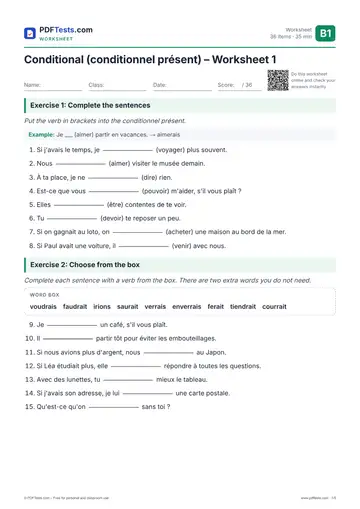
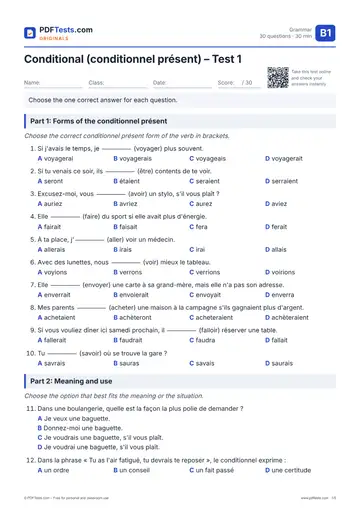
Now practise the forms and uses with our B1 Conditional (conditionnel présent) test. If the stems still cause trouble, review them in our guide to the futur proche and futur simple, and revisit the endings in the imparfait guide. When you are confident, move on to conditional sentences with si and the past conditional to talk about what would have happened.
Was this page helpful?
What was the problem?
Thank you for your feedback!