The plus-que-parfait is the French pluperfect, the equivalent of the English had done. You use it to talk about an action that happened before another past action or moment. You form it with the imparfait of avoir or être plus a past participle, as in j’avais fini (I had finished).
If you already know the passé composé, you know most of what you need. The plus-que-parfait uses the same past participles and the same choice between avoir and être. Only the auxiliary changes tense.
When to use the plus-que-parfait
1. An action before another past action
This is the core use. Two things happened in the past, and you want to show which one came first.
- Quand je suis arrivé à la gare, le train était déjà parti. When I got to the station, the train had already left.
- Elle a enfin lu le livre que je lui avais offert. She finally read the book I had given her.
- Nous avions déjà mangé, alors nous avons refusé le dessert. We had already eaten, so we said no to dessert.
The later action is usually in the passé composé or the imparfait. The earlier action goes into the plus-que-parfait.
2. Explaining the cause or background
When you explain why something happened, the reason often lies further back in time.
- J’étais fatigué parce que je n’avais pas dormi. I was tired because I hadn’t slept.
- Il n’a pas pu entrer : il avait oublié ses clés. He couldn’t get in: he had forgotten his keys.
3. Experiences up to a point in the past
With jamais, déjà or avant, the plus-que-parfait describes what someone had or hadn’t done by a certain time.
- Avant ce voyage, je n’avais jamais pris l’avion. Before that trip, I had never flown.
- À vingt ans, elle avait déjà vécu dans trois pays. By the age of twenty, she had already lived in three countries.
4. Reported speech in the past
When the reporting verb is in the past, a passé composé in the original words usually becomes a plus-que-parfait.
- « J’ai perdu mon portable. » → Elle m’a dit qu’elle avait perdu son portable. She told me she had lost her phone.
- Il m’a demandé si j’avais reçu son mail. He asked me if I had received his email.
You can explore this further in our guide to reported speech in French.
5. Regrets and unreal past conditions with si
After si, the plus-que-parfait expresses something that did not happen.
- Si seulement j’avais écouté ! If only I had listened.
- Si tu étais venu, tu aurais rencontré ma sœur. If you had come, you would have met my sister.
The second example combines the plus-que-parfait with the conditionnel passé. This pattern is covered in detail in our guide to si clauses.
How to form the plus-que-parfait
Formula: imparfait of avoir or être + past participle
With avoir (most verbs)
| Subject | finir | faire |
|---|---|---|
| j’ | avais fini | avais fait |
| tu | avais fini | avais fait |
| il / elle / on | avait fini | avait fait |
| nous | avions fini | avions fait |
| vous | aviez fini | aviez fait |
| ils / elles | avaient fini | avaient fait |
With être
With être, the past participle agrees with the subject in gender and number.
| Subject | partir |
|---|---|
| j’ | étais parti(e) |
| tu | étais parti(e) |
| il / elle / on | était parti / était partie / était parti(e)s |
| nous | étions parti(e)s |
| vous | étiez parti(e)(s) |
| ils / elles | étaient partis / étaient parties |
Negative and question forms
In the negative, ne … pas goes around the auxiliary, not the participle. Object and reflexive pronouns go before the auxiliary.
| Form | Example | Translation |
|---|---|---|
| Affirmative | Tu avais réservé. | You had booked. |
| Negative | Tu **n’**avais pas réservé. | You hadn’t booked. |
| With a pronoun | Je **ne l’**avais pas vu. | I hadn’t seen him/it. |
| Question (intonation) | Tu avais réservé ? | Had you booked? |
| Question (est-ce que) | Est-ce que tu avais réservé ? | Had you booked? |
| Question (inversion) | Avais-tu réservé ? | Had you booked? |
| Inversion with il/elle | Était-elle déjà partie ? | Had she already left? |
Which verbs take être
The same verbs as in the passé composé:
- Verbs of movement or change of state: aller, venir, arriver, partir, entrer, sortir, monter, descendre, tomber, rester, retourner, rentrer, revenir, devenir, naître, mourir, passer (in the sense of to go by).
- All pronominal (reflexive) verbs: se lever, se coucher, s’habiller, se rencontrer, etc.
Examples:
- Ils s’étaient rencontrés à Lyon. They had met in Lyon.
- Ma grand-mère était née en 1945. My grandmother had been born in 1945.
Note that monter, descendre, sortir, passer, rentrer and retourner take avoir when they have a direct object: Il avait sorti la poubelle. He had taken the bin out.
Agreement with avoir
With avoir, the participle does not agree with the subject. It agrees only with a direct object placed before the verb: Les photos ? Je les avais déjà envoyées. The photos? I had already sent them. For the full rules, see our guide to past participle agreement.
Past participles: a reminder
| Verb group | Ending | Example |
|---|---|---|
| -er verbs | -é | parler → parlé |
| Most -ir verbs | -i | choisir → choisi |
| Many -re verbs | -u | attendre → attendu |
Common irregular participles:
| Infinitive | Participle | Infinitive | Participle |
|---|---|---|---|
| avoir | eu | être | été |
| faire | fait | dire | dit |
| prendre | pris | mettre | mis |
| voir | vu | venir | venu |
| lire | lu | écrire | écrit |
| pouvoir | pu | vouloir | voulu |
| recevoir | reçu | ouvrir | ouvert |
Pronunciation and spelling notes
- avais, avait and avaient all sound the same: [avɛ]. The same goes for étais, était, étaient. Check the subject when you write.
- Liaison is required with nous, vous, ils, elles: ils avaient [il-za-vɛ], vous étiez [vu-ze-tje].
- je becomes j’ before both auxiliaries: j’avais, j’étais. In the negative: je n’avais pas, je n’étais pas.
Signal words
These words often appear with the plus-que-parfait, though none of them requires it automatically:
- déjà – already: Le film avait déjà commencé. The film had already started.
- ne … pas encore – not yet: Il n’était pas encore rentré. He hadn’t come home yet.
- ne … jamais – never: Je n’avais jamais goûté ça. I had never tasted that.
- avant / auparavant – before
- la veille – the day before: Elle avait appelé la veille. She had called the day before.
- parce que / car – when explaining an earlier cause
- dire que, expliquer que, demander si – in reported speech
Plus-que-parfait, passé composé or imparfait?
| Tense | What it does | Example |
|---|---|---|
| Passé composé | A completed event in the story | J’ai appelé Marc. I called Marc. |
| Imparfait | Background, description, habit | Il était malade. He was ill. |
| Plus-que-parfait | An event further back than the story | Il avait mangé des huîtres. He had eaten oysters. |
Compare these two sentences:
- Quand je suis arrivé, le film a commencé. When I arrived, the film started. (It started at that moment.)
- Quand je suis arrivé, le film avait commencé. When I arrived, the film had started. (I missed the beginning.)
In English, people often drop had when the order is clear: I gave her the book I bought. French is stricter. If an action clearly comes before another past action, use the plus-que-parfait: Je lui ai donné le livre que j’avais acheté.
However, when you simply tell events in the order they happened, you don’t need it: Je me suis levé, j’ai pris une douche et je suis parti. I got up, had a shower and left.
To revise the two other past tenses, see our guides to the passé composé and the imparfait.
Common mistakes
- ✗ Quand je suis arrivé, le train est déjà parti. → ✓ Quand je suis arrivé, le train était déjà parti. The departure came before the arrival.
- ✗ J’avais allé au marché. → ✓ J’étais allé au marché. Aller takes être.
- ✗ Elle était arrivé en retard. → ✓ Elle était arrivée en retard. With être, the participle agrees with the subject.
- ✗ Je m’avais couché tard. → ✓ Je m’étais couché(e) tard. Pronominal verbs always take être.
- ✗ Il m’a dit qu’il a perdu son portable. → ✓ Il m’a dit qu’il avait perdu son portable. After a past reporting verb, the earlier action shifts back.
- ✗ Si j’aurais su, je serais venu. → ✓ Si j’avais su, je serais venu. Never use the conditional directly after si.
- ✗ Je n’avais vu pas ce film. → ✓ Je n’avais pas vu ce film. Ne … pas goes around the auxiliary.
- ✗ Je m’étais levé, j’avais déjeuné et j’étais sorti. (simple narration) → ✓ Je me suis levé, j’ai déjeuné et je suis sorti. Events told in order need the passé composé.
Quick check
Put the verb in brackets into the correct form.
- Quand nous sommes arrivés, le concert ______ (commencer).
- Elle m’a dit qu’elle ______ (ne pas recevoir) mon message.
- Ils ______ déjà ______ (partir) quand j’ai appelé.
- Si tu ______ (venir), tu aurais rencontré Paul.
- Correct the mistake: Hier, j’étais fatigué parce que je m’avais couché très tard.
Answers
- avait commencé – When we arrived, the concert had started.
- n’avait pas reçu – She told me she hadn’t received my message.
- étaient déjà partis – They had already left when I called.
- étais venu(e) – If you had come, you would have met Paul.
- Hier, j’étais fatigué parce que je m’étais couché très tard. – Yesterday I was tired because I had gone to bed very late. Pronominal verbs take être.
Next step
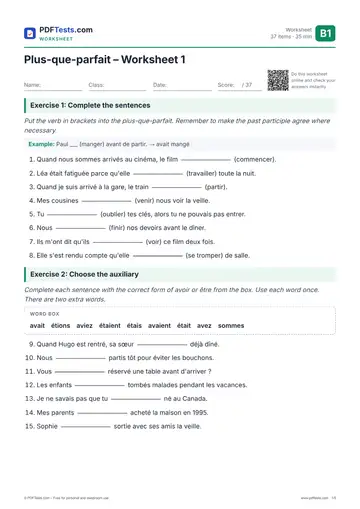
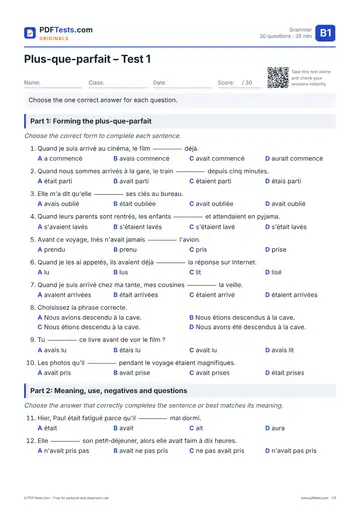
Now put the rules into practice: test yourself with our B1 Plus-que-parfait test, which mixes avoir and être verbs, agreement, negatives and sequence-of-events sentences. Pay special attention to any items where you chose the passé composé instead; they usually show where the timeline needs a step further back. Once you feel confident, combine the plus-que-parfait with the conditionnel passé in our si clauses guide to talk about what might have been.
Was this page helpful?
What was the problem?
Thank you for your feedback!