French conditional sentences combine a si clause (the condition) with a main clause (the result). The tenses you choose show how realistic the situation is: a real possibility, an imaginary present, or a past that can no longer be changed. At B2 you are expected to handle all three patterns, mix them when the timing requires it, and never put a future or conditional after si.
The golden rule: no future or conditional after si
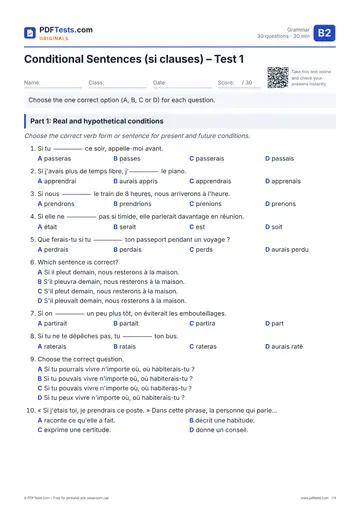
When si means “if”, the verb in the si clause is never in the futur simple or the conditionnel. Only the main clause can take those tenses.
- ✓ Si tu viens, on ira au cinéma. If you come, we’ll go to the cinema.
- ✗ Si tu viendras, on ira au cinéma.
- ✓ Si j’avais le temps, je t’aiderais. If I had the time, I would help you.
- ✗ Si j’aurais le temps, je t’aiderais.
Most of what follows is about choosing the right tense after si.
The three main patterns
| Type | si clause | Main clause | Meaning |
|---|---|---|---|
| 1: real | présent | présent / futur / impératif | possible or likely |
| 2: hypothetical | imparfait | conditionnel présent | unlikely or imaginary, now or in the future |
| 3: unreal past | plus-que-parfait | conditionnel passé | a past that did not happen |
Type 1: real or likely conditions
Use si + présent for things that may genuinely happen. The main clause can be in the présent, the futur simple, the futur proche or the impératif.
- Si on chauffe l’eau à 100 degrés, elle bout. If you heat water to 100 degrees, it boils.
- S’il fait beau samedi, nous irons à la plage. If the weather is nice on Saturday, we’ll go to the beach.
- Si tu as un problème, appelle-moi. If you have a problem, call me.
- Si tu ne te dépêches pas, tu vas rater le bus. If you don’t hurry, you’re going to miss the bus.
You can also use si + passé composé when the condition must be completed before the result: Si tu as fini tes devoirs, tu peux sortir. If you’ve finished your homework, you can go out.
Type 2: hypothetical conditions
Use si + imparfait → conditionnel présent for situations that are imaginary, unlikely or contrary to present reality.
- Si j’étais riche, je voyagerais tout le temps. If I were rich, I would travel all the time.
- Si elle habitait plus près, on se verrait plus souvent. If she lived closer, we would see each other more often.
- Si tu gagnais au loto, qu’est-ce que tu ferais ? If you won the lottery, what would you do?
The imparfait here does not refer to the past; it marks distance from reality. Compare:
- S’il pleut, je reste à la maison. If it rains, I’ll stay at home. (a real possibility)
- S’il pleuvait, je resterais à la maison. If it rained, I would stay at home. (less likely, or just imagining)
Type 3: unreal conditions in the past
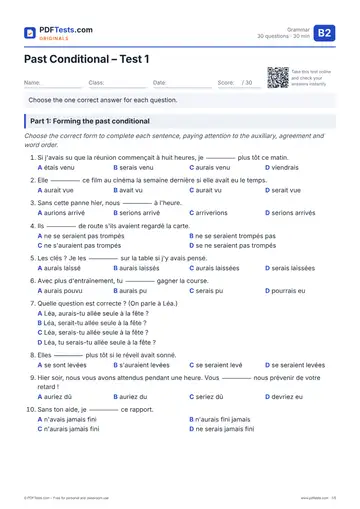
Use si + plus-que-parfait → conditionnel passé for a past that did not happen, often to express regret or criticism.
- Si j’avais su, je serais venu plus tôt. If I had known, I would have come earlier.
- Si nous avions pris un taxi, nous n’aurions pas raté l’avion. If we had taken a taxi, we wouldn’t have missed the plane.
- Si elle s’était levée à l’heure, elle serait arrivée à temps. If she had got up on time, she would have arrived on time.
Both tenses are compound. Verbs that take être in the passé composé (venir, arriver, partir, all reflexive verbs) take être here too, with agreement of the past participle.
Forming the tenses: a quick reminder
| Tense | Formation | Examples |
|---|---|---|
| Imparfait | nous stem + -ais, -ais, -ait, -ions, -iez, -aient | je finissais, j’allais |
| Conditionnel présent | future stem + imparfait endings | je finirais, j’irais, je serais |
| Plus-que-parfait | avoir/être in the imparfait + past participle | j’avais fini, j’étais parti(e) |
| Conditionnel passé | avoir/être in the conditionnel + past participle | j’aurais fini, je serais parti(e) |
Watch the irregular future stems used in the conditional: être → ser-, avoir → aur-, aller → ir-, faire → fer-, pouvoir → pourr-, vouloir → voudr-, venir → viendr-, savoir → saur-, devoir → devr-, voir → verr-.
If any of these forms feel shaky, review our guides to the imparfait, the conditionnel présent, the plus-que-parfait and the past conditional (conditionnel passé).
Mixed conditionals
When the condition and the result belong to different time frames, you can mix the patterns.
Past condition, present result
si + plus-que-parfait → conditionnel présent
- Si j’avais accepté ce poste, je vivrais à Montréal aujourd’hui. If I had accepted that job, I would be living in Montreal today.
- Si tu avais dormi hier soir, tu ne serais pas aussi fatigué maintenant. If you had slept last night, you wouldn’t be so tired now.
Permanent condition, past result
si + imparfait → conditionnel passé
- Si j’étais plus courageux, je lui aurais dit la vérité. If I were braver, I would have told him the truth.
- Si elle parlait espagnol, elle aurait obtenu le poste. If she spoke Spanish, she would have got the job.
Here the imparfait describes a general characteristic that is still true.
Word order and punctuation
The si clause can come first or second. When it comes first, a comma normally separates the clauses; when it comes second, no comma is needed. The tense rules do not change.
- Si tu veux, je t’accompagne. If you like, I’ll go with you.
- Je t’accompagne si tu veux. I’ll go with you if you like.
Spelling: si becomes s’ only before il and ils
Si elides only before il and ils. It never elides before elle, elles, on or other vowels.
- S’il vient, s’ils viennent if he comes, if they come
- Si elle vient, si on part, si un jour… if she comes, if we leave, if one day…
Two conditions: si … et que
When you link two conditions, French usually replaces the second si with que and keeps the indicative.
- Si tu as le temps et que tu en as envie, passe me voir. If you have time and you feel like it, come and see me.
- Si j’étais libre et que j’avais de l’argent, je partirais. If I were free and had money, I would leave.
Si meaning “whether”: a different rule
In indirect questions, si means “whether”, and the golden rule does not apply. The future and the conditional are allowed after it.
- Je ne sais pas s’il viendra demain. I don’t know whether he’ll come tomorrow.
- Elle m’a demandé si j’accepterais l’offre. She asked me whether I would accept the offer.
A useful test: if you can replace “if” with “whether” in English, the future or conditional is possible in French.
Si on… ? Suggestions, wishes and regrets
Si + imparfait or plus-que-parfait can stand alone, without a main clause.
- Si on allait au restaurant ce soir ? How about going to a restaurant tonight?
- Ah, si j’avais vingt ans ! Oh, if only I were twenty.
- Si seulement tu m’avais écouté ! If only you had listened to me.
Other ways to express a condition
These connectors are common at B2, and each has its own mood or tense rule.
| Connector | Followed by | Example |
|---|---|---|
| même si | same tenses as si | Même si tu insistes, je ne viendrai pas. Even if you insist, I won’t come. |
| sauf si | same tenses as si | On mangera dehors, sauf s’il fait froid. We’ll eat outside unless it’s cold. |
| si jamais | same tenses as si | Si jamais tu le vois, dis-lui bonjour. If you happen to see him, say hello. |
| au cas où | conditionnel | Prends un parapluie au cas où il pleuvrait. Take an umbrella in case it rains. |
| à condition que | subjonctif | Je viens à condition que tu conduises. I’ll come on condition that you drive. |
| comme si | imparfait / plus-que-parfait | Il parle comme s’il savait tout. He talks as if he knew everything. |
Si clauses vs English if clauses
The three patterns match English closely, which helps, but two traps remain. First, English sometimes uses “would” after “if” in polite requests; French never does: Si vous voulez bien patienter… If you would kindly wait… Second, English uses the simple past in type 2 (“if I had”), and French uses the imparfait, not the passé composé.
Common mistakes
- ✗ Si j’aurais su, je ne serais pas venu. → ✓ Si j’avais su, je ne serais pas venu. If I had known, I wouldn’t have come. No conditional after si.
- ✗ Si tu viendras, on fera une fête. → ✓ Si tu viens, on fera une fête. If you come, we’ll have a party. No future after si.
- ✗ Si j’étais riche, j’achète une maison. → ✓ Si j’étais riche, j’achèterais une maison. If I were rich, I would buy a house. Imparfait after si needs the conditional.
- ✗ Si il pleut, on reste ici. → ✓ S’il pleut, on reste ici. If it rains, we’ll stay here. Si elides before il.
- ✗ S’elle veut, elle peut venir. → ✓ Si elle veut, elle peut venir. If she wants, she can come. No elision before elle.
- ✗ Si nous avions su, nous aurions venus. → ✓ Si nous avions su, nous serions venus. If we had known, we would have come. Venir takes être.
- ✗ Si j’ai eu le temps hier, je t’aurais appelé. → ✓ Si j’avais eu le temps hier, je t’aurais appelé. If I’d had time yesterday, I would have called you. An unreal past needs the plus-que-parfait.
- ✗ Au cas où tu as besoin de moi, appelle-moi. → ✓ Au cas où tu aurais besoin de moi, appelle-moi. In case you need me, call me. Au cas où takes the conditional.
Quick check
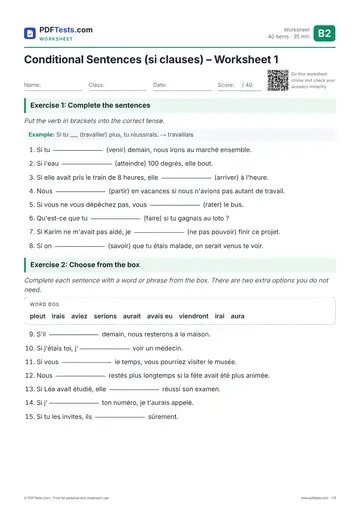
Put the verb in brackets into the correct form, or correct the sentence.
- Si tu ___ (venir) demain, on ira au marché. If you come tomorrow, we’ll go to the market.
- Si j’___ (avoir) plus de temps, j’apprendrais le piano. If I had more time, I would learn the piano.
- Si nous étions partis plus tôt, nous ___ (ne pas rater) le train. If we had left earlier, we wouldn’t have missed the train.
- Correct the error: S’elle veut, elle peut rester. If she wants, she can stay.
- Si tu ___ (écouter) mes conseils l’an dernier, tu ne serais pas dans cette situation aujourd’hui. If you had listened to my advice last year, you wouldn’t be in this situation today.
Answers
- viens (type 1: si + présent)
- avais (type 2: si + imparfait)
- n’aurions pas raté (type 3: conditionnel passé)
- Si elle veut, elle peut rester. (no elision before elle)
- avais écouté (mixed: si + plus-que-parfait → conditionnel présent)
Next step
Now put the rules into practice: test yourself with our B2 Conditional Sentences (si clauses) test, which mixes all three patterns, mixed conditionals and the si = “whether” trap. If type 3 sentences still slow you down, follow up with the B2 Past Conditional test to make the compound forms automatic.
Was this page helpful?
What was the problem?
Thank you for your feedback!