The imparfait is a French past tense. It describes how things were, what used to happen regularly and what was in progress at a given moment. In English it often becomes used to, was/were + -ing or a simple past like was or had. At A2 you mainly use it with the passé composé to talk about your childhood, describe past situations and tell short stories.
When to use the imparfait
1. Habits and repeated actions in the past
Use the imparfait for things that happened regularly. It is very common with quand j’étais petit(e) (when I was little).
- Quand j’étais petit, je passais mes vacances chez ma grand-mère. When I was little, I used to spend my holidays at my grandmother’s.
- Le samedi, nous allions au marché. On Saturdays, we used to go to the market.
- Avant, elle prenait le bus pour aller au travail. She used to take the bus to work.
2. Descriptions and background
Use the imparfait to describe people, places, the weather, the time, age, feelings and states of mind. It sets the scene of a story.
- Il faisait beau et la plage était calme. The weather was nice and the beach was quiet.
- Mon grand-père avait une moustache et il portait toujours un chapeau. My grandfather had a moustache and he always wore a hat.
- Il était minuit et j’avais très faim. It was midnight and I was very hungry.
- À cette époque, j’avais quinze ans. At that time, I was fifteen.
3. Actions in progress
Use the imparfait for an action that was happening when something else happened, or for two actions going on at the same time.
- Je regardais une série quand mon téléphone a sonné. I was watching a series when my phone rang.
- Pendant que tu dormais, je préparais le petit-déjeuner. While you were sleeping, I was making breakfast.
The longer background action is in the imparfait; the short event that interrupts it is in the passé composé.
4. Polite requests and suggestions
Two useful fixed patterns at this level:
- Je voulais vous demander quelque chose. I wanted to ask you something. (softer than je veux)
- Et si on allait au cinéma ? How about going to the cinema?
How to form the imparfait
The stem
Take the nous form of the present tense and remove -ons. This works for almost every verb, including most irregular ones.
| Infinitive | Present (nous) | Imparfait stem |
|---|---|---|
| parler | nous parlons | parl- |
| finir | nous finissons | finiss- |
| prendre | nous prenons | pren- |
| faire | nous faisons | fais- |
| avoir | nous avons | av- |
| aller | nous allons | all- |
| boire | nous buvons | buv- |
If the nous forms of irregular verbs are not automatic for you yet, review our guide to the present tense of irregular verbs.
The endings
All verbs use the same endings: -ais, -ais, -ait, -ions, -iez, -aient.
| Subject | parler | finir | prendre |
|---|---|---|---|
| je / j’ | parlais | finissais | prenais |
| tu | parlais | finissais | prenais |
| il / elle / on | parlait | finissait | prenait |
| nous | parlions | finissions | prenions |
| vous | parliez | finissiez | preniez |
| ils / elles | parlaient | finissaient | prenaient |
Je parlais = I was speaking / I used to speak; nous finissions = we were finishing / we used to finish; ils prenaient = they were taking / they used to take.
The one exception: être
Être has an irregular stem, ét-, but the normal endings.
| Subject | être | English |
|---|---|---|
| j’ | étais | I was |
| tu | étais | you were |
| il / elle / on | était | he / she / one was |
| nous | étions | we were |
| vous | étiez | you were |
| ils / elles | étaient | they were |
Impersonal expressions
These appear constantly in descriptions:
- il y avait there was / there were
- il faisait chaud / froid it was hot / cold
- il pleuvait it was raining
- il neigeait it was snowing
- il fallait you had to / it was necessary
Il y avait beaucoup de monde à la fête. There were a lot of people at the party.
Negative and question forms
The imparfait is a simple tense (one word), so ne … pas goes around the verb.
| Form | Example | English |
|---|---|---|
| Affirmative | Elle travaillait à Lyon. | She worked / used to work in Lyon. |
| Negative | Elle ne travaillait pas à Lyon. | She didn’t work in Lyon. |
| Question (intonation) | Elle travaillait à Lyon ? | Did she work in Lyon? |
| Question (est-ce que) | **Est-ce qu’**elle travaillait à Lyon ? | Did she work in Lyon? |
| Question (inversion) | Travaillait-elle à Lyon ? | Did she work in Lyon? |
Remember elision: je becomes j’ before a vowel or silent h: j’avais, j’habitais, j’étais. In the negative: je n’avais pas (I didn’t have).
Spelling and pronunciation notes
Verbs in -ger and -cer
To keep the soft sound of g and c before a, add e or use ç. Before i (nous, vous), no change is needed.
| manger | commencer | |
|---|---|---|
| je | mangeais | commençais |
| il / elle | mangeait | commençait |
| nous | mangions | commencions |
| ils / elles | mangeaient | commençaient |
Nous mangions à la cantine. We used to eat in the canteen.
Verbs with a stem ending in -i
Verbs like étudier, oublier, rire keep the i of the stem and add the i of the ending, so you get a double i with nous and vous:
- nous étudiions, vous étudiiez we were studying, you were studying
Pronunciation
The endings -ais, -ait and -aient all sound the same, like the è in père. So je parlais, il parlait and ils parlaient sound identical; only the spelling is different. The nous and vous forms are pronounced differently from the present: nous parlons vs nous parlions (with a y sound before the ending).
Signal words
These words often (not always) go with the imparfait because they suggest habit, duration or background:
- avant, autrefois before, in the past
- d’habitude, souvent, toujours usually, often, always
- tous les jours, chaque été every day, every summer
- le lundi, le week-end on Mondays, at weekends
- quand j’étais petit(e) / jeune when I was little / young
- à cette époque at that time
- pendant que while
D’habitude, on dînait à huit heures. We usually had dinner at eight.
Imparfait vs passé composé
This is the main difficulty at A2. The basic idea:
| Imparfait | Passé composé |
|---|---|
| Background, description | Main events |
| Habit, repeated action | Single, completed action |
| Action in progress | Action that interrupts |
| Il pleuvait. It was raining. | Il a plu toute la nuit. It rained all night. |
Compare:
- Le dimanche, je jouais au tennis. On Sundays, I used to play tennis. (habit)
- Dimanche dernier, j’ai joué au tennis. Last Sunday, I played tennis. (one occasion)
In a story, both tenses work together: J’attendais le bus quand j’ai vu Marc. I was waiting for the bus when I saw Marc. For a full explanation with more examples, read our guide to passé composé vs imparfait, and if you need to revise the other tense first, see the passé composé guide.
Common mistakes
- ✗ je mangais → ✓ je mangeais — -ger verbs need an e before a to keep the soft g.
- ✗ nous mangeions → ✓ nous mangions — no extra e before i.
- ✗ nous étudions (meaning we were studying) → ✓ nous étudiions — that is the present; the imparfait has a double i.
- ✗ nous êtions → ✓ nous étions — the stem of être is ét- with an acute accent.
- ✗ ils parlait → ✓ ils parlaient — the ils/elles ending is -aient, even though it sounds like -ait.
- ✗ je avais → ✓ j’avais — je elides before a vowel.
- ✗ Quand j’ai été petit, j’ai habité à Nantes. → ✓ Quand j’étais petit, j’habitais à Nantes. — childhood situations are background, so use the imparfait.
- ✗ Elle a eu les cheveux longs quand elle était jeune. → ✓ Elle avait les cheveux longs… — physical descriptions in the past use the imparfait.
- ✗ Je lisais quand le téléphone sonnait. → ✓ … quand le téléphone a sonné. — the sudden interrupting event is in the passé composé.
Quick check
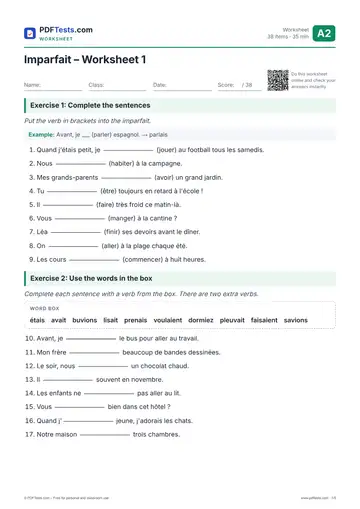
Put the verb in brackets in the correct form.
- Quand j’étais petite, je ___ (jouer) au foot tous les samedis.
- À l’école, nous ___ (manger) à la cantine.
- Il ___ (faire) froid et il ___ (neiger).
- Vous ___ (être) à Paris en 2019 ?
- Je dormais quand mon frère ___ (rentrer). (Imparfait or passé composé?)
Answers
- jouais — a habit in the past.
- mangions — no e before i.
- faisait, neigeait — weather description; neiger keeps the e before a.
- étiez — être uses the stem ét-.
- est rentré — the interrupting event takes the passé composé.
Next step
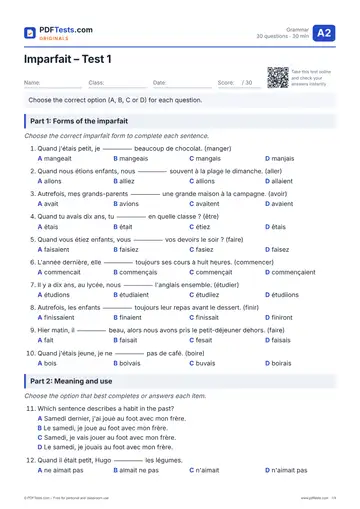
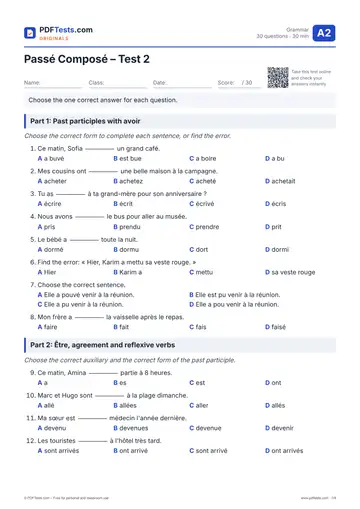
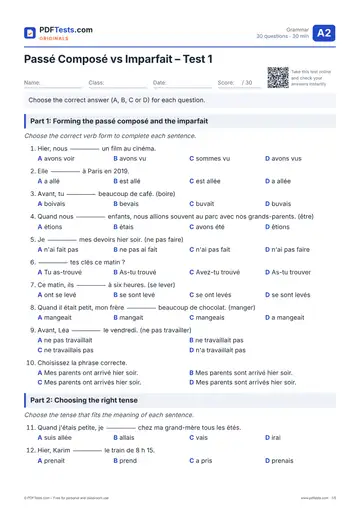
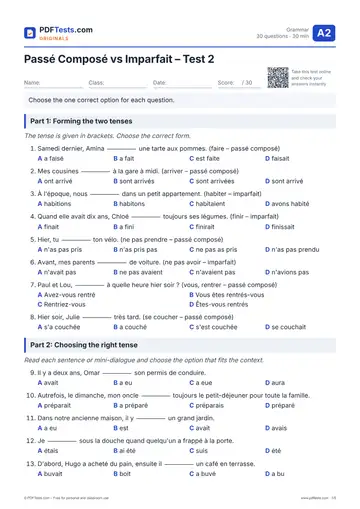
Now practise the forms and uses until they feel automatic: test yourself with our A2 Imparfait test, which checks endings, spelling and the main uses. When you are confident, move on to the Passé Composé vs Imparfait test to practise choosing the right tense in real past-tense stories.
Practise this topic: The French Imparfait
Was this page helpful?
What was the problem?
Thank you for your feedback!