PDFTests Originals

Comparative and Superlative – Worksheet 1

A2 Elementary WorksheetGerman

This worksheet practises comparing people and things in German. You will form the comparative (älter, schneller) and the superlative (am ältesten), and use als, so … wie and nicht so … wie. It is for A2 learners, in class or at home.
items
39
Time
35 min
PDF
5 pages
Answer key
Included
  • 100% free
  • No sign-up or email
  • Print-ready A4 PDF
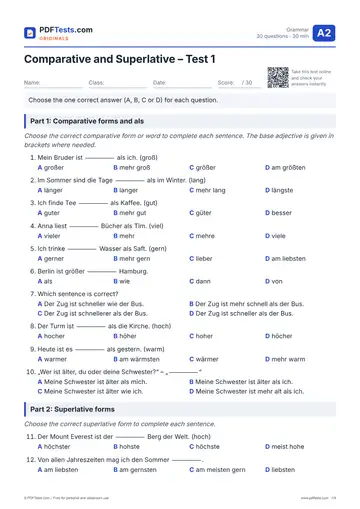
Preview of page 1 of Comparative and Superlative – Worksheet 1 Open PDF
New to this topic? Read the guide first: German Comparative and Superlative: Rules, Examples and Common Mistakes

Do the worksheet online

Type your answers, then press “Check my answers”. Alternative correct answers are accepted.

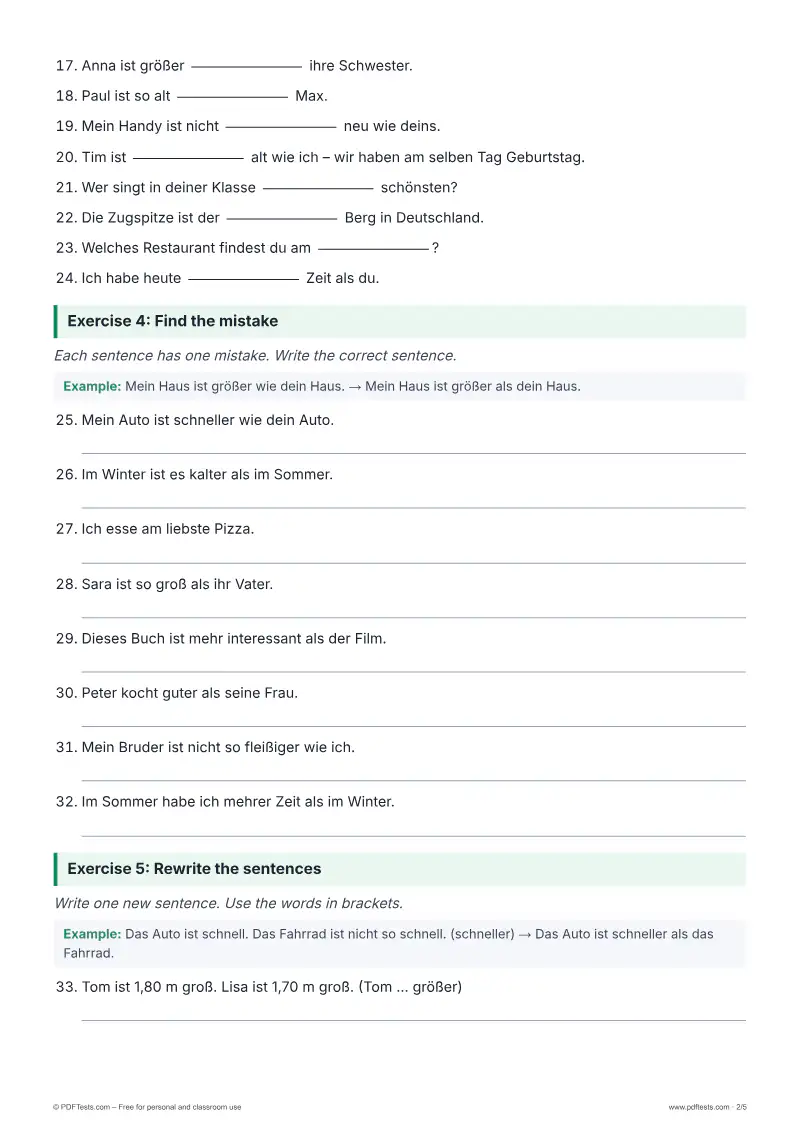
Exercise 1: Comparative forms

Complete the sentences with the comparative form of the word in brackets.

Example: Der Tisch ist ___ als der Stuhl. (groß) → größer

  1. Mein Bruder ist drei Jahre als ich. (alt)

  2. Im Sommer sind die Tage als im Winter. (lang)

  3. Der Zug ist als der Bus. (schnell)

  4. Heute ist es als gestern. (warm)

  5. Ich trinke Tee als Kaffee. (gern)

  6. Lena spricht Englisch als ihr Freund. (gut)

  7. Diese Tasche ist als die rote. (teuer)

  8. Ist es in London als in Rom? (kalt)

Exercise 2: Superlative with am …sten

Complete the sentences with am + the superlative form of the word in brackets.

Example: Von allen Kindern ist Mia ___. (klein) → am kleinsten

  1. Von allen Tieren ist der Gepard . (schnell)

  2. In unserer Familie kocht mein Vater . (gut)

  3. Im Juli ist es hier . (heiß)

  4. Ich lese Krimis. (gern)

  5. Welcher Monat ist ? (kurz)

  6. Von uns dreien wohnt Jonas von der Schule entfernt. (weit)

  7. Das grüne Kleid ist . (teuer)

  8. Am Wochenende schlafe ich . (viel)

Exercise 3: Choose the right word

Complete the sentences with words from the box. There are two extra words.

Word box alswiesogenausoamhöchstemehrbestenliebergrößer

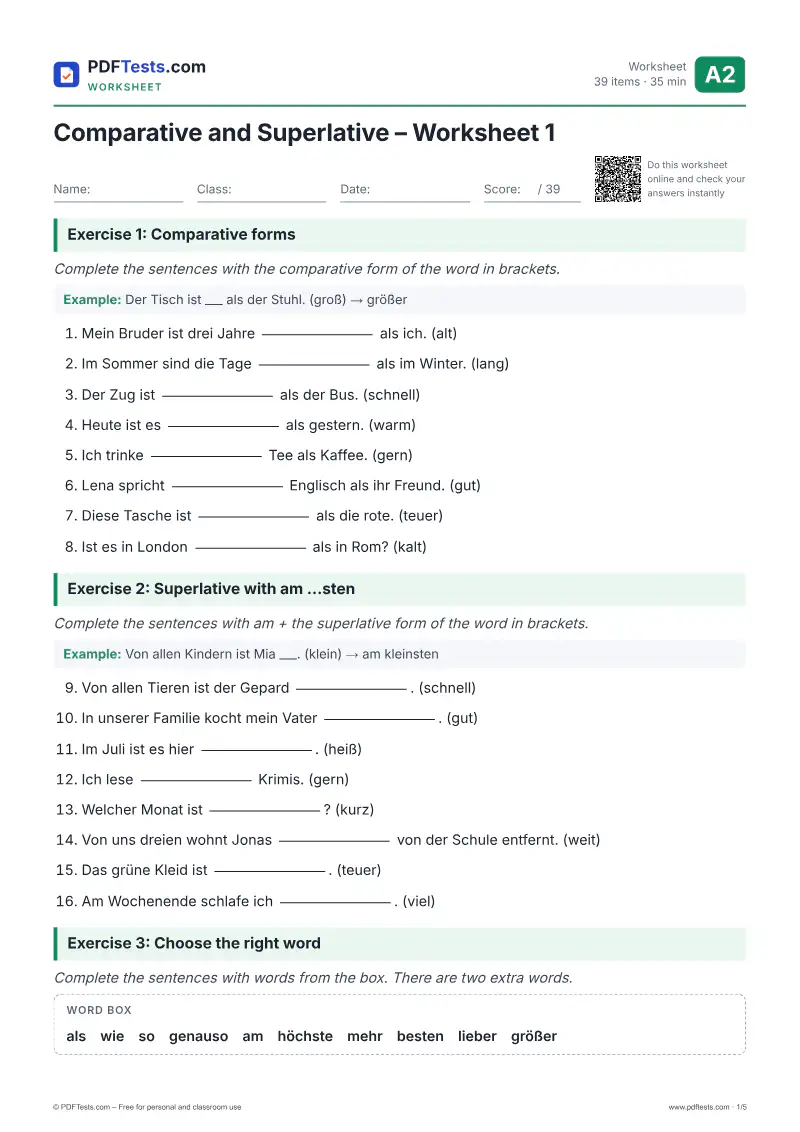
  1. Anna ist größer ihre Schwester.

  2. Paul ist so alt Max.

  3. Mein Handy ist nicht neu wie deins.

  4. Tim ist alt wie ich – wir haben am selben Tag Geburtstag.

  5. Wer singt in deiner Klasse schönsten?

  6. Die Zugspitze ist der Berg in Deutschland.

  7. Welches Restaurant findest du am ?

  8. Ich habe heute Zeit als du.

Exercise 4: Find the mistake

Each sentence has one mistake. Write the correct sentence.

Example: Mein Haus ist größer wie dein Haus. → Mein Haus ist größer als dein Haus.

  1. Mein Auto ist schneller wie dein Auto.

  2. Im Winter ist es kalter als im Sommer.

  3. Ich esse am liebste Pizza.

  4. Sara ist so groß als ihr Vater.

  5. Dieses Buch ist mehr interessant als der Film.

  6. Peter kocht guter als seine Frau.

  7. Mein Bruder ist nicht so fleißiger wie ich.

  8. Im Sommer habe ich mehrer Zeit als im Winter.

Exercise 5: Rewrite the sentences

Write one new sentence. Use the words in brackets.

Example: Das Auto ist schnell. Das Fahrrad ist nicht so schnell. (schneller) → Das Auto ist schneller als das Fahrrad.

  1. Tom ist 1,80 m groß. Lisa ist 1,70 m groß. (Tom … größer)

  2. Der Rock kostet 30 Euro. Die Hose kostet auch 30 Euro. (Der Rock … genauso teuer)

  3. Mein Hund ist 5 Jahre alt. Deine Katze ist 8 Jahre alt. (Mein Hund … nicht so alt)

  4. Ben ist 12, Paul ist 14 und Felix ist 16. (Felix … am)

  5. Der Film ist spannender als das Buch. (Make a question: Ist …?)

  6. Ich esse gern Äpfel, aber Bananen esse ich noch lieber. (Ich esse … lieber … als …)

  7. Berlin ist größer als München. (München … nicht so groß)

Was this page helpful?

Report a mistake

Spotted a wrong answer, a typo or an unclear explanation? Tell us and we will fix it.

Preview

About this test

Printable A2 German worksheet on comparatives and superlatives: als, wie, am …sten, irregular forms, negatives and questions. Answers included.

Topics covered

KomparativSuperlativ with am …stenals / so … wieIrregular forms: gut, gern, vielUmlaut in comparisonsNegatives and questions

Notes for teachers

Revise the forms on the board first, especially the umlaut forms (alt – älter – am ältesten) and the irregular forms gut/besser, gern/lieber, viel/mehr. Learners often use 'wie' after a comparative instead of 'als', forget the umlaut, or say 'mehr interessant'. As a follow-up, ask pairs to compare three cities, animals or classmates and write five sentences, including one with nicht so … wie and one question.

All German A2 tests →