PDFTests Originals

Subordinate Clauses: weil, dass, wenn – Worksheet 1

A2 Elementary WorksheetGerman

This worksheet practises German subordinate clauses with weil, dass and wenn, with a focus on sending the verb to the end of the clause. It covers separable verbs, modal verbs, negatives, questions and sentences that start with the subordinate clause. It is for A2 learners who want controlled practice followed by sentence building.
items
39
Time
30 min
PDF
5 pages
Answer key
Included
  • 100% free
  • No sign-up or email
  • Print-ready A4 PDF
Preview of page 1 of Subordinate Clauses: weil, dass, wenn – Worksheet 1 Open PDF
New to this topic? Read the guide first: Subordinate Clauses in German: weil, dass, wenn – Rules, Examples and Common Mistakes

Do the worksheet online

Type your answers, then press “Check my answers”. Alternative correct answers are accepted.

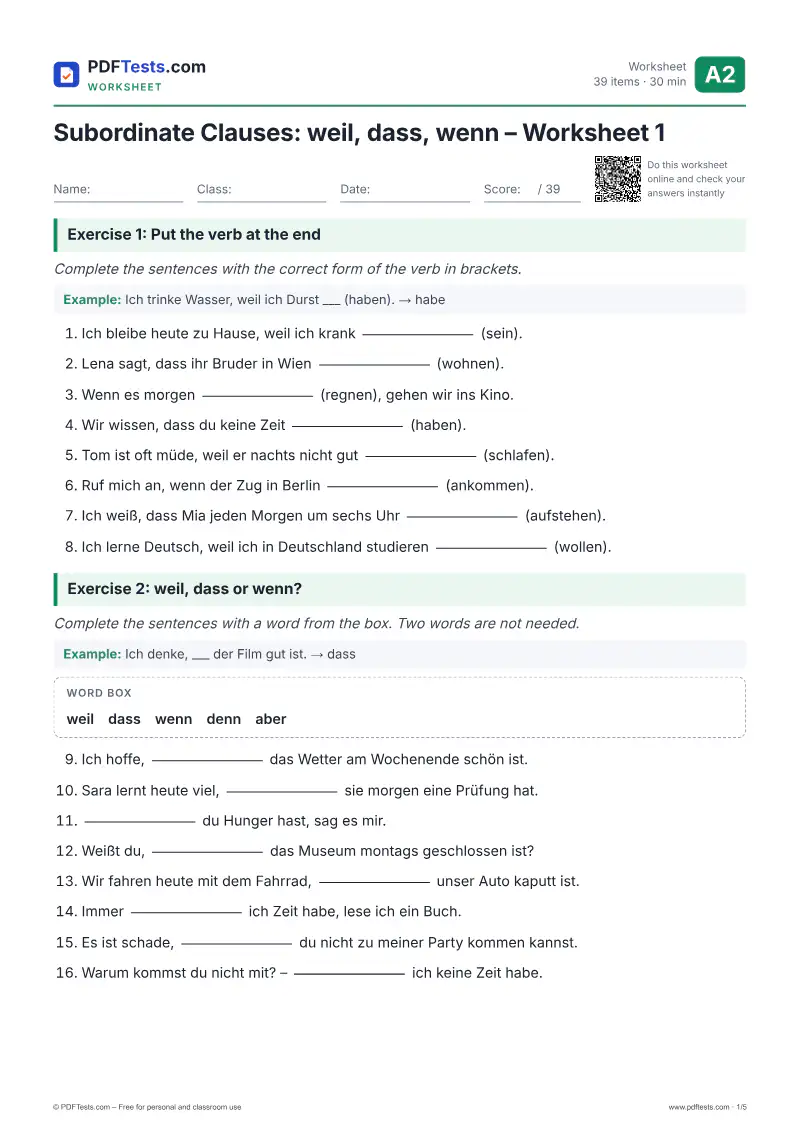
Exercise 1: Put the verb at the end

Complete the sentences with the correct form of the verb in brackets.

Example: Ich trinke Wasser, weil ich Durst ___ (haben). → habe

  1. Ich bleibe heute zu Hause, weil ich krank (sein).

  2. Lena sagt, dass ihr Bruder in Wien (wohnen).

  3. Wenn es morgen (regnen), gehen wir ins Kino.

  4. Wir wissen, dass du keine Zeit (haben).

  5. Tom ist oft müde, weil er nachts nicht gut (schlafen).

  6. Ruf mich an, wenn der Zug in Berlin (ankommen).

  7. Ich weiß, dass Mia jeden Morgen um sechs Uhr (aufstehen).

  8. Ich lerne Deutsch, weil ich in Deutschland studieren (wollen).

Exercise 2: weil, dass or wenn?

Complete the sentences with a word from the box. Two words are not needed.

Example: Ich denke, ___ der Film gut ist. → dass

Word box weildasswenndennaber

  1. Ich hoffe, das Wetter am Wochenende schön ist.

  2. Sara lernt heute viel, sie morgen eine Prüfung hat.

  3. du Hunger hast, sag es mir.

  4. Weißt du, das Museum montags geschlossen ist?

  5. Wir fahren heute mit dem Fahrrad, unser Auto kaputt ist.

  6. Immer ich Zeit habe, lese ich ein Buch.

  7. Es ist schade, du nicht zu meiner Party kommen kannst.

  8. Warum kommst du nicht mit? – ich keine Zeit habe.

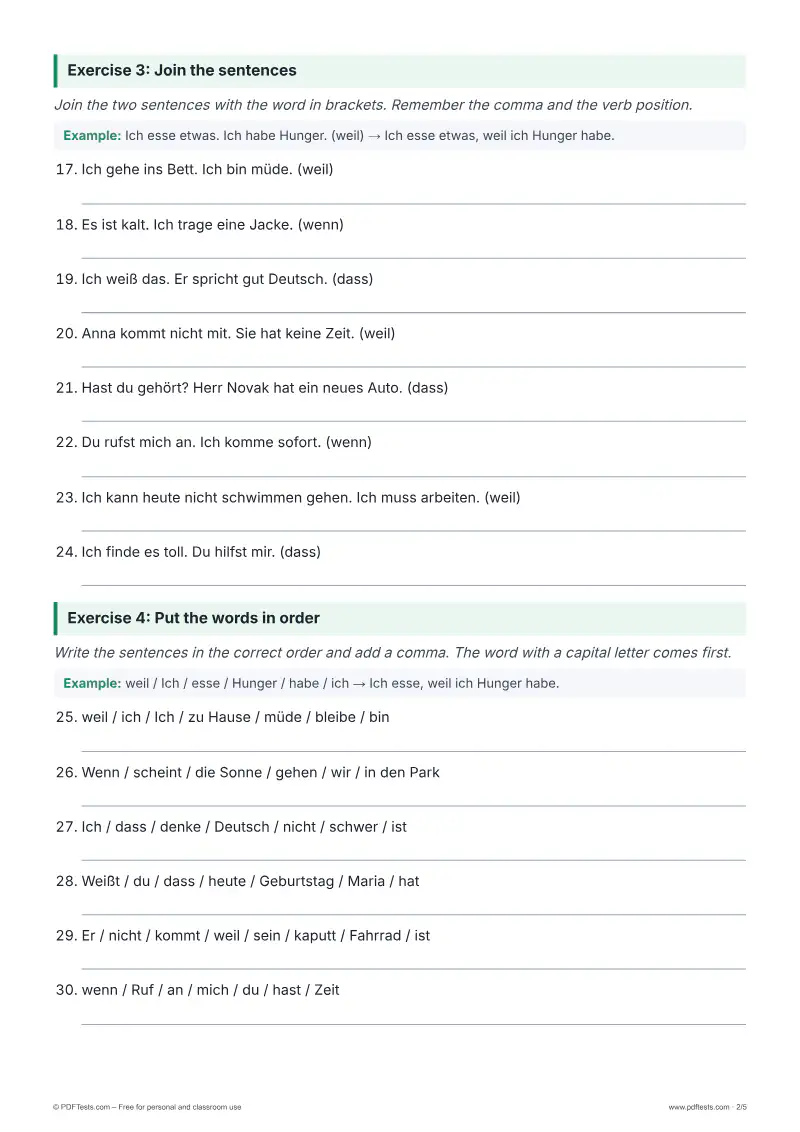
Exercise 3: Join the sentences

Join the two sentences with the word in brackets. Remember the comma and the verb position.

Example: Ich esse etwas. Ich habe Hunger. (weil) → Ich esse etwas, weil ich Hunger habe.

  1. Ich gehe ins Bett. Ich bin müde. (weil)

  2. Es ist kalt. Ich trage eine Jacke. (wenn)

  3. Ich weiß das. Er spricht gut Deutsch. (dass)

  4. Anna kommt nicht mit. Sie hat keine Zeit. (weil)

  5. Hast du gehört? Herr Novak hat ein neues Auto. (dass)

  6. Du rufst mich an. Ich komme sofort. (wenn)

  7. Ich kann heute nicht schwimmen gehen. Ich muss arbeiten. (weil)

  8. Ich finde es toll. Du hilfst mir. (dass)

Exercise 4: Put the words in order

Write the sentences in the correct order and add a comma. The word with a capital letter comes first.

Example: weil / Ich / esse / Hunger / habe / ich → Ich esse, weil ich Hunger habe.

  1. weil / ich / Ich / zu Hause / müde / bleibe / bin

  2. Wenn / scheint / die Sonne / gehen / wir / in den Park

  3. Ich / dass / denke / Deutsch / nicht / schwer / ist

  4. Weißt / du / dass / heute / Geburtstag / Maria / hat

  5. Er / nicht / kommt / weil / sein / kaputt / Fahrrad / ist

  6. wenn / Ruf / an / mich / du / hast / Zeit

  7. Es / dass / ist / schön / du / bist / hier

Exercise 5: Find and correct the mistake

Each sentence has one mistake. Write the correct sentence.

Example: Ich bin froh, dass du bist hier. → Ich bin froh, dass du hier bist.

  1. Ich lerne Deutsch, weil ich habe Freunde in Berlin.

  2. Wenn ich Zeit habe, ich spiele Fußball.

  3. Sie sagt, dass sie hat keinen Hunger.

  4. Ich hoffe, dass du kommst morgen.

  5. Ruf mich an, wenn du in Rom kommst an.

  6. Weil es regnet, wir bleiben zu Hause.

  7. Ich bin traurig, weil ich kann nicht mitkommen.

  8. Ich glaube, wenn Tim heute Geburtstag hat.

Was this page helpful?

Report a mistake

Spotted a wrong answer, a typo or an unclear explanation? Tell us and we will fix it.

Preview

About this test

Free printable A2 German worksheet on subordinate clauses with weil, dass and wenn: verb position, negatives, questions, answer key included.

Topics covered

Subordinate clausesweil (because)dass (that)wenn (if/when)Verb at the endWord order after a subordinate clause

Notes for teachers

Revise the rule first: in a weil/dass/wenn clause the conjugated verb goes to the end, and if the sentence starts with the subordinate clause, the main clause starts with the verb (Wenn ich Zeit habe, spiele ich …). Typical mistakes are main-clause word order after weil (weil ich habe …), splitting separable verbs in the subordinate clause (wenn du kommst an), and using denn with verb-final order. As a follow-up, ask learners to write five true sentences about themselves with weil, dass and wenn, then swap them with a partner to check the word order.

All German A2 tests →