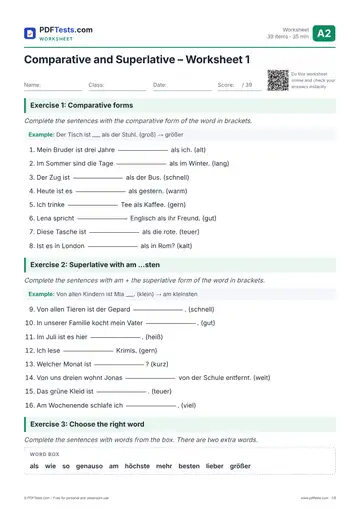
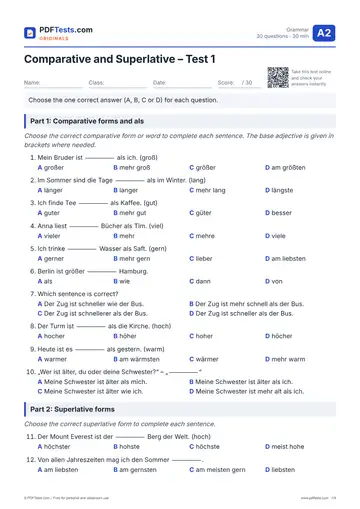
German uses the comparative (Komparativ) to compare two things and the superlative (Superlativ) to say that something is at the top of a group. You form the comparative by adding -er to the adjective (schnell → schneller), and the superlative with am …-sten or der/die/das …-ste (am schnellsten, der schnellste Zug). Unlike English, German never uses more or most with long adjectives. Every adjective takes the endings.
When to use the comparative and superlative
Comparing two things: comparative + als
Use the comparative with als (than) to show a difference.
- Mein Bruder ist älter als ich. – My brother is older than me.
- Der Zug ist schneller als der Bus. – The train is faster than the bus.
- Heute ist es wärmer als gestern. – Today it is warmer than yesterday.
Saying two things are equal: so … wie
Use so + base adjective + wie (as … as) when there is no difference. Add nicht for not as … as.
- Lena ist so groß wie ihre Mutter. – Lena is as tall as her mother.
- Das Hotel ist nicht so teuer wie im letzten Jahr. – The hotel is not as expensive as last year.
The top of a group: superlative
Use the superlative when one thing is the most (or least) of all.
- Im Juli ist es am heißesten. – It is hottest in July.
- Das ist das beste Restaurant in der Stadt. – That is the best restaurant in town.
Form: the basic pattern
| Base form | Comparative (+ -er) | Superlative (am + -sten) |
|---|---|---|
| schnell (fast) | schneller | am schnellsten |
| klein (small) | kleiner | am kleinsten |
| billig (cheap) | billiger | am billigsten |
| schön (beautiful) | schöner | am schönsten |
| interessant (interesting) | interessanter | am interessantesten |
| langweilig (boring) | langweiliger | am langweiligsten |
Notice that long adjectives such as interessant and langweilig follow exactly the same rule. German says interessanter, never mehr interessant.
Spelling rules
Umlaut in short adjectives
Many common one-syllable adjectives with a, o or u add an umlaut in both forms.
| Base form | Comparative | Superlative |
|---|---|---|
| alt (old) | älter | am ältesten |
| jung (young) | jünger | am jüngsten |
| lang (long) | länger | am längsten |
| kurz (short) | kürzer | am kürzesten |
| warm (warm) | wärmer | am wärmsten |
| kalt (cold) | kälter | am kältesten |
| groß (big, tall) | größer | am größten |
| stark (strong) | stärker | am stärksten |
| arm (poor) | ärmer | am ärmsten |
| oft (often) | öfter | am öftesten |
Not every short adjective does this: klar → klarer, froh → froher, laut → lauter. Learn the umlaut forms as vocabulary.
Extra -e- in the superlative: -esten
If the adjective ends in -t, -d, -s, -ß, -z, -sch or -x, add -esten so the word is easy to pronounce.
- alt → am ältesten
- heiß → am heißesten (hottest)
- kurz → am kürzesten
- hübsch → am hübschesten (prettiest)
- interessant → am interessantesten
- neu → am neuesten (also am neusten)
Important exception: groß → am größten (not am größesten).
Adjectives ending in -el and -er
These drop the e in the comparative.
- dunkel → dunkler → am dunkelsten (dark)
- teuer → teurer → am teuersten (expensive)
Die Wohnung ist teurer als das Haus. – The flat is more expensive than the house.
Irregular forms
A few very frequent words are irregular. You need them every day, so learn them by heart.
| Base form | Comparative | Superlative |
|---|---|---|
| gut (good) | besser | am besten |
| viel (much, many) | mehr | am meisten |
| gern (gladly, like to) | lieber | am liebsten |
| hoch (high) | höher | am höchsten |
| nah (near) | näher | am nächsten |
- Ich spreche besser Englisch als Französisch. – I speak English better than French.
- Ich trinke gern Tee, aber lieber Kaffee. Am liebsten trinke ich Wasser. – I like tea, but I prefer coffee. Most of all, I like water.
- Wer arbeitet am meisten? – Who works the most?
Mehr never takes an ending: Ich brauche mehr Zeit. – I need more time.
Hoch loses its c before an ending: Der Berg ist hoch, but ein hoher Berg, ein höherer Berg, der höchste Berg.
Two forms of the superlative
am …-sten: after the verb
Use am + -sten when the superlative comes after the verb, especially with verbs other than sein, and when it describes how someone does something.
- Paul läuft am schnellsten. – Paul runs the fastest.
- Im Winter ist der Strand am ruhigsten. – The beach is quietest in winter.
der/die/das …-ste: before a noun
When the superlative comes before a noun, use the article and an adjective ending (usually -e or -en).
- Das ist der schnellste Zug. – That is the fastest train.
- Sie ist die beste Spielerin im Team. – She is the best player on the team.
- Wir nehmen das billigste Zimmer. – We’ll take the cheapest room.
- Ich wohne in der größten Stadt Österreichs. – I live in the biggest city in Austria.
After sein, both forms are possible when a noun is understood: Dieser Zug ist am schnellsten. / Dieser Zug ist der schnellste.
Comparatives before a noun
A comparative in front of a noun also needs a normal adjective ending after the -er.
- Haben Sie ein billigeres Zimmer? – Do you have a cheaper room?
- Wir suchen eine größere Wohnung. – We’re looking for a bigger flat.
- Ich möchte einen kleineren Tisch. – I’d like a smaller table.
These endings work exactly like other adjective endings. If you want the full system, read our guide to German adjective endings.
Signal words and useful phrases
- als – than: größer als
- so … wie / nicht so … wie – as … as / not as … as
- viel – much: viel teurer (much more expensive)
- noch – even: noch besser (even better)
- etwas / ein bisschen – a bit: etwas kälter (a bit colder)
- immer + comparative – more and more: Die Mieten werden immer teurer. – Rents are getting more and more expensive.
- doppelt so … wie – twice as … as: Das Ticket ist doppelt so teuer wie letztes Jahr. – The ticket is twice as expensive as last year.
After als and wie, a pronoun stays in the nominative: Sie ist älter als ich. – She is older than me.
als or wie?
This is the most common area of confusion.
| Meaning | Structure | Example |
|---|---|---|
| different | comparative + als | Tom ist größer als Max. – Tom is taller than Max. |
| equal | so + base form + wie | Tom ist so groß wie Max. – Tom is as tall as Max. |
| not equal | nicht so + base form + wie | Tom ist nicht so groß wie Max. – Tom is not as tall as Max. |
Simple rule: -er → als, so → wie. In casual speech you may hear größer wie, but this is not standard German and counts as an error in exams.
Common mistakes
- ✗ Berlin ist größer wie München. → ✓ Berlin ist größer als München. A comparative with -er needs als.
- ✗ Er ist so alt als ich. → ✓ Er ist so alt wie ich. so … wie always goes together.
- ✗ Der Film ist mehr interessant. → ✓ Der Film ist interessanter. German never uses mehr to build a comparative.
- ✗ Meine Schwester ist alter als ich. → ✓ Meine Schwester ist älter als ich. alt takes an umlaut.
- ✗ Das ist guter / am gutesten. → ✓ Das ist besser / am besten. gut is irregular.
- ✗ Ich trinke mehr gern Tee. → ✓ Ich trinke lieber Tee. The comparative of gern is lieber.
- ✗ Sie singt die beste. → ✓ Sie singt am besten. Use am …-sten after a verb with no noun.
- ✗ Das ist am teuersten Hotel. → ✓ Das ist das teuerste Hotel. Before a noun, use the article + -ste.
- ✗ Er ist am größesten. → ✓ Er ist am größten. groß is an exception to the -esten rule.
- ✗ der höchere Berg → ✓ der höhere Berg. hoch drops the c before an ending.
- ✗ Er ist größer als mich. → ✓ Er ist größer als ich. The pronoun after als stays in the nominative.
Quick check
Complete the sentences.
- Mein Fahrrad ist schnell, aber dein Fahrrad ist noch ___ . (schnell)
- Anna ist so alt ___ Ben.
- Im Januar ist es ___ als im Mai. (kalt)
- Ich esse gern Pizza, aber ___ esse ich Pasta. (gern – superlative)
- Die Zugspitze ist der ___ Berg in Deutschland. (hoch)
Answers
- schneller – My bike is fast, but your bike is even faster.
- wie – Anna is as old as Ben.
- kälter – In January it is colder than in May.
- am liebsten – I like pizza, but most of all I like pasta.
- höchste – The Zugspitze is the highest mountain in Germany.
Next step
Now put the rules into practice: test yourself with our A2 Comparative and Superlative test and check that you can choose between als and wie, add umlauts correctly and use the irregular forms without thinking. Comparisons come up all the time when you talk about prices, hotels and products, so the A2 Travel and Shopping test is a good way to see them in context. When you feel confident, browse the other German A2 tests, and move on to German adjective endings to master forms like ein billigeres Zimmer and der schnellste Zug in every case.
Was this page helpful?
What was the problem?
Thank you for your feedback!