PDFTests Originals

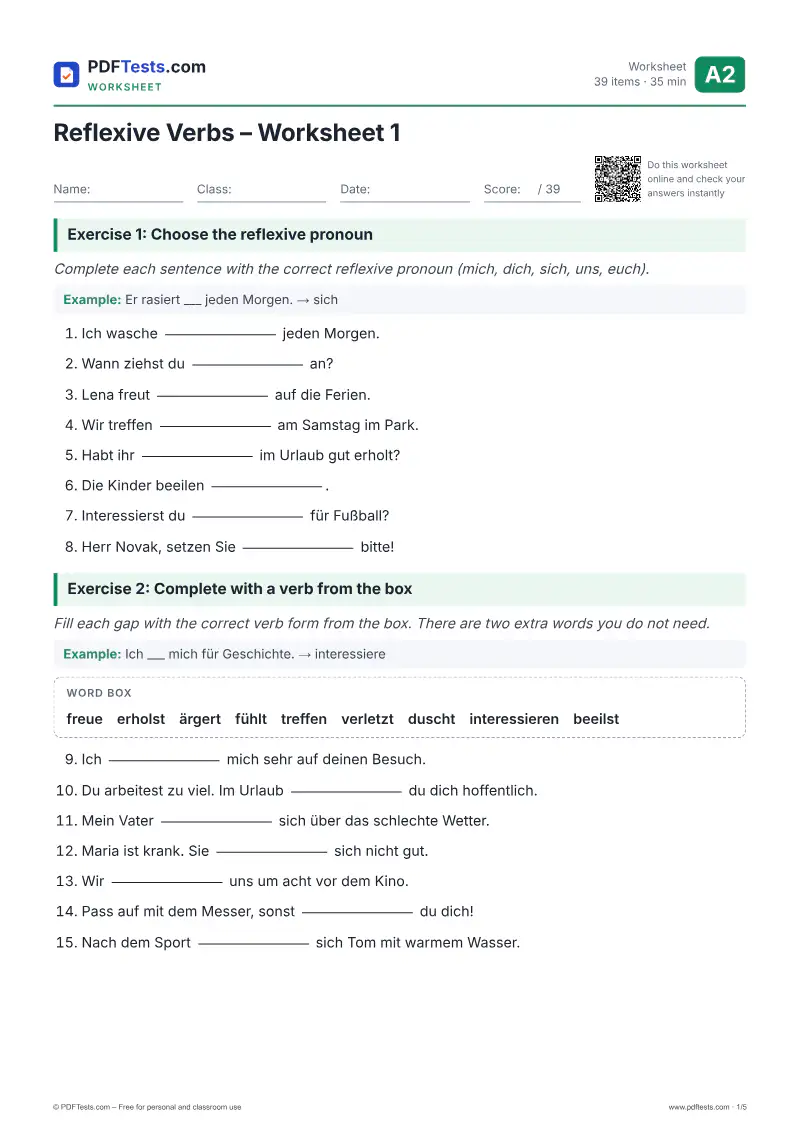
Reflexive Verbs – Worksheet 1

A2 Elementary WorksheetGerman

This worksheet practises German reflexive verbs such as sich freuen, sich waschen and sich treffen. Learners choose the correct reflexive pronoun (mich, dich, sich, mir, dir…) and use reflexive verbs in statements, negatives, questions and the perfect tense. It is designed for A2 learners in class or at home.
items
39
Time
35 min
PDF
5 pages
Answer key
Included
  • 100% free
  • No sign-up or email
  • Print-ready A4 PDF
Preview of page 1 of Reflexive Verbs – Worksheet 1 Open PDF
New to this topic? Read the guide first: German Reflexive Verbs: Pronouns, Word Order and Common Mistakes

Do the worksheet online

Type your answers, then press “Check my answers”. Alternative correct answers are accepted.

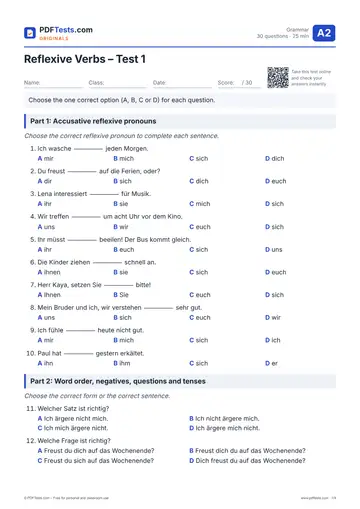
Exercise 1: Choose the reflexive pronoun

Complete each sentence with the correct reflexive pronoun (mich, dich, sich, uns, euch).

Example: Er rasiert ___ jeden Morgen. → sich

  1. Ich wasche jeden Morgen.

  2. Wann ziehst du an?

  3. Lena freut auf die Ferien.

  4. Wir treffen am Samstag im Park.

  5. Habt ihr im Urlaub gut erholt?

  6. Die Kinder beeilen .

  7. Interessierst du für Fußball?

  8. Herr Novak, setzen Sie bitte!

Exercise 2: Complete with a verb from the box

Fill each gap with the correct verb form from the box. There are two extra words you do not need.

Example: Ich ___ mich für Geschichte. → interessiere

Word box freueerholstärgertfühlttreffenverletztduschtinteressierenbeeilst

  1. Ich mich sehr auf deinen Besuch.

  2. Du arbeitest zu viel. Im Urlaub du dich hoffentlich.

  3. Mein Vater sich über das schlechte Wetter.

  4. Maria ist krank. Sie sich nicht gut.

  5. Wir uns um acht vor dem Kino.

  6. Pass auf mit dem Messer, sonst du dich!

  7. Nach dem Sport sich Tom mit warmem Wasser.

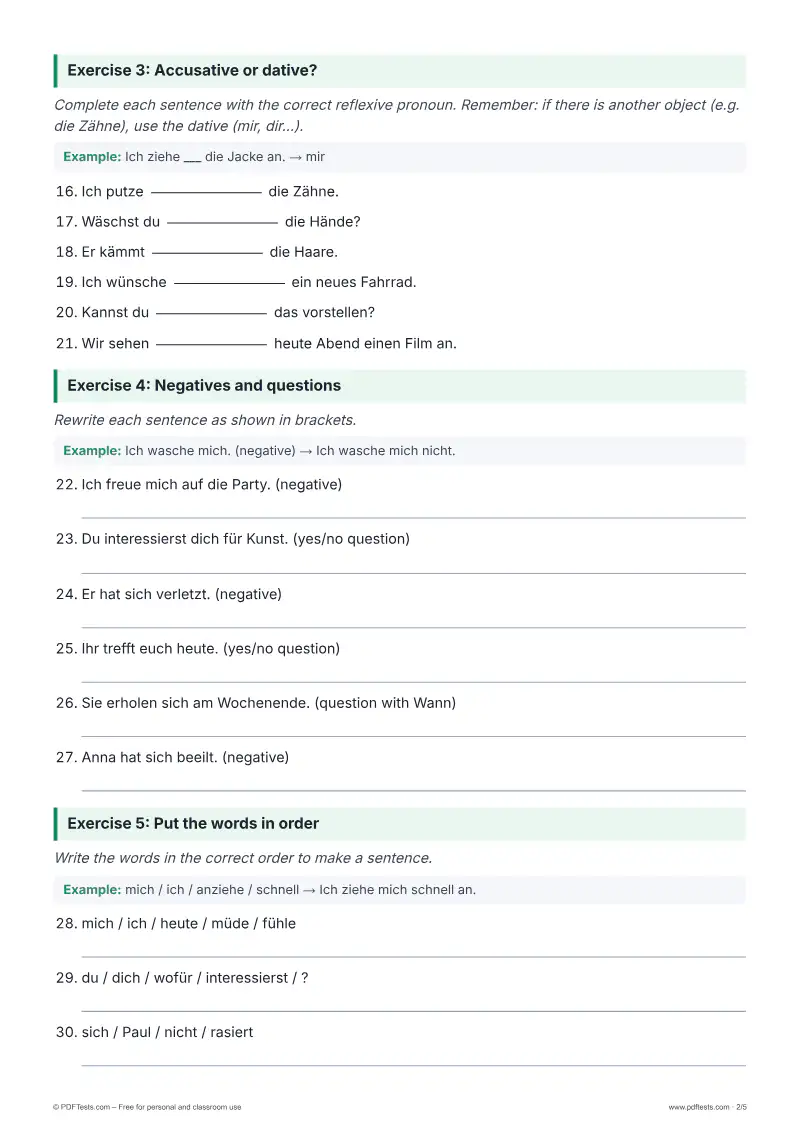
Exercise 3: Accusative or dative?

Complete each sentence with the correct reflexive pronoun. Remember: if there is another object (e.g. die Zähne), use the dative (mir, dir…).

Example: Ich ziehe ___ die Jacke an. → mir

  1. Ich putze die Zähne.

  2. Wäschst du die Hände?

  3. Er kämmt die Haare.

  4. Ich wünsche ein neues Fahrrad.

  5. Kannst du das vorstellen?

  6. Wir sehen heute Abend einen Film an.

Exercise 4: Negatives and questions

Rewrite each sentence as shown in brackets.

Example: Ich wasche mich. (negative) → Ich wasche mich nicht.

  1. Ich freue mich auf die Party. (negative)

  2. Du interessierst dich für Kunst. (yes/no question)

  3. Er hat sich verletzt. (negative)

  4. Ihr trefft euch heute. (yes/no question)

  5. Sie erholen sich am Wochenende. (question with Wann)

  6. Anna hat sich beeilt. (negative)

Exercise 5: Put the words in order

Write the words in the correct order to make a sentence.

Example: mich / ich / anziehe / schnell → Ich ziehe mich schnell an.

  1. mich / ich / heute / müde / fühle

  2. du / dich / wofür / interessierst / ?

  3. sich / Paul / nicht / rasiert

  4. haben / uns / wir / gestern / getroffen

  5. euch / beeilt / bitte / !

  6. sich / am Abend / die Kinder / waschen

Exercise 6: Find and correct the mistake

Each sentence has one mistake. Write the correct sentence.

Example: Du wäschst sich. → Du wäschst dich.

  1. Ich freue sich auf das Wochenende.

  2. Wir ziehen sich schnell an.

  3. Ich putze mich die Zähne.

  4. Er ist sich gestern verletzt.

  5. Interessierst du für Musik dich?

  6. Ihr erholt uns im Urlaub.

Was this page helpful?

Report a mistake

Spotted a wrong answer, a typo or an unclear explanation? Tell us and we will fix it.

Preview

About this test

Printable A2 German worksheet on reflexive verbs: accusative and dative reflexive pronouns, word order, negatives, questions and the perfect tense.

Topics covered

Reflexive pronouns (accusative)Reflexive pronouns (dative)Word order with reflexive verbsNegatives and questionsReflexive verbs in the perfect tense

Notes for teachers

Start by revising the pronoun table on the board, highlighting that only ich and du change between accusative (mich/dich) and dative (mir/dir). Before Exercise 3, point out the rule: if there is another object, such as die Zähne, the reflexive pronoun is dative. Typical mistakes are using sich for every person, putting nicht before the reflexive pronoun, and forming the perfect tense with sein instead of haben. As a follow-up, learners can describe their morning routine in 6–8 sentences using at least five reflexive verbs.

All German A2 tests →