PDFTests Originals

Two-way Prepositions (Wechselpräpositionen) – Worksheet 1

A2 Elementary WorksheetGerman

This worksheet practises the nine German two-way prepositions (an, auf, hinter, in, neben, über, unter, vor, zwischen). It contrasts position (Wo? + dative) with movement (Wohin? + accusative), the verb pairs liegen/legen, stehen/stellen, sitzen/setzen and hängen, contractions like im and ins, and questions and negatives. It is designed for A2 learners in class or at home.
items
40
Time
35 min
PDF
5 pages
Answer key
Included
  • 100% free
  • No sign-up or email
  • Print-ready A4 PDF
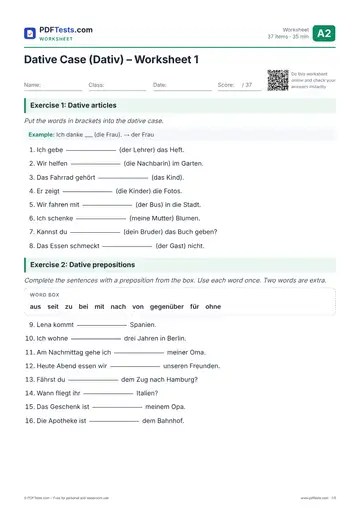
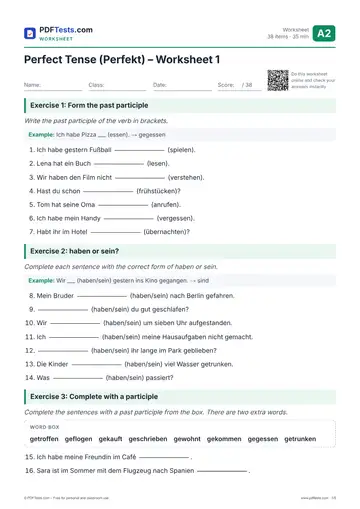
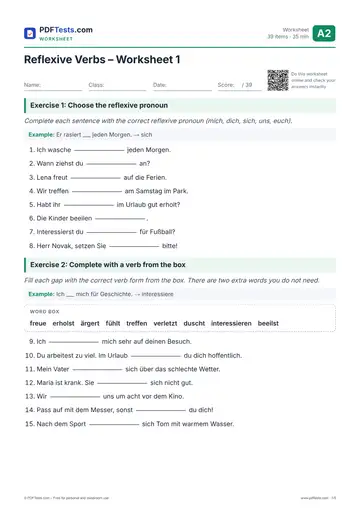
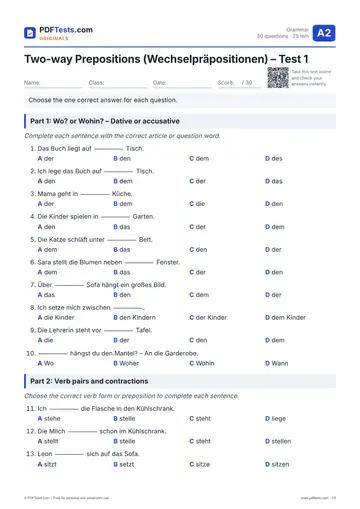
Preview of page 1 of Two-way Prepositions (Wechselpräpositionen) – Worksheet 1 Open PDF
New to this topic? Read the guide first: Two-way Prepositions in German (Wechselpräpositionen): Rules, Examples and Common Mistakes

Do the worksheet online

Type your answers, then press “Check my answers”. Alternative correct answers are accepted.

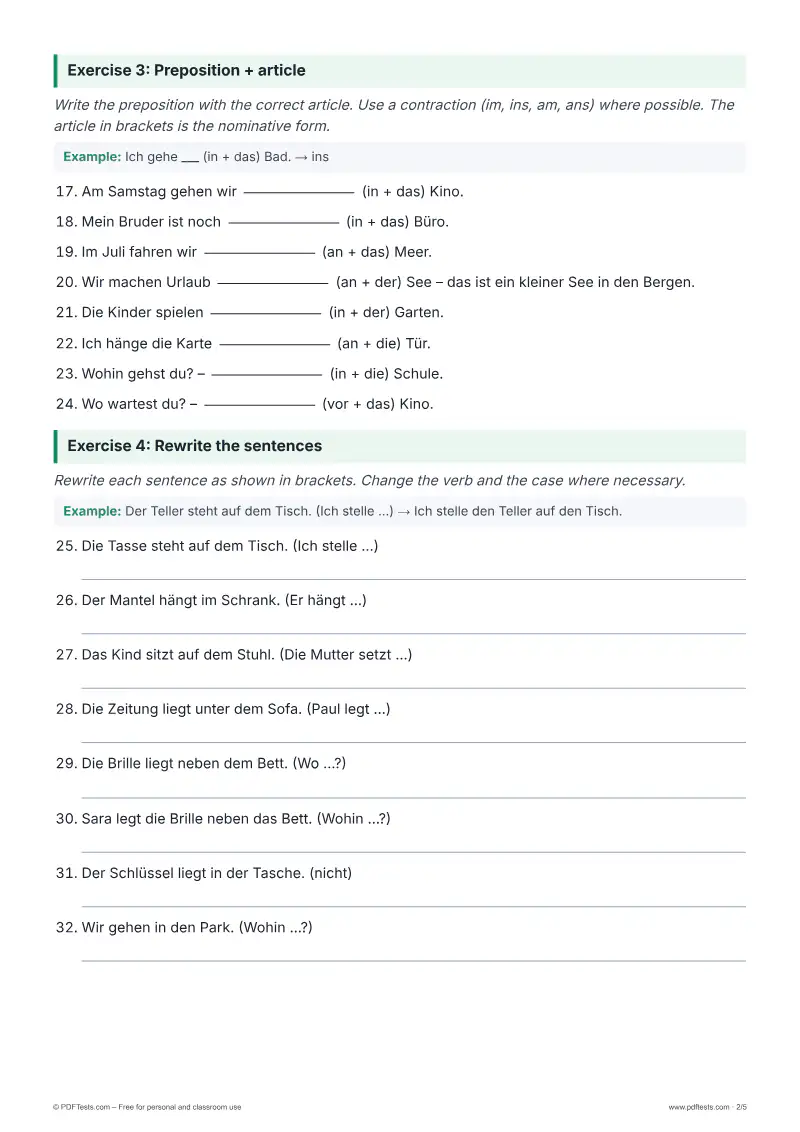
Exercise 1: Dative or accusative?

Complete each sentence with the correct form of the article in brackets. Ask yourself: Wo? (dative) or Wohin? (accusative)?

Example: Das Buch liegt in ___ (die) Tasche. → der

  1. Die Katze schläft unter (das) Sofa.

  2. Ich lege das Handy auf (der) Tisch.

  3. Das Bild hängt an (die) Wand.

  4. Max stellt die Lampe neben (das) Bett.

  5. Das Auto steht vor (das) Haus.

  6. Lena setzt sich zwischen (die, plural) Kinder.

  7. Die Lampe hängt über (der) Tisch.

  8. Der Hund liegt hinter (die) Tür.

Exercise 2: Position or movement?

Complete the sentences with a verb from the box. Use each verb once. There are two extra verbs.

Example: Ich ___ den Teller auf den Tisch. → stelle

Word box legtliegtstelltstehtsitztsetzthängtliegenstehengelegt

  1. Anna das Buch auf den Tisch.

  2. Das Buch jetzt auf dem Tisch.

  3. Der Kellner die Gläser auf den Tisch.

  4. Die Vase auf dem Regal.

  5. Opa auf dem Sofa und liest.

  6. Das Kind sich neben seine Mutter.

  7. Das Foto an der Wand.

  8. Wo meine Schlüssel? – Auf dem Tisch.

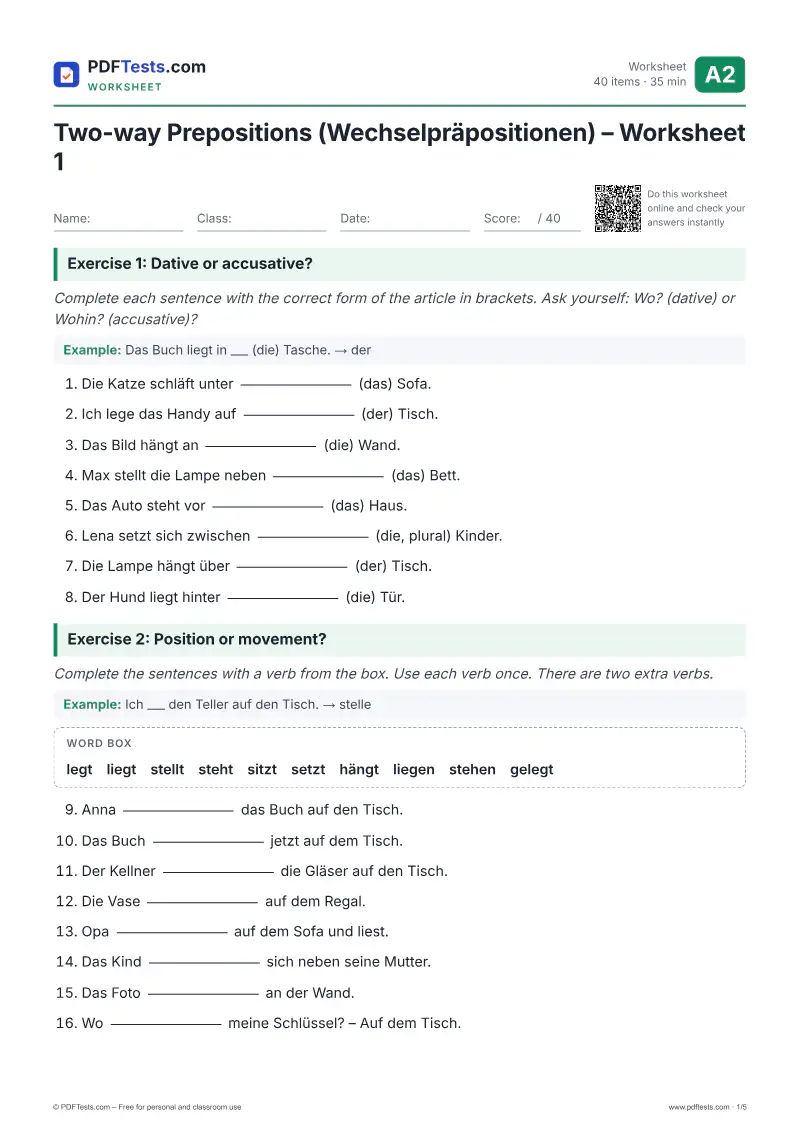
Exercise 3: Preposition + article

Write the preposition with the correct article. Use a contraction (im, ins, am, ans) where possible. The article in brackets is the nominative form.

Example: Ich gehe ___ (in + das) Bad. → ins

  1. Am Samstag gehen wir (in + das) Kino.

  2. Mein Bruder ist noch (in + das) Büro.

  3. Im Juli fahren wir (an + das) Meer.

  4. Wir machen Urlaub (an + der) See – das ist ein kleiner See in den Bergen.

  5. Die Kinder spielen (in + der) Garten.

  6. Ich hänge die Karte (an + die) Tür.

  7. Wohin gehst du? – (in + die) Schule.

  8. Wo wartest du? – (vor + das) Kino.

Exercise 4: Rewrite the sentences

Rewrite each sentence as shown in brackets. Change the verb and the case where necessary.

Example: Der Teller steht auf dem Tisch. (Ich stelle ...) → Ich stelle den Teller auf den Tisch.

  1. Die Tasse steht auf dem Tisch. (Ich stelle ...)

  2. Der Mantel hängt im Schrank. (Er hängt ...)

  3. Das Kind sitzt auf dem Stuhl. (Die Mutter setzt ...)

  4. Die Zeitung liegt unter dem Sofa. (Paul legt ...)

  5. Die Brille liegt neben dem Bett. (Wo ...?)

  6. Sara legt die Brille neben das Bett. (Wohin ...?)

  7. Der Schlüssel liegt in der Tasche. (nicht)

  8. Wir gehen in den Park. (Wohin ...?)

Exercise 5: Find the mistake

Each sentence has one mistake. Write the correct sentence.

Example: Ich lege den Löffel in der Schublade. → Ich lege den Löffel in die Schublade.

  1. Ich stelle die Blumen auf dem Tisch.

  2. Die Katze liegt auf das Bett.

  3. Wir gehen heute in der Stadt.

  4. Das Bild hängt über den Sofa.

  5. Wohin wohnst du?

  6. Lisa setzt sich neben mir.

  7. Der Bus wartet nicht vor die Schule.

  8. Sie legt das Handy in der Tasche.

Was this page helpful?

Report a mistake

Spotted a wrong answer, a typo or an unclear explanation? Tell us and we will fix it.

Preview

About this test

Printable A2 German worksheet on two-way prepositions (Wechselpräpositionen): accusative vs dative, wo/wohin, liegen/legen, stehen/stellen.

Topics covered

Two-way prepositionsAccusative vs dativeWo? and Wohin?liegen/legen, stehen/stellen, sitzen/setzenContractions im, ins, am, ans

Notes for teachers

Start by moving real objects around the classroom and asking 'Wo ist das Buch?' and 'Wohin lege ich das Buch?' so learners connect movement with the accusative and position with the dative. A common mistake is using the dative after movement verbs such as legen, stellen and gehen. Learners also confuse the verb pairs (liegen vs legen), mix up im and ins, and use the dative after neben with pronouns (neben mir instead of neben mich). As a follow-up, learners can describe their own room in five sentences and then explain where they put things when they tidy it.

All German A2 tests →