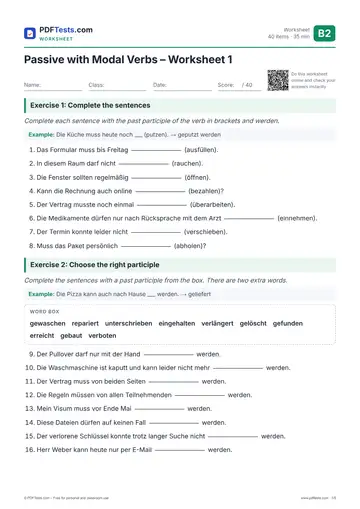
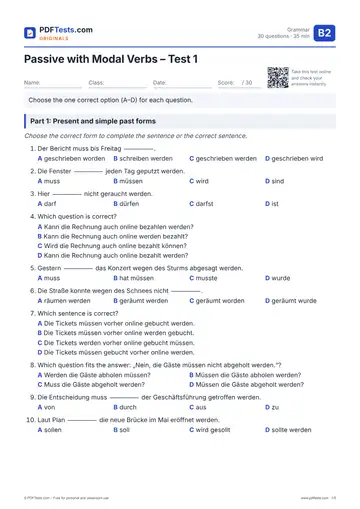
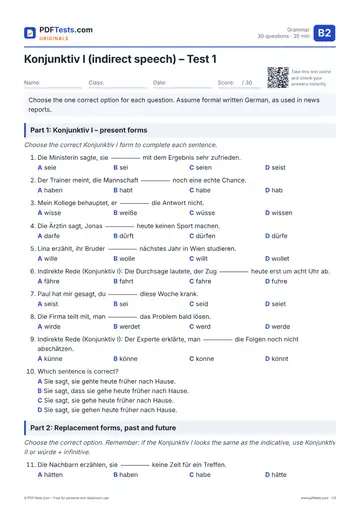
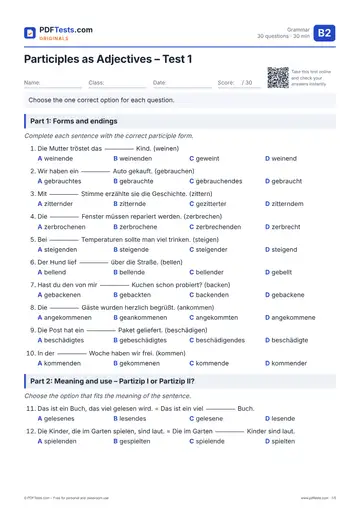
The passive with modal verbs combines a modal verb (können, müssen, dürfen, sollen, wollen) with a passive infinitive: Partizip II + werden. You use it to say what can, must, may or should be done when the action matters more than the person doing it. It is very common in rules, instructions, official letters, news reports and workplace German.
- Der Vertrag muss bis Freitag unterschrieben werden. – The contract must be signed by Friday.
How the structure works
Start with a normal passive sentence. When you add a modal verb, the modal takes the conjugated position, and werden moves to the end as an infinitive.
- Die Rechnung wird bezahlt. – The bill is (being) paid.
- Die Rechnung muss bezahlt werden. – The bill must be paid.
The pattern is:
subject + modal verb (position 2) + … + Partizip II + werden
The modal verb agrees with the subject:
- Die Rechnungen müssen sofort bezahlt werden. – The bills must be paid immediately.
If you need to revise the basic structure first, read our guide to the German passive voice. For the meanings of each modal, see the modal verbs guide.
When to use it
Rules and obligations
Müssen and dürfen are typical in regulations, signs and instructions.
- Der Antrag muss persönlich abgegeben werden. – The application must be submitted in person.
- Die Medikamente dürfen nicht über 25 Grad gelagert werden. – The medication must not be stored above 25 degrees.
Possibility and ability
Können expresses what is possible.
- Tickets können auch online gekauft werden. – Tickets can also be bought online.
- Der Fehler konnte schnell behoben werden. – The error could be fixed quickly.
Recommendations, plans and expectations
Sollen (and sollte) express what is planned, expected or advisable.
- Die neue Straße soll nächstes Jahr gebaut werden. – The new road is to be built next year.
- Das Thema sollte im Meeting besprochen werden. – The topic should be discussed in the meeting.
Impersonal passive
Verbs without an accusative object can still form a passive with modals. The sentence then has no subject, and the modal is always singular. Es can fill position 1, but it disappears when another element comes first.
- Hier darf nicht geraucht werden. – Smoking is not allowed here.
- Es muss endlich etwas getan werden. – Something finally has to be done.
With dative verbs (helfen, danken, antworten, gratulieren), the dative object stays in the dative:
- Den Betroffenen muss schnell geholfen werden. – The people affected must be helped quickly.
Form in the present tense
| Type | Example | Translation |
|---|---|---|
| Affirmative | Das Formular muss online ausgefüllt werden. | The form must be filled in online. |
| Negative | Das Formular muss nicht ausgedruckt werden. | The form doesn’t have to be printed. |
| Yes/no question | Muss das Formular unterschrieben werden? | Does the form have to be signed? |
| W-question | Bis wann muss das Formular abgegeben werden? | By when does the form have to be handed in? |
| Subordinate clause | Ich weiß nicht, ob das Formular unterschrieben werden muss. | I don’t know whether the form has to be signed. |
In a subordinate clause, the conjugated modal goes to the very end, after werden: Partizip II + werden + modal.
Adding the agent
Use von + dative for the person or organisation, and durch + accusative for a means, method or cause.
- Die Entscheidung kann nur vom Vorstand getroffen werden. – The decision can only be made by the board.
- Viele Schäden können durch regelmäßige Wartung vermieden werden. – A lot of damage can be avoided through regular maintenance.
Other tenses
| Tense | Pattern | Example | Translation |
|---|---|---|---|
| Präsens | muss + P II + werden | Die Brücke muss renoviert werden. | The bridge must be renovated. |
| Präteritum | musste + P II + werden | Die Brücke musste renoviert werden. | The bridge had to be renovated. |
| Perfekt | hat + P II + werden + müssen | Die Brücke hat renoviert werden müssen. | The bridge has had to be renovated. |
| Plusquamperfekt | hatte + P II + werden + müssen | Die Brücke hatte renoviert werden müssen. | The bridge had had to be renovated. |
| Konjunktiv II (present) | müsste + P II + werden | Die Brücke müsste renoviert werden. | The bridge ought to be renovated. |
| Konjunktiv II (past) | hätte + P II + werden + müssen | Die Brücke hätte renoviert werden müssen. | The bridge should have been renovated. |
Three points to remember:
- For the past, the Präteritum (musste, konnte, sollte) is far more common than the Perfekt, even in speech.
- In the Perfekt and Plusquamperfekt, the modal appears as an infinitive (müssen, not gemusst). This is the double infinitive, or Ersatzinfinitiv.
- The auxiliary is always haben, because it belongs to the modal verb.
Subordinate clauses with hat and hätte
When the double infinitive appears in a subordinate clause, the auxiliary does not go to the end. It comes before the whole verb group:
- Ich ärgere mich, weil die Straße schon wieder hat gesperrt werden müssen. – I’m annoyed because the road has had to be closed again.
- Alle wissen, dass das Problem früher hätte gelöst werden können. – Everyone knows that the problem could have been solved earlier.
Konjunktiv II for criticism and suggestions
The Konjunktiv II forms are extremely useful at B2 for polite suggestions and criticism of past decisions:
- Das müsste noch einmal geprüft werden. – That ought to be checked again.
- Das hätte vorher geklärt werden müssen. – That should have been clarified beforehand.
- Der Unfall hätte verhindert werden können. – The accident could have been prevented.
müssen nicht or dürfen nicht
The negative meanings are a classic trap for English speakers, because must not and doesn’t have to are easy to mix up.
| German | Meaning | Example | Translation |
|---|---|---|---|
| nicht müssen | not necessary | Das muss nicht heute erledigt werden. | That doesn’t have to be done today. |
| nicht dürfen | forbidden | Die Daten dürfen nicht weitergegeben werden. | The data must not be passed on. |
| nicht können | not possible | Die Datei kann nicht geöffnet werden. | The file cannot be opened. |
From active to passive
Sentences with man + modal are the most common starting point:
- Man muss die Fenster schließen. → Die Fenster müssen geschlossen werden. – The windows must be closed.
The steps:
- The accusative object (die Fenster) becomes the nominative subject.
- The modal agrees with the new subject (muss → müssen).
- The main verb becomes Partizip II + werden at the end.
- Man disappears completely.
Both versions are correct. The man version sounds more conversational; the passive sounds more formal and is typical in writing.
Don’t confuse it with
werden as a full verb or future auxiliary
After a modal, werden can also mean become. The difference is whether there is a Partizip II.
- Sie will Ärztin werden. – She wants to become a doctor. (full verb)
- Sie muss sofort operiert werden. – She has to be operated on immediately. (passive)
Process vs state: werden or sein
Partizip II + sein after a modal describes a finished result (Zustandspassiv), not the action itself.
- Die Arbeit muss bis Montag erledigt werden. – The work must be done by Monday. (the action has to happen)
- Die Arbeit muss bis Montag erledigt sein. – The work must be finished by Monday. (the result must exist)
Alternatives with the same meaning
Formal German often replaces the modal passive with other structures:
- Der Antrag ist bis Freitag zu stellen. = Der Antrag muss bis Freitag gestellt werden. – The application must be submitted by Friday.
- Das Problem lässt sich lösen. = Das Problem kann gelöst werden. – The problem can be solved.
These are covered in detail in our guide to alternatives to the passive.
Signal words and typical phrases
The modal passive often appears with time and urgency expressions: unbedingt, sofort, rechtzeitig, vorher, bis (+ date), spätestens, nur, leider nicht.
Learn these fixed phrases as chunks; they are common in B2 exams and at work:
- Es muss noch geklärt werden, ob … – It still needs to be clarified whether …
- Das kann nicht ausgeschlossen werden. – That cannot be ruled out.
- Das darf nicht unterschätzt werden. – That must not be underestimated.
- Es sollte berücksichtigt werden, dass … – It should be taken into account that …
Common mistakes
- ✗ Die Tür muss geschlossen wird. → ✓ Die Tür muss geschlossen werden. – After a modal, werden must be an infinitive.
- ✗ Die Tür muss werden geschlossen. → ✓ Die Tür muss geschlossen werden. – The participle comes before werden.
- ✗ Die Fenster muss geputzt werden. → ✓ Die Fenster müssen geputzt werden. – The modal agrees with the plural subject.
- ✗ Die Kinder müssen geholfen werden. → ✓ Den Kindern muss geholfen werden. – Helfen takes the dative, which stays dative in the passive.
- ✗ Hier darf man nicht geraucht werden. → ✓ Hier darf nicht geraucht werden. – Man disappears in the passive.
- ✗ Das Auto hat repariert werden gemusst. → ✓ Das Auto hat repariert werden müssen. – The Perfekt uses the double infinitive.
- ✗ …, dass das Auto repariert werden müssen hat. → ✓ …, dass das Auto hat repariert werden müssen. – Hat comes before the double infinitive.
- ✗ Das Projekt ist gestern abgeschlossen werden müssen. → ✓ Das Projekt hat gestern abgeschlossen werden müssen. – The auxiliary is always haben with modals.
Quick check
- Rewrite in the passive: Man muss den Antrag online stellen.
- Fill the gap: Die Fenster ___ jeden Morgen geöffnet werden. (müssen)
- Put into the Präteritum: Das Problem kann nicht gelöst werden.
- Translate using Konjunktiv II: The software should have been tested better.
- Complete the subordinate clause in the Perfekt: Ich weiß, dass die Wohnung ___. (renovieren, müssen)
Answers
- Der Antrag muss online gestellt werden.
- müssen
- Das Problem konnte nicht gelöst werden.
- Die Software hätte besser getestet werden müssen.
- Ich weiß, dass die Wohnung hat renoviert werden müssen.
Next step
Now put the rules into practice with our B2 Passive with Modal Verbs test, which mixes present, past and Konjunktiv II forms as well as subordinate clauses. If you notice that the basic passive with werden still causes problems, go back one step and work through the B1 Passive Voice test first, then return to the modal forms.
Was this page helpful?
What was the problem?
Thank you for your feedback!