German can put both participles in front of a noun and use them like ordinary adjectives. Partizip I (lachend) describes an active, ongoing action: das lachende Kind means the laughing child. Partizip II (repariert, geschlossen) usually describes something completed or done to the noun: das reparierte Auto means the repaired car.
In front of a noun, participles take normal adjective endings. They let you shrink a whole relative clause into one word, which makes them common in news, reports and B2 exam texts.
The two participles at a glance
| Partizip I | Partizip II | |
|---|---|---|
| Form | infinitive + -d | ge-…-t / ge-…-en |
| Meaning | active, happening at the same time | passive and completed, or a completed change |
| Example | die schlafende Katze | die geschlossene Tür |
| English | the sleeping cat | the closed door |
Partizip I: form and meaning
Formation
Take the infinitive and add -d. That is the whole rule.
| Infinitive | Partizip I | Example | English |
|---|---|---|---|
| warten | wartend | die wartenden Fahrgäste | the waiting passengers |
| lächeln | lächelnd | eine lächelnde Verkäuferin | a smiling shop assistant |
| ankommen | ankommend | die ankommenden Gäste | the arriving guests |
| tun | tuend | doing (rare) | |
| sich nähern | sich nähernd | das sich nähernde Gewitter | the approaching storm |
Separable verbs stay together in one word (ankommend). Reflexive verbs keep their pronoun, which goes before the participle (das sich nähernde Gewitter).
Meaning
Partizip I is always active: the noun is doing the action. The action happens at the same time as the main event in the sentence.
- Die wartenden Fahrgäste wurden über die Verspätung informiert. — The waiting passengers were informed about the delay.
- Viele Familien leiden unter den steigenden Mieten. — Many families are suffering from rising rents.
- Der Hund lief zu dem weinenden Kind. — The dog ran to the crying child.
Each of these replaces a relative clause in the present: das Kind, das weint becomes das weinende Kind.
Partizip II: form and meaning
Formation
You already know this form from the Perfekt. If you need a refresher, see our guide to the Perfect Tense (Perfekt).
| Verb type | Infinitive | Partizip II | Example | English |
|---|---|---|---|---|
| regular | kaufen | gekauft | das gekaufte Ticket | the purchased ticket |
| irregular | schreiben | geschrieben | ein geschriebener Text | a written text |
| separable | einladen | eingeladen | die eingeladenen Gäste | the invited guests |
| -ieren | reparieren | repariert | das reparierte Auto | the repaired car |
| inseparable | verkaufen | verkauft | die verkauften Wohnungen | the sold flats |
Meaning 1: passive (transitive verbs)
With verbs that take an accusative object, Partizip II has a passive meaning. Something has been done to the noun.
- Die Polizei hat das gestohlene Fahrrad gefunden. — The police found the stolen bike.
- Bitte legen Sie die ausgefüllten Formulare auf den Tisch. — Please put the completed forms on the table.
Das gestohlene Fahrrad means das Fahrrad, das gestohlen worden ist.
Meaning 2: completed change (verbs with sein)
Some intransitive verbs form the Perfekt with sein and describe a change of state. With these verbs, Partizip II is active and completed: the noun did it, and it is finished.
- Die gestiegenen Preise ärgern viele Kunden. — The increased prices annoy many customers.
- Der verspätet angekommene Zug fährt gleich weiter. — The train that arrived late is leaving again shortly.
- Wir haben das eingeschlafene Baby ins Bett gelegt. — We put the baby, who had fallen asleep, to bed.
Intransitive verbs that form the Perfekt with haben cannot be used this way. Der geschlafene Mann is wrong. Use Partizip I (der schlafende Mann) or a relative clause (der Mann, der geschlafen hat).
Reflexive verbs
With Partizip II, the reflexive pronoun disappears:
- sich verlieben → das verliebte Paar — the couple in love
- sich erholen → die erholten Urlauber — the rested holidaymakers
Endings: participles behave like adjectives
In front of a noun, a participle takes exactly the same endings as any other adjective. The ending depends on the article, gender, case and number. If these still feel shaky, review our guide to Adjective Endings first.
| Case | Definite article | Indefinite article | Plural, no article |
|---|---|---|---|
| Nominative | der wartende Kunde | ein wartender Kunde | wartende Kunden |
| Accusative | den wartenden Kunden | einen wartenden Kunden | wartende Kunden |
| Dative | dem wartenden Kunden | einem wartenden Kunden | wartenden Kunden |
| Genitive | des wartenden Kunden | eines wartenden Kunden | wartender Kunden |
the waiting customer / a waiting customer / waiting customers
With Partizip II forms ending in -en, the adjective ending is added on top: geschrieben + -e → die geschriebene Nachricht (the written message). Do not drop either part.
From relative clause to participle
Turning relative clauses into participles is a typical B2 task. Ask yourself two questions. Is the noun doing the action or receiving it? Is the action ongoing or finished?
| Relative clause | Participle attribute | English |
|---|---|---|
| der Mann, der telefoniert | der telefonierende Mann | the man who is on the phone |
| die Fenster, die geputzt wurden | die geputzten Fenster | the cleaned windows |
| der Zug, der angekommen ist | der angekommene Zug | the train that has arrived |
| die Kinder, die spielen | die spielenden Kinder | the playing children |
- Active and ongoing → Partizip I
- Passive (transitive verb) → Partizip II
- Completed change (sein verb) → Partizip II
The Relative Clauses guide covers the long version if you want to compare.
You can also add extra information before the participle: der seit einer Stunde wartende Kunde (the customer who has been waiting for an hour). These longer structures are a C1 topic, explained in our guide to Extended Participle Attributes.
A note on zu + Partizip I
In formal texts you will also see zu + Partizip I with an ending. It expresses what must or can be done: die zu lösende Aufgabe (the task to be solved), ein nicht zu unterschätzendes Risiko (a risk not to be underestimated). At B2 you mainly need to recognise it.
Predicative and adverbial use
Participles can also appear after the verb or describe how something is done. In these positions they take no ending.
Partizip II after sein describes a state:
- Die Tür ist geschlossen. — The door is closed.
- Das Problem ist gelöst. — The problem is solved.
Partizip I after sein only works when the participle has become a real adjective:
- Der Film ist spannend. — The film is exciting.
- Die Arbeit war anstrengend. — The work was tiring.
You cannot say Das Kind ist weinend. German uses the verb instead: Das Kind weint. (The child is crying.)
Adverbial use describes the manner of an action:
- Sie verließ lachend den Raum. — She left the room laughing.
- Er kam völlig erschöpft nach Hause. — He came home completely exhausted.
Partizip I vs Partizip II: -end or ge-…-t?
Many participles are now everyday adjectives. They work much like English -ing and -ed adjectives. The Partizip I form describes the thing that causes a feeling. The Partizip II form describes the person who has the feeling.
| Partizip I (causes it) | Partizip II (feels it) |
|---|---|
| ein spannender Krimi — an exciting thriller | gespannte Zuschauer — eager viewers |
| eine überraschende Nachricht — surprising news | ein überraschter Kollege — a surprised colleague |
| eine enttäuschende Leistung — a disappointing performance | enttäuschte Fans — disappointed fans |
| eine verwirrende Anleitung — confusing instructions | ein verwirrter Kunde — a confused customer |
| ein überzeugendes Argument — a convincing argument | ein überzeugter Veganer — a committed vegan |
These adjectives also form comparatives and superlatives: Das Buch war spannender als der Film. (The book was more exciting than the film.)
Participles as nouns
Participles are often turned into nouns. They keep their adjective endings:
- der/die Reisende, ein Reisender, die Reisenden — the traveller(s)
- die Studierenden — the students
- der/die Angestellte, eine Angestellte — the employee
- Bei dem Unfall gab es drei Verletzte. — There were three injured people in the accident.
Common mistakes
- ✗ das weinend Kind → ✓ das weinende Kind — A participle in front of a noun always needs an adjective ending.
- ✗ die steigende Preise → ✓ die steigenden Preise — After die in the plural, the ending is -en.
- ✗ der geschlafene Hund → ✓ der schlafende Hund — Schlafen forms the Perfekt with haben, so its Partizip II cannot describe a noun.
- ✗ Ich bin spannend auf das Ergebnis. → ✓ Ich bin gespannt auf das Ergebnis. — The person who feels the tension is gespannt.
- ✗ der geinformierte Kunde → ✓ der informierte Kunde — Verbs ending in -ieren never take ge-.
- ✗ das nähernde Gewitter → ✓ das sich nähernde Gewitter — Partizip I of a reflexive verb keeps the reflexive pronoun.
- ✗ Das Baby ist schlafend. → ✓ Das Baby schläft. — Partizip I after sein only works with true adjectives like spannend.
- ✗ ein geschriebenes Brief → ✓ ein geschriebener Brief — Brief is masculine, so the nominative after ein is -er.
Quick check
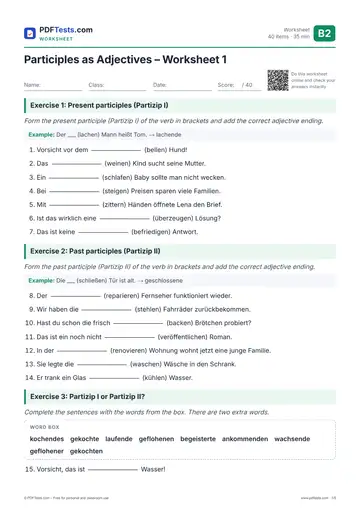
Fill in the correct form of the participle.
- Das ___ (schreien) Baby hat die ganze Nacht nicht geschlafen.
- Wir haben das ___ (reparieren) Fahrrad gestern abgeholt.
- Die gerade ___ (ankommen) Gäste wurden herzlich begrüßt.
- Er hatte Angst vor dem ___ (bellen) Hund.
- Ich bin sehr ___ (spannend / gespannt), wie das Spiel ausgeht.
Answers
- schreiende — active and ongoing, so Partizip I; neuter nominative after das. The screaming baby didn’t sleep all night.
- reparierte — passive, so Partizip II with no ge-; neuter accusative after das. We picked up the repaired bike yesterday.
- angekommenen — completed change with a sein verb; plural after die. The guests who had just arrived were warmly welcomed.
- bellenden — active, so Partizip I; masculine dative after dem. He was afraid of the barking dog.
- gespannt — the speaker feels the suspense; no ending after sein. I’m very curious to see how the match ends.
Next step
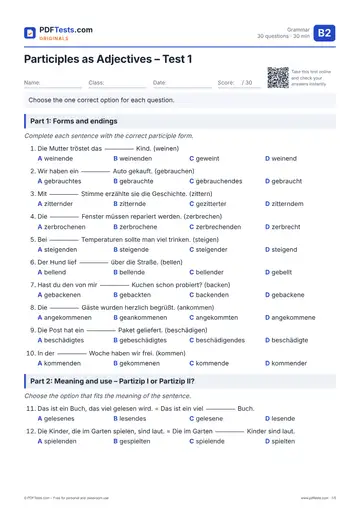
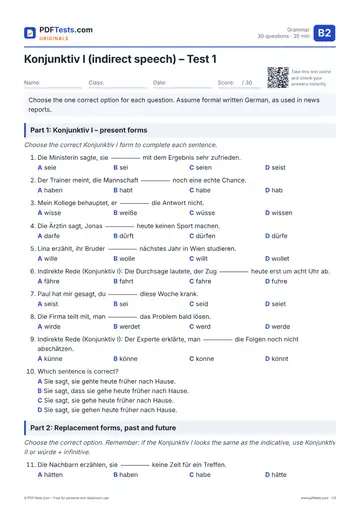
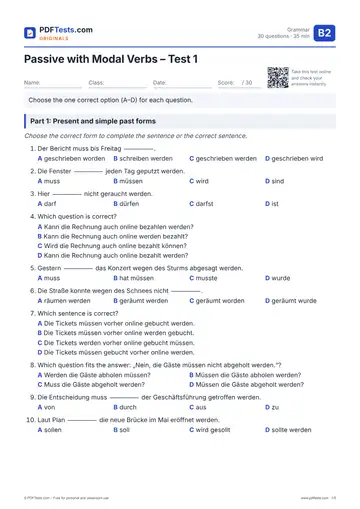
The key decision is always the same: active and ongoing means Partizip I, while passive or completed means Partizip II, followed by the correct adjective ending. Practise that decision in context with our B2 Participles as Adjectives test. Look at any mistakes and check whether the problem was the participle, the ending, or both.
Practise this topic: Participles as Adjectives in German
Was this page helpful?
What was the problem?
Thank you for your feedback!