The German passive (das Passiv) is formed with werden + Partizip II: Das Auto wird repariert. (The car is being repaired.) You use it when the action matters more than the person doing it, or when that person is unknown, obvious or unimportant. It is common in news, instructions, rules, processes and formal writing.
When to use the passive
Use the passive when you want to focus on what happens, not who does it.
- The doer is unknown: Mein Fahrrad wurde gestohlen. (My bike was stolen.)
- The doer is obvious or unimportant: Der Patient wird morgen operiert. (The patient is being operated on tomorrow.) Obviously a surgeon does it.
- Processes and instructions: Zuerst wird das Wasser gekocht. (First the water is boiled.)
- Rules and notices: Hier wird nicht geraucht. (There is no smoking here.)
- News and reports: Die neue Brücke wurde gestern eröffnet. (The new bridge was opened yesterday.)
In everyday speech, Germans often use man instead: Man repariert das Auto. (Someone is repairing the car.) Both are correct; the passive sounds more neutral and more formal.
How to form the passive
The German passive with werden is called the Vorgangspassiv (process passive), because it describes an action in progress. You need two parts:
- a form of werden in position 2 (the conjugated verb)
- the Partizip II of the main verb at the end of the clause
If you need to review past participles, see our guide to the Perfect Tense (Perfekt).
werden in the present and simple past
| Person | Präsens | Präteritum |
|---|---|---|
| ich | werde | wurde |
| du | wirst | wurdest |
| er/sie/es | wird | wurde |
| wir | werden | wurden |
| ihr | werdet | wurdet |
| sie/Sie | werden | wurden |
Ich werde vom Bahnhof abgeholt. (I am being picked up from the station.)
Die Fenster werden jede Woche geputzt. (The windows are cleaned every week.)
The form of werden agrees with the subject of the passive sentence: one window → wird, several windows → werden.
Statements, negatives and questions
| Type | Example |
|---|---|
| Statement | Das Paket wird heute geliefert. (The parcel is being delivered today.) |
| Negative | Das Paket wird heute nicht geliefert. (The parcel isn’t being delivered today.) |
| Yes/no question | Wird das Paket heute geliefert? (Is the parcel being delivered today?) |
| W-question | Wann wird das Paket geliefert? (When is the parcel being delivered?) |
Word order in subordinate clauses
In a subordinate clause (after dass, weil, wenn, ob…), the conjugated form of werden moves to the very end, after the participle:
Ich hoffe, dass das Paket heute geliefert wird. (I hope that the parcel is delivered today.)
Er ist sauer, weil sein Antrag abgelehnt wurde. (He is annoyed because his application was rejected.)
The passive in different tenses
At B1 you need the passive in the present, simple past and present perfect. The past perfect and future appear less often but follow the same logic.
| Tense | Form | Example |
|---|---|---|
| Präsens | wird + Partizip II | Das Haus wird gebaut. (The house is being built.) |
| Präteritum | wurde + Partizip II | Das Haus wurde gebaut. (The house was built.) |
| Perfekt | ist + Partizip II + worden | Das Haus ist gebaut worden. (The house has been built.) |
| Plusquamperfekt | war + Partizip II + worden | Das Haus war gebaut worden. (The house had been built.) |
| Futur I | wird + Partizip II + werden | Das Haus wird gebaut werden. (The house will be built.) |
Präteritum is the main past form
In writing and in the news, the Präteritum passive is by far the most common past form: Der Täter wurde schnell gefunden. (The perpetrator was found quickly.) Because wurde is so frequent, it is worth knowing its forms by heart. Our guide to the Simple Past (Präteritum) explains how this tense works in general.
Perfekt: sein + worden
In the Perfekt passive, two things are important:
- The auxiliary is always sein, never haben: Das Auto ist repariert worden.
- The participle of werden is shortened to worden, not geworden.
Geworden is only used when werden is a full verb meaning to become: Sie ist Ärztin geworden. (She became a doctor.)
From active to passive
To turn an active sentence into a passive one:
- The accusative object of the active sentence becomes the subject (nominative) of the passive sentence.
- The verb changes to werden + Partizip II.
- The active subject either disappears or is added with von + dative.
| Active | Passive |
|---|---|
| Der Mechaniker repariert den Wagen. (The mechanic is repairing the car.) | Der Wagen wird (vom Mechaniker) repariert. (The car is being repaired by the mechanic.) |
| Die Firma entließ viele Mitarbeiter. (The company laid off many employees.) | Viele Mitarbeiter wurden entlassen. (Many employees were laid off.) |
Notice the case change: den Wagen (accusative) becomes der Wagen (nominative).
Only verbs with an accusative object can form a normal personal passive. Verbs such as haben, bekommen, besitzen, kennen and wissen are not used in the passive.
Mentioning the doer: von or durch
- von + dative for people, animals and organisations that act: Das Bild wurde von einem jungen Künstler gemalt. (The picture was painted by a young artist.)
- durch + accusative for the means, cause or a person acting as a channel: Die Stadt wurde durch ein Erdbeben zerstört. (The city was destroyed by an earthquake.) Ich wurde durch einen Brief informiert. (I was informed by letter.)
In many sentences the doer is simply left out. That is often the reason for choosing the passive in the first place.
Verbs with a dative object
If the verb takes a dative object (helfen, danken, gratulieren, antworten), the dative stays dative. There is no nominative subject, and werden is always in the 3rd person singular:
Man hilft dem Mann. → Dem Mann wird geholfen. (The man is being helped.)
Man sagte mir nichts. → Mir wurde nichts gesagt. (I wasn’t told anything.)
If the dative case still feels uncertain, review our Dative Case guide.
The impersonal passive
German can even make passives from verbs without any object, to describe an activity in general. The verb is always singular. If nothing else stands in position 1, es fills the gap:
Es wird heute Abend getanzt. (There will be dancing tonight.)
As soon as another element takes position 1, es disappears:
Heute Abend wird getanzt. / In unserem Büro wird viel gelacht. (There is a lot of laughing in our office.)
Vorgangspassiv vs Zustandspassiv
Learners often confuse the passive with werden and the structure sein + Partizip II, called the Zustandspassiv (state passive).
| Form | Meaning | Example | |
|---|---|---|---|
| Vorgangspassiv | werden + Partizip II | an action/process | Die Tür wird geschlossen. (The door is being closed.) |
| Zustandspassiv | sein + Partizip II | the result/state | Die Tür ist geschlossen. (The door is closed.) |
Compare: Das Geschäft wird um 20 Uhr geschlossen. (The shop is closed / gets closed at 8 pm — the action.) Das Geschäft ist sonntags geschlossen. (The shop is closed on Sundays — the state.)
The three jobs of werden
Because werden has several functions, check what it combines with:
| werden + | Function | Example |
|---|---|---|
| noun/adjective | full verb: to become | Es wird kalt. (It’s getting cold.) |
| infinitive | future | Ich werde dich anrufen. (I will call you.) |
| Partizip II | passive | Ich werde angerufen. (I am being called.) |
With modal verbs, the passive infinitive is Partizip II + werden: Das Formular muss heute ausgefüllt werden. (The form must be filled in today.) This is covered in detail in our guide to the Passive with Modal Verbs.
Common mistakes
- ✗ Das Auto ist repariert geworden. → ✓ Das Auto ist repariert worden. In the Perfekt passive, use the short form worden.
- ✗ Das Haus hat gebaut worden. → ✓ Das Haus ist gebaut worden. The passive Perfekt always uses sein.
- ✗ Der Mann wird geholfen. → ✓ Dem Mann wird geholfen. Helfen takes the dative, which stays dative in the passive.
- ✗ Ich wurde gesagt, dass … → ✓ Mir wurde gesagt, dass … Sagen has a dative person, so there is no ich subject.
- ✗ Die Fenster wird geputzt. → ✓ Die Fenster werden geputzt. Werden agrees with the plural subject.
- ✗ Der Brief wurde durch meiner Schwester geschrieben. → ✓ Der Brief wurde von meiner Schwester geschrieben. Use von + dative for a person doing the action.
- ✗ Das Paket wird geliefert heute. → ✓ Das Paket wird heute geliefert. The participle goes to the end of the main clause.
- ✗ …, weil das Paket wird geliefert. → ✓ …, weil das Paket geliefert wird. In subordinate clauses, werden goes to the very end.
Quick check
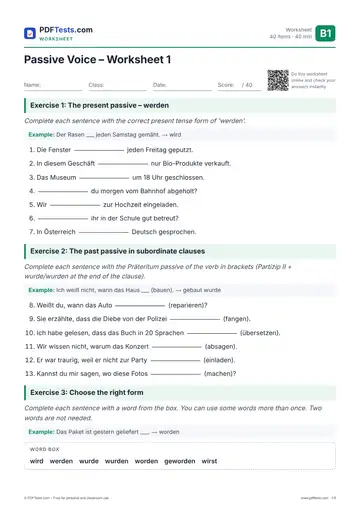
- Fill in the present tense: Die Pizza ___ in 20 Minuten geliefert.
- Make it passive (Präteritum): Man baute die Brücke 1950.
- Complete the Perfekt: Der Dieb ___ gestern verhaftet ___.
- Choose: (Das Kind / Dem Kind) wurde sofort geholfen.
- Complete in the present passive: Ich glaube, dass das Problem bald ___ ___. (lösen)
Answers
- wird
- Die Brücke wurde 1950 gebaut.
- ist … worden
- Dem Kind (helfen + dative)
- gelöst wird
Next step
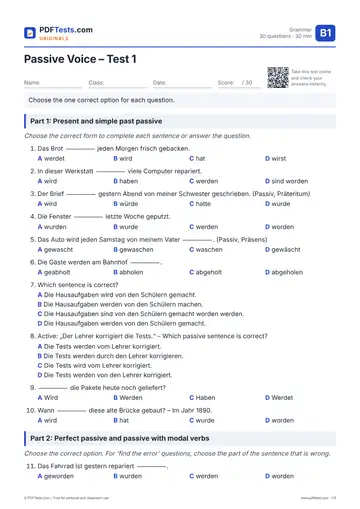
Now put the rules into practice: test yourself with our B1 Passive Voice test, which mixes present, Präteritum and Perfekt forms, dative passives and von vs durch. Pay special attention to worden vs geworden and to word order in subordinate clauses, since these cause the most errors. Once you are confident, move on to the passive with modal verbs such as muss gemacht werden.
Was this page helpful?
What was the problem?
Thank you for your feedback!