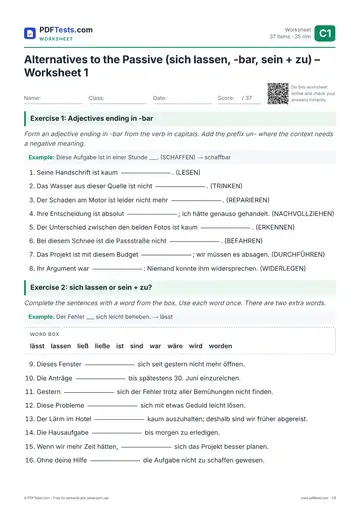
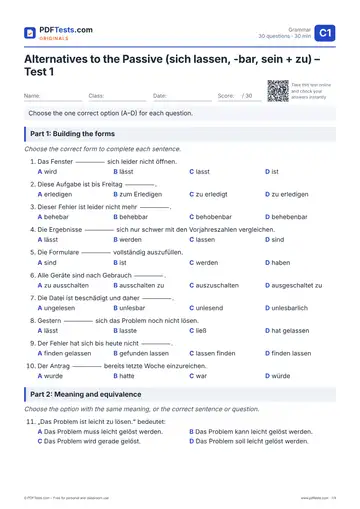
German has several structures that express a passive meaning without the auxiliary werden. The three most important are sich lassen + infinitive, adjectives ending in -bar and sein + zu + infinitive. They almost always add a modal idea: something can or must be done. You meet them constantly in formal writing, news, instructions and academic texts, and using them yourself makes your German more concise and less repetitive.
Overview: what each structure replaces
Each alternative corresponds to a passive with a modal verb:
| Structure | Example | Passive equivalent | Meaning |
|---|---|---|---|
| sich lassen + infinitive | Das Problem lässt sich lösen. | Das Problem kann gelöst werden. | possibility |
| -bar adjective | Das Problem ist lösbar. | Das Problem kann gelöst werden. | possibility |
| sein + zu + infinitive | Das Problem ist zu lösen. | Das Problem kann / muss gelöst werden. | possibility or necessity |
All three examples mean The problem can be solved (the last one can also mean must be solved, depending on context).
In all three structures the grammatical subject is the thing affected by the action, just as in the normal passive voice. The person doing the action is usually not mentioned.
sich lassen + infinitive
Meaning
Sich lassen + infinitive expresses possibility: kann … werden.
- Die Tür lässt sich nur von innen öffnen. The door can only be opened from the inside.
- Dieser Fleck lässt sich leicht entfernen. This stain can easily be removed.
- Das lässt sich nicht beweisen. That can’t be proven.
It combines naturally with adverbs such as leicht, schwer, kaum, gut, problemlos, nur mit Mühe.
Form in different tenses
Only lassen changes; the main verb stays in the infinitive without zu.
| Tense | Example | Translation |
|---|---|---|
| Präsens | Die Datei lässt sich nicht öffnen. | The file can’t be opened. |
| Präteritum | Die Datei ließ sich nicht öffnen. | The file couldn’t be opened. |
| Perfekt | Die Datei hat sich nicht öffnen lassen. | The file couldn’t be opened. |
| Futur I | Das wird sich nicht vermeiden lassen. | That won’t be avoidable. |
| Konjunktiv II | Das ließe sich ändern. | That could be changed. |
Note the Perfekt: like modal verbs, lassen uses the double infinitive (öffnen lassen), not the participle gelassen.
Word order in subordinate clauses
In a subordinate clause lässt goes to the end:
- Ich rufe an, weil sich die Datei nicht öffnen lässt. I’m calling because the file can’t be opened.
With the double infinitive, the auxiliary hat moves in front of both infinitives:
- Ich rufe an, weil sich die Datei nicht hat öffnen lassen. I’m calling because the file couldn’t be opened.
Impersonal use with es
With intransitive verbs, es acts as a dummy subject. These sentences usually describe how pleasant or easy an activity is:
- Hier lässt es sich gut leben. Life is good here.
- In diesem Café lässt es sich ruhig arbeiten. You can work in peace in this café.
Do not confuse it with causative lassen
When the subject is a person who arranges for something to be done, lassen is causative, not a passive alternative:
- Ich lasse mein Fahrrad reparieren. I’m having my bike repaired.
- Mein Fahrrad lässt sich nicht mehr reparieren. My bike can’t be repaired any more.
A simple test: if you can rephrase the sentence with kann … werden, it is the passive alternative.
Adjectives ending in -bar
Formation and meaning
Add -bar to the verb stem. The adjective means can be …ed, much like English -able. The negative is formed with un-.
| Verb | Adjective | Negative | Example |
|---|---|---|---|
| lesen | lesbar | unlesbar | Seine Handschrift ist kaum lesbar. His handwriting is barely legible. |
| essen | essbar | ungenießbar* | Sind diese Pilze essbar? Are these mushrooms edible? |
| erreichen | erreichbar | unerreichbar | Das Ziel ist realistisch erreichbar. The goal can realistically be achieved. |
| austauschen | austauschbar | – | Der Akku ist austauschbar. The battery is replaceable. |
| vorhersehen | vorhersehbar | unvorhersehbar | Das Ende war vorhersehbar. The ending was predictable. |
| vorstellen | vorstellbar | unvorstellbar | Das ist kaum vorstellbar. That is hardly imaginable. |
(unessbar exists but ungenießbar is far more common.)
Points to watch
- Mainly transitive verbs. -bar adjectives normally come from verbs that take an accusative object: etwas waschen → waschbar. A few exceptions exist, such as brennbar (flammable).
- Not every verb uses -bar. Some verbs prefer -lich: verständlich (understandable), erhältlich (available), unverzeihlich (unforgivable). Some have both: unvermeidbar / unvermeidlich (unavoidable).
- Some meanings are idiomatic. Unbezahlbar can mean unaffordable or priceless; brauchbar simply means useful.
- -fähig is a related suffix meaning capable of: Der Patient ist nicht transportfähig. The patient can’t be moved.
Used before a noun, these adjectives take normal adjective endings: ein waschbarer Bezug (a washable cover).
sein + zu + infinitive
Two possible meanings
This structure can mean can be done or must be done. Context decides.
Possibility (kann … werden):
- Der Fehler ist leicht zu finden. The mistake is easy to find.
- Frau Berger ist heute nicht zu erreichen. Ms Berger can’t be reached today.
Necessity (muss … werden):
- Die Gebühr ist bis zum 30. Juni zu überweisen. The fee must be transferred by 30 June.
- Den Anweisungen des Personals ist Folge zu leisten. Staff instructions must be followed.
Typical clues:
| Points to können | Points to müssen |
|---|---|
| leicht, schwer, kaum, gut, nicht, nur mit Mühe | deadlines (bis …), sofort, unbedingt |
| descriptions and evaluations | instructions, rules, official notices |
Some sentences remain open: Das ist noch zu prüfen most likely means That still has to be checked, but only context makes it certain.
Form
| Tense | Example | Translation |
|---|---|---|
| Präsens | Die Regeln sind zu beachten. | The rules must be observed. |
| Präteritum | Der Lärm war kaum zu ertragen. | The noise was almost unbearable. |
| Perfekt (rare) | Das ist nicht zu ändern gewesen. | That couldn’t be changed. |
| Konjunktiv II | Das wäre noch zu klären. | That would still need to be clarified. |
With separable verbs, zu goes between prefix and stem, just as in the infinitive with zu:
- Das Formular ist vollständig auszufüllen. The form must be filled in completely.
- …, dass der Antrag bis Freitag einzureichen ist. … that the application must be submitted by Friday.
Impersonal use
With verbs that have no accusative object, the sentence can be subjectless:
- Mit ihm ist nicht zu reden. There’s no talking to him.
- Dagegen ist nichts zu sagen. There’s nothing to be said against that.
sein + zu vs haben + zu
Haben + zu is active: the subject is the person who must act.
- Sie haben das Formular auszufüllen. You have to fill in the form.
- Das Formular ist auszufüllen. The form has to be filled in.
The attributive form
Before a noun, sein + zu becomes the zu-participle (zu + present participle):
- die Aufgabe, die zu lösen ist → die zu lösende Aufgabe the task to be solved
This form is typical of extended participle attributes in academic German.
Other ways to avoid the passive
At C1 you should also recognise these:
- man: Man kann das Problem lösen. The problem can be solved.
- Reflexive verbs with passive meaning: Das Buch verkauft sich gut. The book is selling well. / Der Schlüssel hat sich gefunden. The key has turned up.
- Noun-verb phrases: Die Methode kommt hier zur Anwendung. The method is applied here. / Der Vorschlag fand breite Zustimmung. The proposal met with broad approval.
Common mistakes
- ✗ Das Problem lässt sich gelöst werden. → ✓ Das Problem lässt sich lösen. — sich lassen takes a plain infinitive, never werden.
- ✗ Die Tür lässt leicht öffnen. → ✓ Die Tür lässt sich leicht öffnen. — the reflexive sich is obligatory.
- ✗ Das hat sich nicht lösen gelassen. → ✓ Das hat sich nicht lösen lassen. — use the double infinitive in the Perfekt.
- ✗ …, weil sich das nicht lösen lassen hat. → ✓ …, weil sich das nicht hat lösen lassen. — hat comes before the double infinitive.
- ✗ Die Aufgabe ist bis Montag zu erledigt. → ✓ Die Aufgabe ist bis Montag zu erledigen. — sein + zu needs the infinitive, not the participle.
- ✗ Das Formular ist zu ausfüllen. → ✓ Das Formular ist auszufüllen. — with separable verbs zu goes inside the verb.
- ✗ Ich bin den Bericht zu schreiben. → ✓ Ich habe den Bericht zu schreiben. — a person who must act takes haben + zu.
- ✗ Der Text ist gut verstehbar. → ✓ Der Text ist gut verständlich. — this verb uses the -lich form.
Quick check
Rewrite each sentence using the structure in brackets.
- Das Gerät kann leicht bedient werden. (sich lassen)
- Die Unterlagen müssen bis Montag abgegeben werden. (sein + zu)
- Dieses Wasser kann nicht getrunken werden. (-bar)
- Der Fehler konnte nicht gefunden werden. (sich lassen, Perfekt)
- Die Rechnung ist sofort zu bezahlen. Does this mean can or must?
Answers
- Das Gerät lässt sich leicht bedienen. The device is easy to operate.
- Die Unterlagen sind bis Montag abzugeben. The documents must be handed in by Monday.
- Dieses Wasser ist nicht trinkbar. This water is not drinkable.
- Der Fehler hat sich nicht finden lassen. The mistake couldn’t be found.
- Must: sofort and the context of a bill signal an obligation. The invoice must be paid immediately.
Next step
The fastest way to make these structures automatic is to transform passive sentences in both directions until the patterns feel natural. Test yourself with our C1 test on alternatives to the passive, and if the underlying werden forms still cause hesitation, review the passive with modal verbs first.
Practise this topic: Alternatives to the Passive in German
Was this page helpful?
What was the problem?
Thank you for your feedback!