German modal verbs are helper verbs such as können (can), müssen (must, have to) and wollen (want to). They express ability, obligation, permission or wishes, and they usually work together with a second verb in the infinitive at the end of the sentence: Ich kann gut schwimmen. I can swim well. You need them from your very first week of German to ask for things, make plans and follow rules.
The modal verbs and what they mean
At A1 you need six modal verbs plus the polite form möchte.
| Modal verb | Main meaning | Example |
|---|---|---|
| können | can, be able to; be possible | Ich kann Gitarre spielen. I can play the guitar. |
| müssen | must, have to | Wir müssen heute arbeiten. We have to work today. |
| dürfen | may, be allowed to | Darf ich hier parken? May I park here? |
| wollen | want to (strong wish, plan) | Sie will Ärztin werden. She wants to become a doctor. |
| sollen | should, be supposed to (someone else’s instruction) | Soll ich das Fenster öffnen? Shall I open the window? |
| mögen | like (mostly with a noun at A1) | Ich mag Pizza. I like pizza. |
| möchten | would like (polite wish) | Ich möchte einen Kaffee, bitte. I would like a coffee, please. |
können
Use können for ability, for possibility and for informal requests.
- Mein Sohn kann schon lesen. My son can already read.
- Hier kann man gut essen. You can eat well here.
- Kannst du mir helfen? Can you help me?
müssen
Use müssen for something that is necessary or obligatory.
- Ich muss um sieben Uhr aufstehen. I have to get up at seven o’clock.
- Du musst den Bus nehmen. You have to take the bus.
dürfen
Use dürfen for permission. With nicht, it expresses a prohibition.
- Darf ich das Fenster aufmachen? May I open the window?
- Hier darf man nicht rauchen. You are not allowed to smoke here.
wollen
Use wollen for a clear wish or plan. It sounds direct, so it is not the best choice when you order or ask politely.
- Wir wollen im Sommer nach Italien fahren. We want to go to Italy in the summer.
- Willst du mitkommen? Do you want to come along?
sollen
Use sollen when the obligation comes from another person: a doctor, a teacher, a boss. In questions, it offers help.
- Der Arzt sagt: Ich soll viel Wasser trinken. The doctor says I should drink a lot of water.
- Was soll ich machen? What should I do?
mögen and möchten
At A1, mögen usually appears with a noun: Magst du Hunde? Do you like dogs? Möchten is the polite way to say what you want, especially in shops, cafés and on the phone.
- Ich möchte ein Ticket nach Berlin. I would like a ticket to Berlin.
- Möchtest du etwas trinken? Would you like something to drink?
Form: conjugation in the present tense
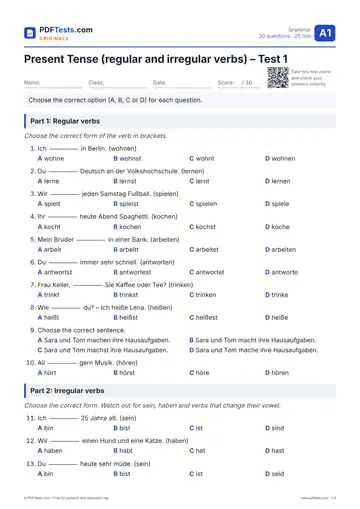
Modal verbs are irregular. Compare them with normal verbs in our guide to the German present tense. Look at the table first, then read the three rules below it.
| können | müssen | dürfen | wollen | sollen | mögen | möchten | |
|---|---|---|---|---|---|---|---|
| ich | kann | muss | darf | will | soll | mag | möchte |
| du | kannst | musst | darfst | willst | sollst | magst | möchtest |
| er/sie/es | kann | muss | darf | will | soll | mag | möchte |
| wir | können | müssen | dürfen | wollen | sollen | mögen | möchten |
| ihr | könnt | müsst | dürft | wollt | sollt | mögt | möchtet |
| sie/Sie | können | müssen | dürfen | wollen | sollen | mögen | möchten |
Three rules to remember
- ich and er/sie/es are identical and have no ending: ich kann, er kann (not er kannt).
- The vowel changes in the singular (ich, du, er/sie/es) for all modals except sollen: können → kann, müssen → muss, dürfen → darf, wollen → will, mögen → mag.
- The plural forms are regular: wir and sie/Sie use the infinitive, ihr adds -t to the stem: ihr könnt, ihr müsst.
Möchten is technically a form of mögen, but at A1 you can learn it as its own verb with regular endings: ich möchte, du möchtest, er möchte.
Word order: the sentence bracket
This is the most important point. The modal verb is conjugated and stands in position 2. The second verb stays in the infinitive and goes to the very end of the sentence. Everything else goes in between, like a bracket.
| Sentence type | Example | Translation |
|---|---|---|
| Affirmative | Ich kann heute nicht lange bleiben. | I can’t stay long today. |
| Affirmative (time first) | Morgen muss ich früh arbeiten. | Tomorrow I have to work early. |
| Negative with nicht | Er will nicht tanzen. | He doesn’t want to dance. |
| Negative with kein | Wir dürfen keinen Alkohol trinken. | We are not allowed to drink alcohol. |
| Yes/no question | Kannst du Deutsch sprechen? | Can you speak German? |
| W-question | Wann müssen wir gehen? | When do we have to go? |
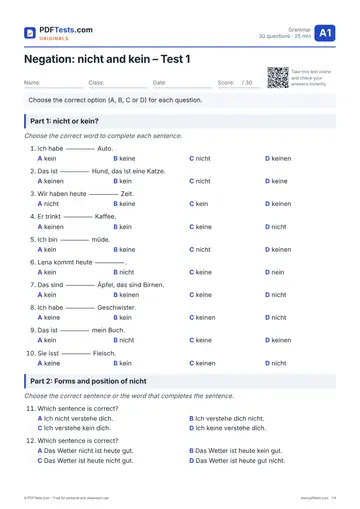
Notice that the infinitive does not take zu after a modal verb. For more on where nicht and kein go, see our guide to negation with nicht and kein.
Modal verbs with separable verbs
With a modal verb, a separable verb is not separated. It stays together as one infinitive at the end.
- Without modal: Ich stehe früh auf. I get up early.
- With modal: Ich muss früh aufstehen. I have to get up early.
- Kannst du mich morgen anrufen? Can you call me tomorrow?
Our guide to separable verbs explains the normal pattern in detail.
Modal verbs without a second verb
In everyday speech, the infinitive is sometimes left out when the meaning is obvious.
- Ich kann Deutsch. I can speak German. (sprechen is understood)
- Ich muss jetzt nach Hause. I have to go home now. (gehen is understood)
- Ich möchte einen Tee. I would like a tea. (haben is understood)
Commonly confused pairs
müssen nicht vs. dürfen nicht
This pair causes real misunderstandings, because English must not looks like muss nicht but means something else.
| German | Meaning | Example |
|---|---|---|
| nicht müssen | it is not necessary | Du musst nicht kommen. You don’t have to come. |
| nicht dürfen | it is forbidden | Du darfst nicht kommen. You must not come. |
So English must not = German nicht dürfen.
wollen vs. möchten
Both express wishes. Wollen is direct and firm; möchten is softer and polite. Use möchte when you speak to strangers, order food or ask for something.
- Ich will jetzt nach Hause! I want to go home now! (firm, maybe impatient)
- Ich möchte bitte zahlen. I’d like to pay, please. (polite)
wollen is not English will
Ich will means I want, not I will. For the future, German usually uses the present tense with a time word.
- Morgen fahre ich nach Hamburg. Tomorrow I will go to Hamburg.
mögen vs. möchten
Mögen is a general like; möchten is a wish at this moment.
- Ich mag Kaffee. I like coffee. (in general)
- Ich möchte einen Kaffee. I would like a coffee. (now)
müssen vs. sollen
Müssen is a necessity or strong obligation; sollen reports what someone else wants you to do.
- Ich muss den Zug um acht nehmen. I have to take the eight o’clock train.
- Mein Chef sagt, ich soll morgen früher kommen. My boss says I should come earlier tomorrow.
Common mistakes
- ✗ Er kannt gut kochen. → ✓ Er kann gut kochen. He can cook well. The er/sie/es form of a modal has no -t.
- ✗ Ich wille Deutsch lernen. → ✓ Ich will Deutsch lernen. I want to learn German. The ich form has no ending.
- ✗ Ich muss gehen nach Hause. → ✓ Ich muss nach Hause gehen. I have to go home. The infinitive goes to the end.
- ✗ Sie kann arbeitet heute. → ✓ Sie kann heute arbeiten. She can work today. Only the modal is conjugated; the second verb stays in the infinitive.
- ✗ Ich will zu schwimmen. → ✓ Ich will schwimmen. I want to swim. Modal verbs never take zu.
- ✗ Du musst hier nicht rauchen. (meaning it is forbidden) → ✓ Du darfst hier nicht rauchen. You must not smoke here. Prohibition uses nicht dürfen.
- ✗ Ich muss stehe früh auf. → ✓ Ich muss früh aufstehen. I have to get up early. After a modal, a separable verb stays together at the end.
- ✗ Ich will einen Kaffee. (to a waiter) → ✓ Ich möchte einen Kaffee, bitte. I’d like a coffee, please. Möchte is the polite form.
- ✗ Morgen will es regnen. → ✓ Morgen regnet es. It will rain tomorrow. Wollen means want, not future will.
Quick check
- Fill in können: ___ du mir bitte helfen?
- Put the words in order: muss / heute / ich / arbeiten
- Smoking is forbidden: Sie ___ hier nicht rauchen. (müssen or dürfen?)
- Fill in wollen: Mein Bruder ___ Lehrer werden.
- Correct the sentence: Ich möchte trinken einen Tee.
Answers
- Kannst du mir bitte helfen? Can you help me, please?
- Ich muss heute arbeiten. I have to work today.
- dürfen: Sie dürfen hier nicht rauchen. You are not allowed to smoke here.
- will: Mein Bruder will Lehrer werden. My brother wants to become a teacher.
- Ich möchte einen Tee trinken. I’d like to drink a tea.
Next step
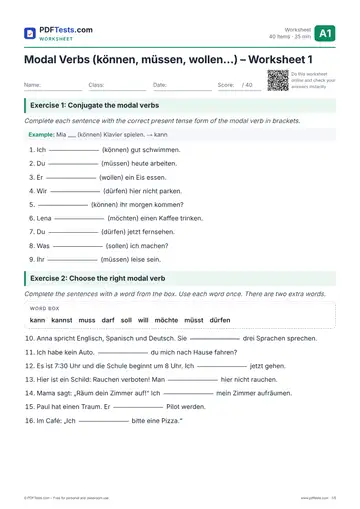
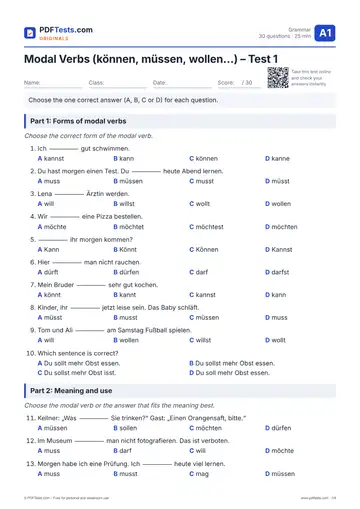
Now practise the forms and the word order until they feel automatic: test yourself with our A1 Modal Verbs test, which mixes conjugation, sentence building and the müssen nicht / dürfen nicht contrast. If you want to see how modal verbs fit into your overall level, try the German Level Test A1 or browse all our German A1 tests.
Was this page helpful?
What was the problem?
Thank you for your feedback!