The genitive (der Genitiv) is the German case that links one noun to another, usually to show possession or belonging: das Auto des Lehrers (the teacher’s car). It also follows a group of prepositions such as wegen, trotz and während, and appears with a few verbs, adjectives and time expressions. At B2 you need it mainly for written and formal German, where it is expected and where the dative alternatives of everyday speech sound careless.
When to use the genitive
1. To show possession or a relationship between nouns
The genitive noun phrase normally comes after the noun it describes:
- Das ist die Wohnung meiner Schwester. – That is my sister’s flat.
- Der Anfang des Films war langweilig. – The beginning of the film was boring.
- Die Meinung der Experten ist geteilt. – The experts’ opinion is divided.
With names, the genitive usually comes before the noun, similar to the English ’s, but without an apostrophe:
- Annas Bruder studiert in Wien. – Anna’s brother studies in Vienna.
- Deutschlands Hauptstadt ist Berlin. – Germany’s capital is Berlin.
2. After genitive prepositions
- Wegen des Streiks fallen viele Züge aus. – Because of the strike, many trains are cancelled.
- Trotz der Kälte sind wir spazieren gegangen. – Despite the cold, we went for a walk.
3. With some verbs and adjectives
These belong to formal or literary style, but appear in B2 reading texts:
- Man beschuldigt ihn des Diebstahls. – He is accused of theft.
- Das bedarf einer Erklärung. – That requires an explanation.
- Sie war sich des Risikos bewusst. – She was aware of the risk.
4. In fixed time expressions
- Eines Tages wirst du das verstehen. – One day you will understand that.
- Eines Abends klingelte das Telefon. – One evening the phone rang.
Note the exception eines Nachts (one night): Nacht is feminine, but the phrase copies the pattern of eines Tages.
The question word for the genitive is wessen: Wessen Jacke ist das? – Whose jacket is that?
Form: articles and determiners
| Masculine | Feminine | Neuter | Plural | |
|---|---|---|---|---|
| Definite article | des Mannes | der Frau | des Kindes | der Leute |
| Indefinite article | eines Mannes | einer Frau | eines Kindes | – |
| kein / mein | keines / meines | keiner / meiner | keines / meines | keiner / meiner |
| dieser | dieses | dieser | dieses | dieser |
The key pattern: masculine and neuter take -es on the article and -(e)s on the noun. Feminine and plural take -er on the article and no ending on the noun.
- der Name des Hotels – the name of the hotel
- die Farbe der Tür – the colour of the door
- die Zimmer der Häuser – the rooms of the houses
Noun endings: -s or -es
Masculine and neuter nouns add -s or -es. Use these guidelines:
| Rule | Ending | Examples |
|---|---|---|
| Nouns ending in -s, -ß, -x, -z, -tz | always -es | des Hauses, des Fußes, des Reflexes, des Satzes |
| Nouns ending in -nis | -ses | des Ergebnisses, des Zeugnisses |
| One-syllable nouns | usually -es (often both possible) | des Tages, des Mannes, des Buch(e)s |
| Nouns with more than one syllable | -s | des Lehrers, des Computers, des Problems |
| Nouns ending in a vowel | -s | des Autos, des Kinos, des Sofas |
des Hauses – of the house; des Ergebnisses – of the result; des Lehrers – of the teacher.
Weak nouns (n-declension)
Weak masculine nouns take -(e)n instead of -s, just as in the accusative and dative:
- die Frage des Studenten – the student’s question
- das Büro des Kollegen – the colleague’s office
- die Wünsche des Kunden – the customer’s wishes
- die Tasche des Herrn – the gentleman’s bag
A small group of mixed nouns takes -ns: des Namens, des Gedankens, des Glaubens, des Willens and the neuter des Herzens.
- Die Bedeutung des Namens ist unklar. – The meaning of the name is unclear.
Adjective endings in the genitive
After an article, the adjective always ends in -en: des alten Mannes, der neuen Regel, eines kleinen Kindes.
Without an article, masculine and neuter adjectives take -en (because the noun already shows the genitive with -s), while feminine and plural take -er:
- trotz starken Regens – despite heavy rain
- wegen schlechten Wetters – because of bad weather
- mit großer Mühe – with great effort (dative, for comparison)
- wegen hoher Kosten – because of high costs
For the full system, see our guide to German adjective endings.
Names
Add -s without an apostrophe: Peters Fahrrad – Peter’s bike. If the name ends in -s, -ß, -x or -z, use only an apostrophe: Thomas’ Wohnung – Thomas’s flat; Max’ Idee – Max’s idea.
Genitive prepositions
These are the genitive prepositions you need at B2:
| Preposition | Meaning | Example |
|---|---|---|
| wegen | because of | wegen des Lärms – because of the noise |
| trotz | despite | trotz des Verbots – despite the ban |
| während | during | während der Pause – during the break |
| (an)statt | instead of | statt eines Briefes – instead of a letter |
| innerhalb | within, inside | innerhalb einer Woche – within a week |
| außerhalb | outside | außerhalb der Stadt – outside the city |
| aufgrund | due to | aufgrund eines Fehlers – due to a mistake |
| infolge | as a result of | infolge des Unfalls – as a result of the accident |
| angesichts | in view of | angesichts der Lage – in view of the situation |
| anlässlich | on the occasion of | anlässlich seines Geburtstags – on the occasion of his birthday |
| bezüglich / hinsichtlich | regarding | bezüglich Ihrer Anfrage – regarding your enquiry |
| mithilfe | with the help of | mithilfe eines Wörterbuchs – with the help of a dictionary |
| oberhalb / unterhalb | above / below | unterhalb des Gipfels – below the summit |
| diesseits / jenseits | on this side / beyond | jenseits der Grenze – beyond the border |
| zugunsten | in favour of | zugunsten der Opfer – in favour of the victims |
Sentence examples:
- Während des Meetings war sein Handy aus. – During the meeting his phone was off.
- Aufgrund eines technischen Problems verspätet sich der Flug. – Due to a technical problem, the flight is delayed.
- Angesichts der hohen Preise kaufen viele weniger ein. – In view of the high prices, many people buy less.
Prepositions with two possible cases
- dank takes genitive or dative: dank deiner Hilfe / dank deinem Einsatz – thanks to your help / thanks to your effort.
- laut takes genitive or dative and often appears without an article: laut Wetterbericht – according to the weather forecast.
- entlang takes the genitive when it comes first, but the accusative when it follows the noun: entlang des Flusses / den Fluss entlang – along the river.
Spoken German and the dative
In everyday speech many Germans say wegen dem Wetter or trotz dem Regen. You will hear this constantly, but in exams, emails and essays use the genitive: wegen des Wetters – because of the weather.
There is one case where the dative is correct even in writing: when a plural noun has no article or adjective, the genitive is invisible, so German switches to the dative.
- Statt Büchern kaufte er Spiele. – Instead of books he bought games.
- Innerhalb von zwei Wochen war alles fertig. – Within two weeks everything was finished.
With personal pronouns, wegen combines into one word: meinetwegen, deinetwegen, seinetwegen, ihretwegen, unseretwegen, euretwegen.
- Sie ist deinetwegen gekommen. – She came because of you.
Genitive vs von + dative
Learners often ask whether they can simply use von + dative. The answer depends on style and on the noun.
| Situation | Use | Example |
|---|---|---|
| Formal or written style | genitive | das Ende des Romans – the end of the novel |
| Casual speech | von + dative is common | das Ende von dem Roman – the end of the novel |
| Plural without article | von + dative required | die Meinung von Experten – the opinion of experts |
| Name ending in -s in speech | von often preferred | das Auto von Klaus – Klaus’s car |
| Quantities and numbers | von + dative | der Preis von drei Kilo – the price of three kilos |
At B2 level the goal is control: use von naturally in conversation, but produce clean genitive forms in formal writing. The genitive also matters in nominal style, which you will meet in our guide to nominalisation: Nach der Eröffnung des Museums… – After the opening of the museum…
Common mistakes
- ✗ des Lehrer → ✓ des Lehrers – masculine and neuter nouns need -s.
- ✗ der Fraus → ✓ der Frau – feminine nouns never take an ending in the genitive.
- ✗ des Students → ✓ des Studenten – weak nouns take -(e)n, not -s.
- ✗ des Hauss → ✓ des Hauses – nouns ending in -s need -es.
- ✗ Anna’s Handy → ✓ Annas Handy – standard German uses no apostrophe before -s.
- ✗ wegen dem Unfall (in an essay) → ✓ wegen des Unfalls – formal writing requires the genitive.
- ✗ trotz schlechtes Wetter → ✓ trotz schlechten Wetters – the adjective takes -en and the noun takes -s.
- ✗ innerhalb zwei Tage → ✓ innerhalb von zwei Tagen – with an article-less plural, use von + dative.
- ✗ des Names → ✓ des Namens – Name belongs to the mixed group with -ns.
Quick check
Complete or correct the sentences.
- Wir sind trotz ___ (der Regen) gewandert.
- Das ist das Auto ___ (mein Nachbar).
- Während ___ (die Prüfung) ist das Handy verboten.
- Correct for an essay: Wegen dem Streik kam er zu spät.
- ___ (innerhalb, drei Monate) muss die Rechnung bezahlt werden.
Answers
- des Regens – We hiked despite the rain.
- meines Nachbarn – That is my neighbour’s car. (Nachbar is a weak noun.)
- der Prüfung – During the exam, phones are forbidden.
- Wegen des Streiks kam er zu spät. – Because of the strike he arrived late.
- Innerhalb von drei Monaten – The invoice must be paid within three months.
Next step
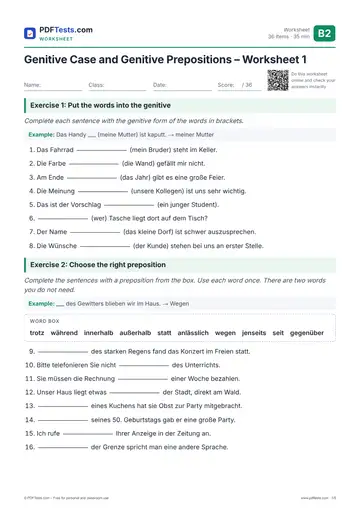
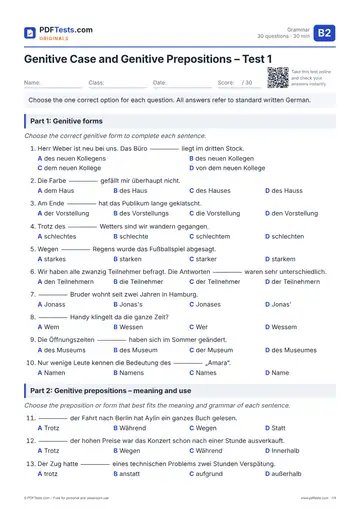
Now put the rules into practice: test yourself with our B2 Genitive Case and Genitive Prepositions test, which mixes article endings, weak nouns and prepositions like aufgrund and trotz. If the dative forms still cause hesitation, review our guide to the German dative case first, then explore the other German B2 tests to see how the genitive combines with connectors, the passive and formal vocabulary.
Was this page helpful?
What was the problem?
Thank you for your feedback!