Two-part connectors (zweiteilige Konnektoren) are pairs of words that work together to link two words, phrases or clauses, such as sowohl … als auch (both … and) or entweder … oder (either … or). They make the relationship between two ideas clear from the start: adding, excluding, choosing, contrasting or comparing. At B2 you need them for opinions, discussions and formal writing. The tricky parts are word order and verb agreement.
The connectors at a glance
| Connector | Meaning | Relationship |
|---|---|---|
| sowohl … als auch | both … and | adding two things |
| nicht nur … sondern auch | not only … but also | adding, with emphasis on the second |
| weder … noch | neither … nor | excluding both |
| entweder … oder | either … or | choosing one of two |
| zwar … aber | admittedly … but | conceding, then contrasting |
| einerseits … andererseits | on the one hand … on the other hand | weighing two sides |
| je … desto / umso | the more … the more | proportion |
Uses
sowohl … als auch: both things are true
Use it to show that two elements apply equally. A less common variant is sowohl … wie auch.
- Sie spricht sowohl Englisch als auch Französisch. She speaks both English and French.
- Das Angebot gilt sowohl für Studierende als auch für Rentner. The offer applies to both students and pensioners.
nicht nur … sondern auch: adding with emphasis
The meaning is similar to sowohl … als auch, but the second element is stressed, often as something surprising or extra.
- Die Wohnung ist nicht nur hell, sondern auch ruhig. The flat is not only bright but also quiet.
- Er hat nicht nur die Prüfung bestanden, sondern auch die beste Note bekommen. He not only passed the exam but also got the best mark.
weder … noch: neither one nor the other
This is the negative of sowohl … als auch. It already contains the negation, so you do not add nicht or kein.
- Ich habe weder Zeit noch Geld. I have neither time nor money.
- Weder mein Bruder noch meine Schwester kann Auto fahren. Neither my brother nor my sister can drive.
entweder … oder: one option, not both
- Wir fahren entweder mit dem Zug oder mit dem Auto. We’ll go either by train or by car.
- Entweder du rufst sie heute an, oder du schreibst ihr eine Mail. Either you call her today or you send her an email.
zwar … aber: admitting a point, then contrasting
The zwar part concedes something; the aber part brings the more important point.
- Das Hotel ist zwar teuer, aber es liegt direkt am Strand. The hotel is expensive, admittedly, but it’s right on the beach.
- Ich habe zwar lange gelernt, aber die Prüfung war trotzdem schwer. I did study for a long time, but the exam was still hard.
einerseits … andererseits: two sides of a question
Very common in discussions and essays when you weigh arguments.
- Einerseits möchte ich im Ausland studieren, andererseits vermisse ich dann meine Familie. On the one hand I’d like to study abroad; on the other hand I’d miss my family.
je … desto / umso: the more … the more
Both parts are followed by a comparative. Desto and umso mean the same; umso is slightly more frequent in speech. If you need a refresher on comparatives, see our guide to comparative and superlative forms.
- Je früher wir losfahren, desto weniger Stau haben wir. The earlier we leave, the less traffic we’ll have.
- Je mehr ich übe, umso sicherer werde ich. The more I practise, the more confident I become.
Word order
When the connectors link single words or phrases, word order stays normal: the pair simply surrounds the two elements. When they link whole clauses, each part has its own rule.
| Part | Position | Effect on the verb |
|---|---|---|
| sowohl … als auch | around words or phrases | none (rarely used for full clauses) |
| nicht nur | middle field, or position 1 | inversion if in position 1 |
| sondern (auch) | position 0 | no inversion |
| weder / noch | position 1 in each clause | inversion after both |
| entweder | position 1 or position 0 | inversion optional |
| oder | position 0 | no inversion |
| zwar | middle field, or position 1 | inversion if in position 1 |
| aber | position 0 (or middle field) | no inversion in position 0 |
| einerseits / andererseits | position 1 (or middle field) | inversion |
| je | starts a subordinate clause | verb at the end |
| desto / umso + comparative | position 1 | inversion |
Connectors that cause inversion
Weder, noch, einerseits, andererseits and fronted zwar or nicht nur are adverbs. When they come first, the verb follows immediately.
- Weder hat er angerufen, noch hat er geschrieben. He neither called nor wrote.
- Zwar ist die Arbeit stressig, aber sie macht Spaß. The work is stressful, admittedly, but it’s fun.
- Nicht nur kennt sie die Stadt gut, sie spricht auch den Dialekt. Not only does she know the city well, she also speaks the dialect.
Connectors in position 0
Oder, aber and sondern behave like ordinary coordinating conjunctions: subject first, then verb.
- Entweder kommst du mit, oder du bleibst hier. Either you come along or you stay here.
- Der Film war zwar lang, aber er war spannend. The film was long, but it was exciting.
With entweder, both versions are correct: Entweder kommst du mit … (inversion) and Entweder du kommst mit … (no inversion, more conversational).
je … desto: subordinate clause plus main clause
The je clause works like a subordinate clause with weil or dass: the verb goes to the end. Then desto + comparative takes position 1 of the main clause, so the verb comes next.
- Je länger ich in Wien wohne, desto besser gefällt mir die Stadt. The longer I live in Vienna, the more I like the city.
Pattern: Je + comparative + subject … verb, desto + comparative + verb + subject …
Verb agreement with two subjects
When the connector links two subjects, the verb form depends on the connector.
| Connector | Verb | Example |
|---|---|---|
| sowohl … als auch | plural | Sowohl Anna als auch Tom arbeiten hier. Both Anna and Tom work here. |
| entweder … oder | agrees with the nearer subject | Entweder der Chef oder seine Kollegen rufen dich an. Either the boss or his colleagues will call you. |
| weder … noch | singular or plural | Weder Paul noch Lisa hat / haben Zeit. Neither Paul nor Lisa has time. |
| nicht nur … sondern auch | agrees with the nearer subject | Nicht nur die Kinder, sondern auch der Vater war begeistert. Not only the children but also the father was thrilled. |
If the agreement feels awkward, especially with ich and du, rephrase: Entweder gehst du einkaufen oder ich. Either you go shopping or I do.
Easily confused structures
sowohl … als auch vs. nicht nur … sondern auch
Both add two elements. Sowohl … als auch treats them as equal; nicht nur … sondern auch puts the weight on the second.
- Das Café bietet sowohl Frühstück als auch Mittagessen an. The café offers both breakfast and lunch. (neutral list)
- Das Café ist nicht nur günstig, sondern auch richtig gemütlich. The café is not only cheap but also really cosy. (the second point is the highlight)
weder … noch vs. nicht / kein
Weder … noch replaces nicht or kein for two elements. Compare with our guide to negation with nicht and kein.
- Ich trinke keinen Kaffee und keinen Tee. → Ich trinke weder Kaffee noch Tee. I drink neither coffee nor tea.
zwar … aber vs. obwohl
The meaning is close, but the structure differs. Obwohl introduces a subordinate clause with the verb at the end; zwar … aber links two main clauses.
- Obwohl das Hotel teuer ist, buchen wir es. Although the hotel is expensive, we’re booking it.
- Das Hotel ist zwar teuer, aber wir buchen es. The hotel is expensive, but we’re booking it.
entweder … oder vs. oder
Simple oder can allow both options. Entweder … oder makes it clear that only one is possible, which is why it often sounds like an ultimatum.
Common mistakes
- ✗ Ich habe weder Zeit noch keine Lust. → ✓ Ich habe weder Zeit noch Lust. Weder … noch is already negative; no second negation.
- ✗ Sie spricht sowohl Englisch als Französisch. → ✓ Sie spricht sowohl Englisch als auch Französisch. The second part is always als auch.
- ✗ Er ist nicht nur klug, aber auch witzig. → ✓ Er ist nicht nur klug, sondern auch witzig. Nicht nur pairs with sondern auch.
- ✗ Je länger ich lerne, desto ich verstehe besser. → ✓ Je länger ich lerne, desto besser verstehe ich. The comparative follows desto directly, then the verb.
- ✗ Je ich mehr übe, desto … → ✓ Je mehr ich übe, desto … The comparative comes right after je.
- ✗ Einerseits ich möchte umziehen … → ✓ Einerseits möchte ich umziehen … Einerseits takes position 1, so the verb follows.
- ✗ Weder hat er angerufen, noch er hat geschrieben. → ✓ … noch hat er geschrieben. Noch also triggers inversion.
- ✗ Zwar ist es teuer, aber ist es gut. → ✓ Zwar ist es teuer, aber es ist gut. Aber is in position 0, so there is no inversion after it.
- ✗ Sowohl mein Bruder als auch meine Schwester wohnt in Köln. → ✓ … wohnen in Köln. Sowohl … als auch with two subjects takes a plural verb.
Quick check
- Complete: Ich habe ___ Hunger ___ Durst. (I’m neither hungry nor thirsty.)
- Complete the sentence: Je mehr du schläfst, desto ___ (du / fit sein).
- Correct the mistake: Sie ist nicht nur Ärztin, aber auch Autorin.
- Choose the verb: Sowohl der Lehrer als auch die Schüler (war / waren) überrascht.
- Complete: Zwar ist die Reise lang, aber ___ (sie / sehr schön / sein).
Answers
- Ich habe weder Hunger noch Durst.
- Je mehr du schläfst, desto fitter bist du.
- Sie ist nicht nur Ärztin, sondern auch Autorin.
- waren (plural after sowohl … als auch)
- Zwar ist die Reise lang, aber sie ist sehr schön.
Next step
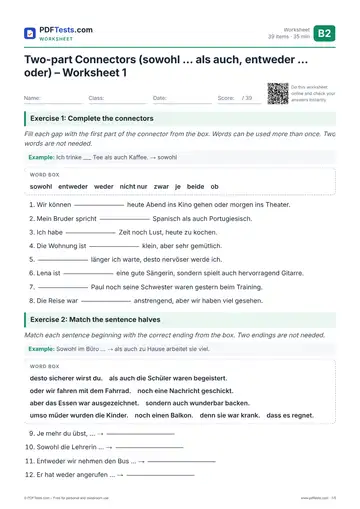
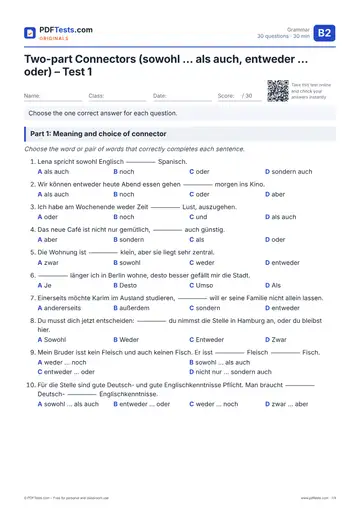
Now put the rules into practice: test yourself with our B2 Two-part Connectors test, paying special attention to inversion after weder, noch and desto, and to the missing auch in als auch. When you feel confident, try the German B2 Level Test to see how well you use these connectors alongside other B2 structures.
Was this page helpful?
What was the problem?
Thank you for your feedback!