PDFTests Originals

Hay vs Estar – Worksheet 1

A1 Beginner WorksheetSpanish

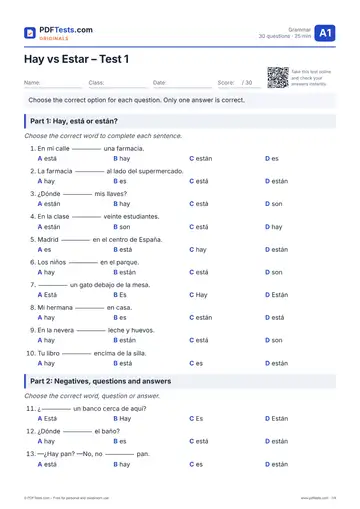
This A1 worksheet helps beginners choose between hay and estar (está/están) to talk about what exists and where things are. Learners practise the key article rule (hay + un/una/unos/unas, estar + el/la/los/las), plus negatives and questions, through controlled and freer exercises.
items
39
Time
25 min
PDF
5 pages
Answer key
Included
  • 100% free
  • No sign-up or email
  • Print-ready A4 PDF
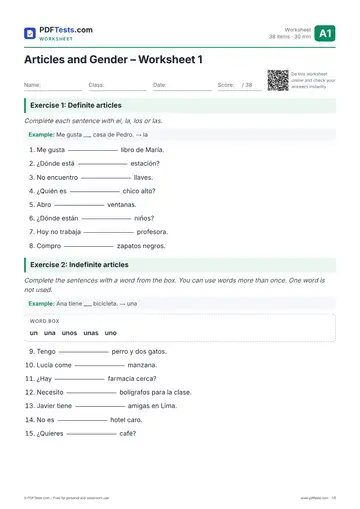
Preview of page 1 of Hay vs Estar – Worksheet 1 Open PDF
New to this topic? Read the guide first: Hay vs Estar in Spanish: Rules, Examples and Common Mistakes

Do the worksheet online

Type your answers, then press “Check my answers”. Alternative correct answers are accepted.

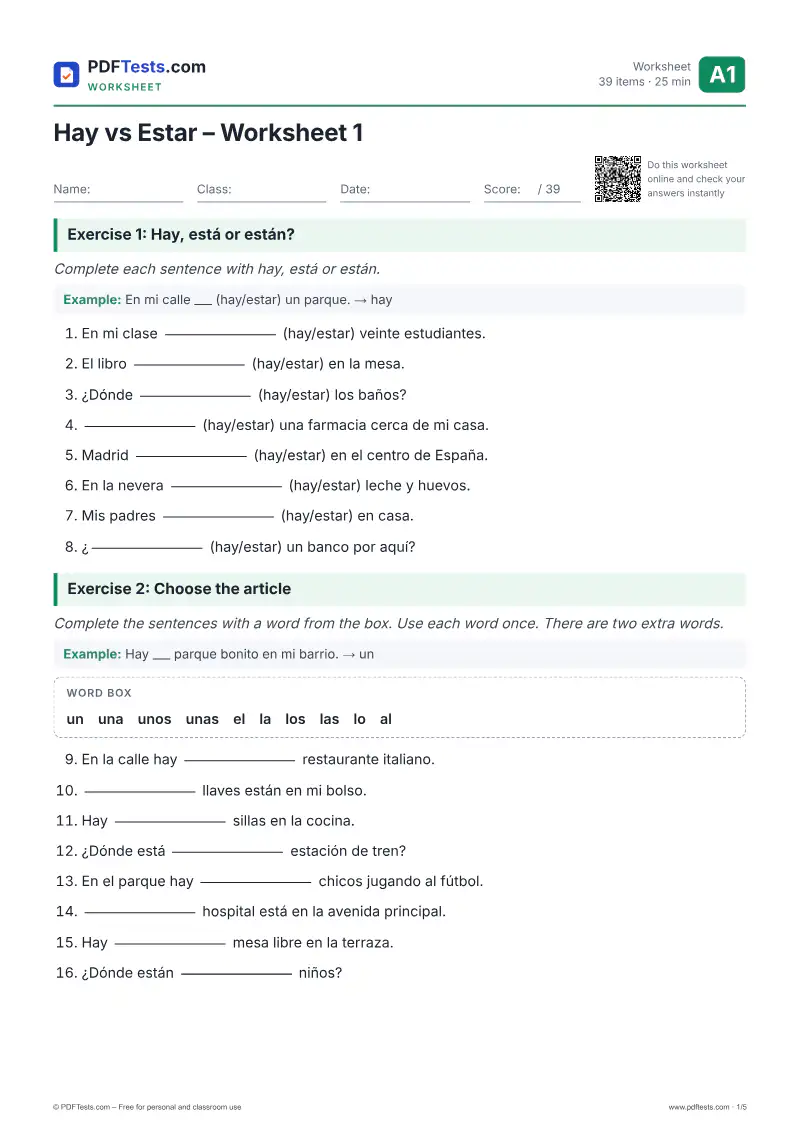
Exercise 1: Hay, está or están?

Complete each sentence with hay, está or están.

Example: En mi calle ___ (hay/estar) un parque. → hay

  1. En mi clase (hay/estar) veinte estudiantes.

  2. El libro (hay/estar) en la mesa.

  3. ¿Dónde (hay/estar) los baños?

  4. (hay/estar) una farmacia cerca de mi casa.

  5. Madrid (hay/estar) en el centro de España.

  6. En la nevera (hay/estar) leche y huevos.

  7. Mis padres (hay/estar) en casa.

  8. ¿ (hay/estar) un banco por aquí?

Exercise 2: Choose the article

Complete the sentences with a word from the box. Use each word once. There are two extra words.

Example: Hay ___ parque bonito en mi barrio. → un

Word box ununaunosunasellaloslasloal

  1. En la calle hay restaurante italiano.

  2. llaves están en mi bolso.

  3. Hay sillas en la cocina.

  4. ¿Dónde está estación de tren?

  5. En el parque hay chicos jugando al fútbol.

  6. hospital está en la avenida principal.

  7. Hay mesa libre en la terraza.

  8. ¿Dónde están niños?

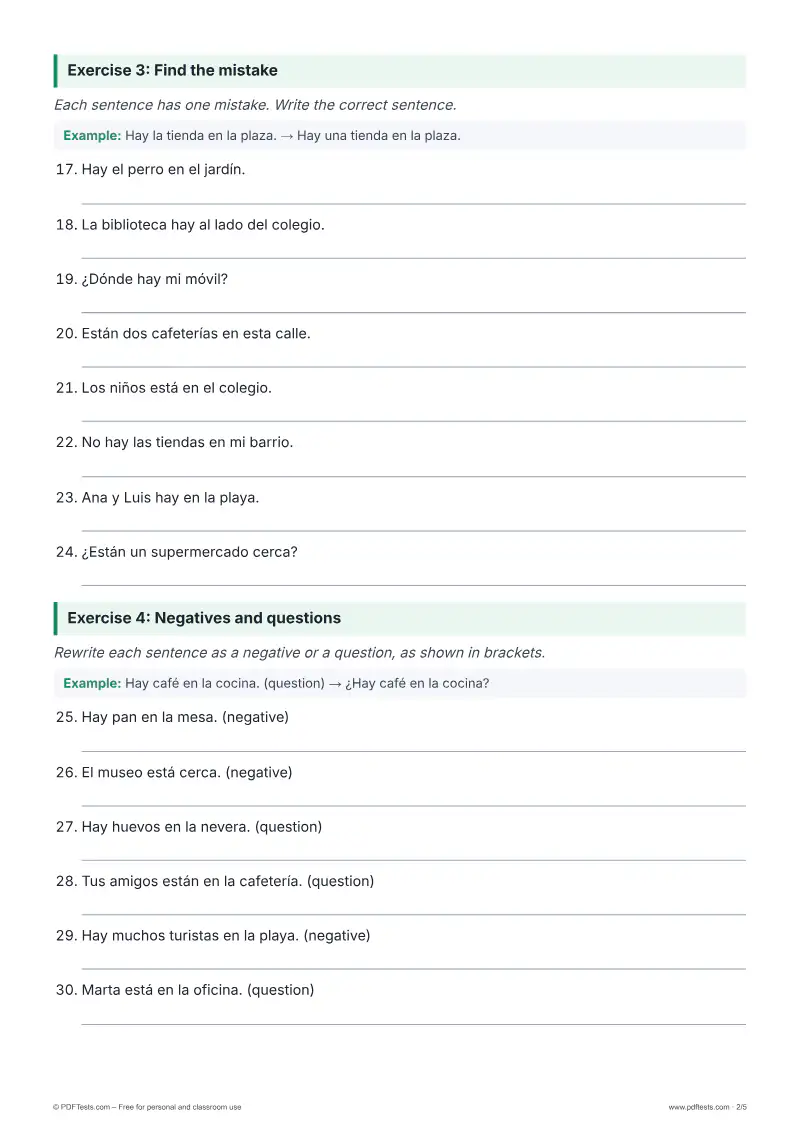
Exercise 3: Find the mistake

Each sentence has one mistake. Write the correct sentence.

Example: Hay la tienda en la plaza. → Hay una tienda en la plaza.

  1. Hay el perro en el jardín.

  2. La biblioteca hay al lado del colegio.

  3. ¿Dónde hay mi móvil?

  4. Están dos cafeterías en esta calle.

  5. Los niños está en el colegio.

  6. No hay las tiendas en mi barrio.

  7. Ana y Luis hay en la playa.

  8. ¿Están un supermercado cerca?

Exercise 4: Negatives and questions

Rewrite each sentence as a negative or a question, as shown in brackets.

Example: Hay café en la cocina. (question) → ¿Hay café en la cocina?

  1. Hay pan en la mesa. (negative)

  2. El museo está cerca. (negative)

  3. Hay huevos en la nevera. (question)

  4. Tus amigos están en la cafetería. (question)

  5. Hay muchos turistas en la playa. (negative)

  6. Marta está en la oficina. (question)

  7. Hay agua en la botella. (question)

  8. Los platos están en el armario. (negative)

Exercise 5: Put the words in order

Put the words in the correct order to make sentences or questions.

Example: hay / un / sofá / en / el salón → Hay un sofá en el salón.

  1. hay / en / tres / la / dormitorios / casa

  2. dónde / la / está / parada (question)

  3. el / está / sofá / gato / en / el

  4. no / leche / hay / la / en / nevera

  5. hay / una / por / aquí / farmacia (question)

  6. mis / no / en / están / llaves / el / bolso

  7. la / playa / está / cerca / del / hotel

Was this page helpful?

Report a mistake

Spotted a wrong answer, a typo or an unclear explanation? Tell us and we will fix it.

Preview

About this test

Free printable A1 Spanish worksheet on hay vs estar: location, articles, negatives and questions, with answers. Ideal for class or home study.

Topics covered

Hay vs estarDefinite and indefinite articlesLocationNegatives with noQuestions with ¿Hay...? and ¿Dónde está...?

Notes for teachers

Start by writing two sentences on the board, 'Hay un banco en la plaza' and 'El banco está en la plaza', and ask learners what changes. The most common mistakes are using hay with el/la or with names and possessives (*Hay el perro, *¿Dónde hay mi móvil?) and forgetting the plural están. As a follow-up, learners can describe their bedroom or neighbourhood to a partner using hay for what exists and está/están for where things are.

All Spanish A1 tests →