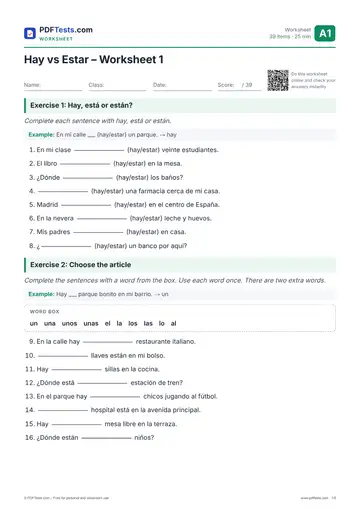
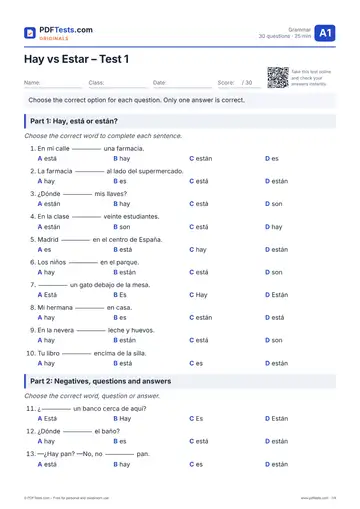
Spanish uses hay to say that something exists (there is or there are) and estar to say where a specific person or thing is. Use hay to introduce something new or general, such as un café, tres sillas or mucha gente. Use estar to say where something already known is, such as el café, mis llaves or Madrid.
If you remember the one-line rule and the article test below, you will choose correctly in most A1 sentences.
The rule in one line
- Hay + something new or general = there is / there are
- Something specific + estar + place = it is / they are (somewhere)
Compare:
- Hay un banco en esta calle. — There is a bank on this street.
- El banco está en esta calle. — The bank is on this street.
The first sentence tells the listener that a bank exists. The second assumes they already know which bank you mean and tells them where it is.
Hay: there is / there are
Hay is a special form of the verb haber. At A1 you only need this one form, and it never changes. The same word means both there is and there are.
| Spanish | English |
|---|---|
| Hay un gato en el sofá. | There is a cat on the sofa. |
| Hay dos gatos en el sofá. | There are two cats on the sofa. |
| Hay mucha gente en la playa. | There are a lot of people on the beach. |
| Hay leche en la nevera. | There is milk in the fridge. |
Pronunciation
The h is silent, so hay sounds like the English word eye. Don’t confuse it with ahí (there), which has two syllables and stress on the í: a-Í.
- El libro está ahí. — The book is there.
What comes after hay
Hay is followed by words that introduce something non-specific:
| After hay | Example | Translation |
|---|---|---|
| un / una | Hay una farmacia cerca. | There’s a pharmacy nearby. |
| unos / unas | Hay unas llaves en la mesa. | There are some keys on the table. |
| a number | Hay tres dormitorios en el piso. | There are three bedrooms in the flat. |
| mucho / poco | Hay poco tráfico hoy. | There is little traffic today. |
| algún / alguna | ¿Hay algún restaurante por aquí? | Is there a restaurant around here? |
| no article | Hay tomates y pan. | There are tomatoes and bread. |
With uncountable things such as water, milk, money or time, Spanish usually uses no article at all:
- Hay agua en la botella. — There’s water in the bottle.
- No hay tiempo. — There’s no time.
Questions and negatives with hay
To make a question, just add question marks and use rising intonation. To make a negative, put no before hay.
| Type | Example | Translation |
|---|---|---|
| Affirmative | Hay un baño arriba. | There is a bathroom upstairs. |
| Negative | No hay baño arriba. | There isn’t a bathroom upstairs. |
| Yes/no question | ¿Hay un baño arriba? | Is there a bathroom upstairs? |
| How many? | ¿Cuántos baños hay? | How many bathrooms are there? |
In negative sentences, un and una usually disappear:
- No hay pan. — There’s no bread.
- No hay ascensor en el edificio. — There’s no lift in the building.
In how many questions, cuántos or cuántas agrees with the noun:
- ¿Cuántas personas hay en tu familia? — How many people are there in your family?
Estar: where something is
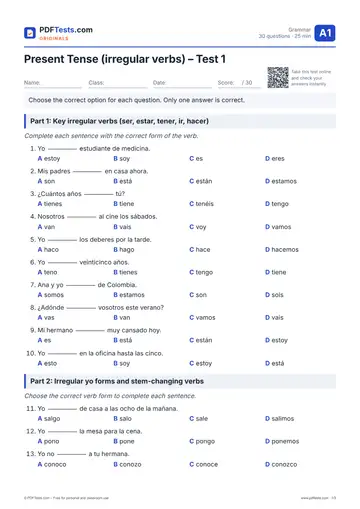
Estar tells you the location of a specific person, place or thing. Unlike hay, it changes with the subject. It is irregular in the present tense.
| Subject | Estar | Example | Translation |
|---|---|---|---|
| yo | estoy | Estoy en casa. | I’m at home. |
| tú | estás | ¿Estás en la oficina? | Are you at the office? |
| él / ella / usted | está | La estación está cerca. | The station is nearby. |
| nosotros / nosotras | estamos | Estamos en el parque. | We’re in the park. |
| vosotros / vosotras | estáis | ¿Estáis en el hotel? | Are you (all) at the hotel? |
| ellos / ellas / ustedes | están | Mis padres están en Sevilla. | My parents are in Seville. |
Watch the accents. Está means is, but esta without an accent means this.
When you talk about things and places, you mostly need está (one thing) and están (more than one). The verb must agree with the noun, which is a key difference from hay.
- La farmacia está en la esquina. — The pharmacy is on the corner.
- Las farmacias están en el centro. — The pharmacies are in the centre.
What comes before estar
Estar goes with nouns that are specific. Look for these words:
- el, la, los, las: El supermercado está al lado del banco. — The supermarket is next to the bank.
- names of people and places: Lima está en Perú. — Lima is in Peru.
- possessives (mi, tu, su…): Mi móvil está en la mochila. — My phone is in my backpack.
- demonstratives (este, esa…): Este hotel está lejos de la playa. — This hotel is far from the beach.
- subject pronouns: Ella está en el trabajo. — She’s at work.
Questions and negatives with estar
The most useful question at A1 is ¿Dónde está…? or ¿Dónde están…?
- ¿Dónde está el baño? — Where is the bathroom?
- ¿Dónde están mis llaves? — Where are my keys?
- El museo no está en el centro. — The museum isn’t in the centre.
Hay vs estar side by side
| Hay | Estar | |
|---|---|---|
| Meaning | there is / there are | is / are (located) |
| Changes form? | No: always hay | Yes: estoy, está, están… |
| Used with | un, una, unos, unas, numbers, mucho, algún, no article | el, la, los, las, names, mi, tu, este… |
| Information given | something exists | where a known thing is |
| Typical question | ¿Hay…? ¿Cuántos… hay? | ¿Dónde está…? |
Now look at these pairs. The place is the same; only the information changes.
-
Hay un hotel en la plaza. — There’s a hotel in the square.
-
El hotel está en la plaza. — The hotel is in the square.
-
Hay dos chicos en el jardín. — There are two boys in the garden.
-
Los chicos están en el jardín. — The boys are in the garden.
-
¿Dónde hay una farmacia? — Where is there a pharmacy? (any pharmacy)
-
¿Dónde está la farmacia? — Where is the pharmacy? (a specific one you both know)
The article test
When you are not sure, look at the word just before the noun.
- un, una, unos, unas, a number, mucho/poco, algún, or nothing → use hay.
- el, la, los, las, mi/tu/su, este/ese, or a name → use estar.
A common trap: even if you start the sentence with un or una, Spanish still prefers hay. Un perro está en el jardín sounds strange to native speakers.
- Hay un perro en el jardín. — There’s a dog in the garden.
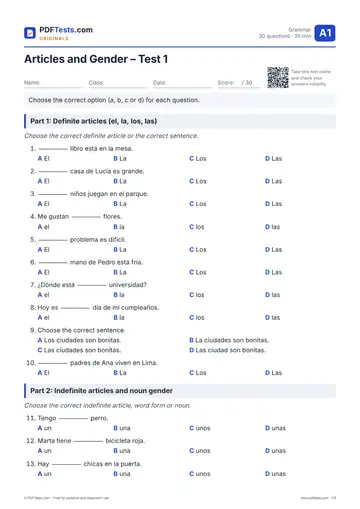
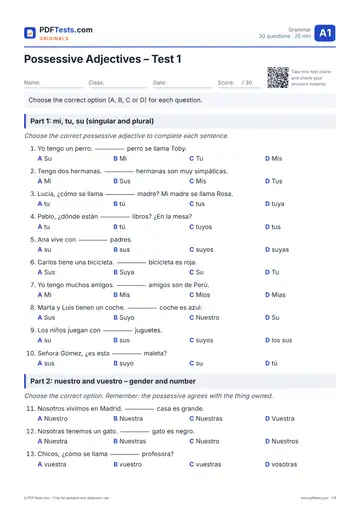
To practise the articles themselves, see our guide to Spanish articles and gender.
Location words for hay and estar
Both structures often appear with words of place:
| Spanish | English | Example | Translation |
|---|---|---|---|
| en | in, on, at | Hay fruta en la mesa. | There’s fruit on the table. |
| cerca de | near | El metro está cerca de mi casa. | The metro is near my house. |
| lejos de | far from | El aeropuerto está lejos del centro. | The airport is far from the centre. |
| al lado de | next to | Hay un café al lado del cine. | There’s a café next to the cinema. |
| delante de | in front of | El coche está delante de la casa. | The car is in front of the house. |
| detrás de | behind | Hay un jardín detrás de la escuela. | There’s a garden behind the school. |
| encima de | on top of | Las llaves están encima de la mesa. | The keys are on the table. |
| debajo de | under | El gato está debajo de la cama. | The cat is under the bed. |
| entre | between | El banco está entre la farmacia y el bar. | The bank is between the pharmacy and the bar. |
| a la derecha de | to the right of | Hay una silla a la derecha de la puerta. | There’s a chair to the right of the door. |
Remember that de + el becomes del: al lado del banco (next to the bank), not al lado de el banco.
Two things not to confuse
Hay que + infinitive
Hay que + infinitive has a different meaning: you have to or it is necessary to. It doesn’t say that something exists.
- Hay que comprar pan. — We need to buy bread.
Events use ser, not estar
For the location of events (parties, concerts, meetings, classes), Spanish uses ser:
- La fiesta es en mi casa. — The party is at my house.
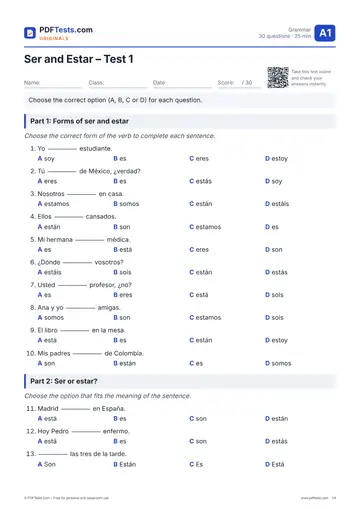
Objects and people still use estar. For more on this, read our Ser and Estar guide.
Common mistakes
- ✗ Hay el banco en la calle Mayor. → ✓ El banco está en la calle Mayor. — The bank is on Calle Mayor. With el, the bank is specific, so use estar.
- ✗ Está un supermercado cerca. → ✓ Hay un supermercado cerca. — There’s a supermarket nearby. With un, you are introducing something new, so use hay.
- ✗ Hay dos baños… Han dos baños. → ✓ Hay dos baños. — There are two bathrooms. Hay never changes for plural.
- ✗ ¿Dónde hay mi móvil? → ✓ ¿Dónde está mi móvil? — Where is my phone? Possessives make the noun specific.
- ✗ Los libros está en la mesa. → ✓ Los libros están en la mesa. — The books are on the table. Estar must agree with a plural subject.
- ✗ Es un perro en el jardín. → ✓ Hay un perro en el jardín. — There’s a dog in the garden. There is is hay, never es.
- ✗ Hay una leche en la nevera. → ✓ Hay leche en la nevera. — There’s milk in the fridge. Uncountable nouns normally take no article after hay.
- ✗ El hotel esta cerca. → ✓ El hotel está cerca. — The hotel is nearby. Without the accent, esta means this.
Quick check
Choose or correct.
- ___ un parque cerca de mi casa. (hay / está)
- ¿Dónde ___ la estación? (hay / está)
- Mis libros ___ en la mesa. (está / están)
- En mi clase ___ quince estudiantes. (hay / están)
- Correct the sentence: Hay el museo en el centro.
Answers
- Hay un parque cerca de mi casa. — There’s a park near my house. (un introduces something new)
- ¿Dónde está la estación? — Where is the station? (la = a specific station)
- Mis libros están en la mesa. — My books are on the table. (plural subject)
- En mi clase hay quince estudiantes. — There are fifteen students in my class. (number = hay)
- El museo está en el centro. — The museum is in the centre. (or Hay un museo en el centro. — There’s a museum in the centre.)
Next step
Now put the rule into practice: test yourself with our A1 Hay vs Estar test and check that you choose the right form with articles, plurals and questions. Describing your home is a great way to practise both structures, so follow up with the A1 Everyday Vocabulary test on family, home and daily routine. When you feel confident, browse all our Spanish A1 tests to review the rest of the level.
Was this page helpful?
What was the problem?
Thank you for your feedback!