PDFTests Originals

Possessive Adjectives – Worksheet 1

A1 Beginner WorksheetSpanish

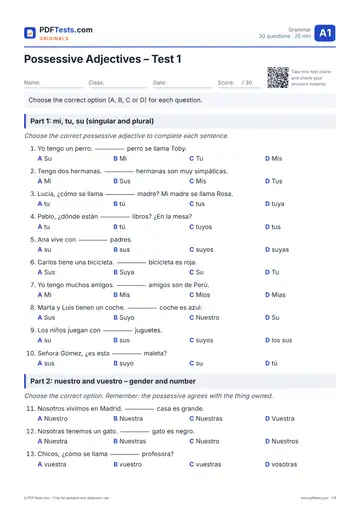
This worksheet practises Spanish possessive adjectives: mi/mis, tu/tus, su/sus, nuestro/a/os/as and vuestro/a/os/as. Beginners (A1) learn to match the possessive to the thing owned and use it in statements, negatives and questions.
items
34
Time
30 min
PDF
5 pages
Answer key
Included
  • 100% free
  • No sign-up or email
  • Print-ready A4 PDF
Preview of page 1 of Possessive Adjectives – Worksheet 1 Open PDF
New to this topic? Read the guide first: Spanish Possessive Adjectives: Mi, Tu, Su, Nuestro and Vuestro

Do the worksheet online

Type your answers, then press “Check my answers”. Alternative correct answers are accepted.

Exercise 1: Complete the sentences

Write the correct possessive adjective for the person in brackets.

Example: ___ (yo) padre es alto. → Mi

  1. (yo) hermana se llama Lucía.

  2. ¿Dónde están (tú) llaves?

  3. (nosotros) casa es pequeña.

  4. Pablo y Elena viven con (ellos) padres.

  5. ¿Es (vosotros) profesor?

  6. No encuentro (yo) libros.

  7. Carmen, ¿cómo se llama (tú) perro?

  8. (nosotros) amigas son de Chile.

Exercise 2: Use the words in the box

Complete each sentence with a word from the box. Use each word once. There are two extra words.

Example: Yo tengo una casa. ___ casa es bonita. → Mi

Word box mimistusususnuestrovuestrasnuestrastus

  1. Yo tengo un gato. gato es negro.

  2. Tengo dos primos. primos viven en Madrid.

  3. María tiene una bicicleta. bicicleta es roja.

  4. Los niños tienen muchos juguetes. juguetes están en la mesa.

  5. Nosotros tenemos un piso. piso está en el centro.

  6. Vosotras tenéis dos maletas. ¿Dónde están maletas?

  7. ¿Tú tienes un móvil nuevo? ¿Es caro móvil?

Exercise 3: Rewrite the sentences

Rewrite each sentence. Replace "el/la/los/las ... de + person" with su or sus.

Example: Es el gato de Luis. → Es su gato.

  1. Es el coche de Ana.

  2. Son los libros de Marcos.

  3. Es la casa de mis abuelos.

  4. No es la mochila de Pedro.

  5. ¿Es el abrigo de usted?

  6. Las hijas de Rosa son altas.

Exercise 4: Find the mistake

Each sentence has one mistake. Write the correct sentence.

Example: Mis casa es grande. → Mi casa es grande.

  1. Mis hermano tiene diez años.

  2. Nuestro madre es médica.

  3. ¿Dónde está tus mochila?

  4. Ellos no tienen su libros.

  5. Vuestro clases son interesantes.

  6. Hablo con mi padres todos los días.

  7. ¿Cómo se llaman tu hijos?

Exercise 5: Put the words in order

Put the words in the correct order to make sentences and questions.

Example: es / mi / Este / perro → Este es mi perro.

  1. es / mi / Esta / casa

  2. no / Nuestro / grande / es / piso

  3. tu / es / ¿Cuál / número / de / teléfono?

  4. Sus / en / Madrid / viven / abuelos

  5. ¿Dónde / vuestros / están / padres?

  6. gafas / encuentro / No / mis

Was this page helpful?

Report a mistake

Spotted a wrong answer, a typo or an unclear explanation? Tell us and we will fix it.

Preview

About this test

Printable A1 Spanish worksheet on possessive adjectives (mi, tu, su, nuestro, vuestro) with gap-fills, corrections and word order. Answers included.

Topics covered

Possessive adjectivesmi / tu / sunuestro / vuestroGender and number agreementQuestions and negatives

Notes for teachers

Start by reminding learners that the possessive agrees with the thing owned, not the owner (nuestra casa, sus libros). A common mistake is using the singular with a plural noun (mi padres) or forgetting gender with nuestro/vuestro. Another is confusing su with tu. As a follow-up, learners can bring a family photo and describe it to a partner using mi, su and nuestro.

All Spanish A1 tests →