Spanish possessive adjectives are the words for my, your, his, her, our and their: mi, tu, su, nuestro, vuestro and su. They go before the noun and show who something belongs to. The key rule is that they agree with the thing owned, not with the owner.
What possessive adjectives do
You use possessive adjectives to talk about your family, your things, your home and your daily life. They are some of the most frequent words in Spanish.
- Mi hermano vive en Madrid. — My brother lives in Madrid.
- ¿Dónde está tu móvil? — Where is your phone?
- Nuestra casa es pequeña. — Our house is small.
- Sus hijos estudian inglés. — Their children study English.
In every sentence, the possessive comes directly before the noun, just like in English.
Form: the full table
| Owner | Before a singular noun | Before a plural noun | English |
|---|---|---|---|
| yo | mi | mis | my |
| tú | tu | tus | your (informal) |
| él / ella / usted | su | sus | his / her / its / your (formal) |
| nosotros / nosotras | nuestro / nuestra | nuestros / nuestras | our |
| vosotros / vosotras | vuestro / vuestra | vuestros / vuestras | your (plural, informal, Spain) |
| ellos / ellas / ustedes | su | sus | their / your (plural) |
Notice two groups:
- Mi, tu, su change only for number (singular or plural). They have no masculine or feminine forms.
- Nuestro and vuestro change for number and gender, so each has four forms.
Mi, tu, su: add -s for plural
| Singular | Plural |
|---|---|
| mi libro — my book | mis libros — my books |
| tu amiga — your friend | tus amigas — your friends |
| su coche — his/her/their car | sus coches — his/her/their cars |
The same form works for masculine and feminine nouns: mi padre (my father), mi madre (my mother).
Nuestro and vuestro: four forms
| Masculine | Feminine | |
|---|---|---|
| Singular | nuestro piso — our flat | nuestra ciudad — our city |
| Plural | nuestros vecinos — our neighbours | nuestras llaves — our keys |
| Singular | vuestro profesor — your teacher | vuestra clase — your class |
| Plural | vuestros padres — your parents | vuestras bicicletas — your bikes |
To choose the right ending, you need to know the gender of the noun. If you are not sure about gender, review our guide to articles and gender in Spanish.
The golden rule: agree with the thing, not the owner
This is where English speakers make most mistakes. In English, his or her depends on the owner. In Spanish, the possessive depends on the noun that follows it.
- Marta tiene un hermano. → su hermano — her brother
- Pablo tiene una hermana. → su hermana — his sister
- Mis padres tienen tres gatos. → sus gatos — their cats
- Mis padres tienen un gato. → su gato — their cat
The owners in the last two examples are plural (my parents), but su gato is singular because there is only one cat.
The same logic applies to nuestro and vuestro:
- Nosotras tenemos un perro. → nuestro perro — our dog
The speakers are women (nosotras), but perro is masculine, so the form is nuestro, not nuestra.
- Vosotros tenéis una profesora muy simpática. → vuestra profesora — your teacher
The owners are masculine (vosotros), but profesora is feminine, so the form is vuestra.
A quick method: ignore the owner once you have chosen the right word (mi, tu, su, nuestro, vuestro). Then look only at the noun and match its gender and number.
Su: one word, many meanings
Su and sus can mean his, her, its, their or formal your (usted / ustedes). Usually the context makes the meaning clear.
- Carlos está con su novia. — Carlos is with his girlfriend.
- Señora López, ¿es su bolso? — Mrs López, is this your bag?
- Los niños juegan con sus juguetes. — The children are playing with their toys.
Making su clear with de + person
When su is confusing, Spanish uses el / la / los / las + noun + de + person instead:
| With su | Clearer version | English |
|---|---|---|
| su casa | la casa de él | his house |
| su casa | la casa de ella | her house |
| su casa | la casa de usted | your house (formal) |
| sus amigos | los amigos de ellos | their friends |
| su coche | el coche de Ana | Ana’s car |
Example in context:
- Juan y Lucía viven juntos. La bicicleta es de ella, el coche es de él. — Juan and Lucía live together. The bike is hers, the car is his.
This de structure is also how Spanish says Ana’s or my friend’s. There is no ’s in Spanish: el coche de Ana — Ana’s car; la madre de mi amigo — my friend’s mother.
Asking about possession
To ask whose?, use ¿De quién es…? (one thing) or ¿De quién son…? (more than one).
- ¿De quién es esta chaqueta? — Es mi chaqueta. / Es de Laura. — Whose jacket is this? — It’s my jacket. / It’s Laura’s.
- ¿De quién son estas llaves? — Son nuestras llaves. — Whose keys are these? — They’re our keys.
Note that es and son here come from ser. See our ser and estar guide for more on this verb.
Vuestro or su? Spain vs Latin America
In Spain, vosotros is the informal plural you, so vuestro is common:
- Chicos, ¿dónde está vuestra clase? — Guys, where is your classroom?
In Latin America, vosotros is not used in everyday speech. People use ustedes for all plural you, and the possessive is su / sus:
- Chicos, ¿dónde está su clase? — Guys, where is your classroom?
Both are correct. Learn the one that matches the Spanish you study, but recognise the other.
Spelling: mi vs mí, tu vs tú
The possessive adjectives mi and tu have no accent. With an accent, they are different words.
| Without accent (possessive) | With accent (pronoun) |
|---|---|
| mi casa — my house | para mí — for me |
| tu perro — your dog | tú eres — you are |
- Tú tienes tu libro. — You have your book.
- Este regalo es para mí, ¿no? Es mi cumpleaños. — This present is for me, right? It’s my birthday.
Su never has an accent.
No article before the possessive
In some languages you can say the my book. In Spanish you cannot: the possessive replaces the article.
- Mis amigos son de Chile. — My friends are from Chile. (not los mis amigos)
You can, however, use an article with de + person: los amigos de Pedro — Pedro’s friends.
Body parts and clothes: use the article
When it is obvious whose body or clothes you mean, Spanish normally uses el / la / los / las instead of a possessive, especially with reflexive verbs and doler.
- Me duele la cabeza. — My head hurts.
- Me lavo las manos. — I wash my hands.
- Pedro se pone el abrigo. — Pedro puts on his coat.
The pronoun (me, se) already shows who the person is, so a possessive is not needed.
Looking ahead: the long forms
Spanish also has long possessives: mío, tuyo, suyo, nuestro, vuestro, suyo. They go after the noun or stand alone:
- Es mío. — It’s mine.
- un amigo mío — a friend of mine
At A1, focus on the short forms before the noun. Never use a long form before a noun: mi madre, not mía madre.
Possessives with family words
Family vocabulary is the most common place to use possessives at A1:
- Mi madre se llama Elena y mi padre se llama Luis. — My mother is called Elena and my father is called Luis.
- Mis abuelos viven en el campo. — My grandparents live in the countryside.
- ¿Cómo se llaman tus hermanos? — What are your brothers and sisters called?
- Nuestros primos son muy divertidos. — Our cousins are a lot of fun.
To build this vocabulary, try our A1 Everyday Vocabulary test on family, home and daily routine.
Common mistakes
- ✗ mis casa → ✓ mi casa — casa is singular, so the possessive is singular.
- ✗ nuestro casa → ✓ nuestra casa — nuestro agrees with the feminine noun casa.
- ✗ Nosotras y nuestra perro → ✓ Nosotras y nuestro perro — the noun decides the gender, not the owners.
- ✗ Mis padres y sus coche → ✓ Mis padres y su coche — one car, so su, even with two owners.
- ✗ los mis amigos → ✓ mis amigos — no article before a possessive adjective.
- ✗ Tú tienes tú libro → ✓ Tú tienes tu libro — the possessive tu has no accent.
- ✗ Ella es mía madre → ✓ Ella es mi madre — long forms do not go before the noun.
- ✗ Me duele mi cabeza → ✓ Me duele la cabeza — with body parts, use the article.
- ✗ el coche de Ana’s → ✓ el coche de Ana — Spanish has no ’s.
Quick check
Choose the correct possessive.
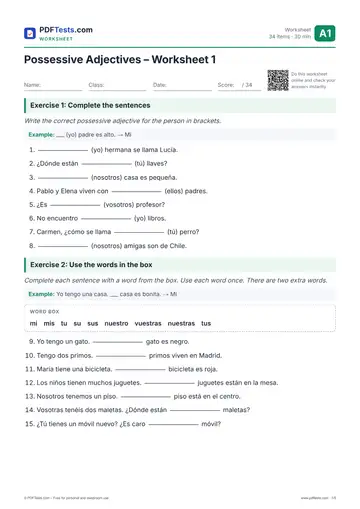
- (yo) ___ hermanas son altas.
- Nosotros vivimos en ___ casa nueva.
- Ana y Luis están con ___ perro.
- ¿Es ___ mochila, Pablo? (tú)
- Vosotros estudiáis con ___ profesoras.
Answers
- Mis — hermanas is plural.
- nuestra — casa is feminine singular.
- su — one dog, so singular su, even with two owners.
- tu — no accent on the possessive.
- vuestras — profesoras is feminine plural.
Next step
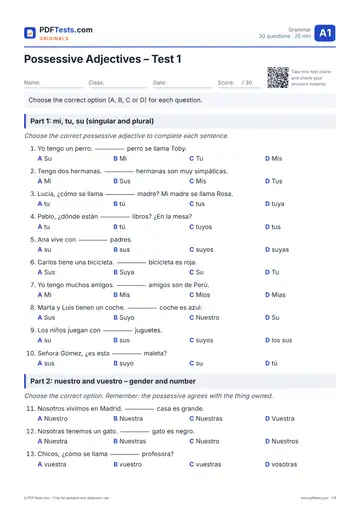
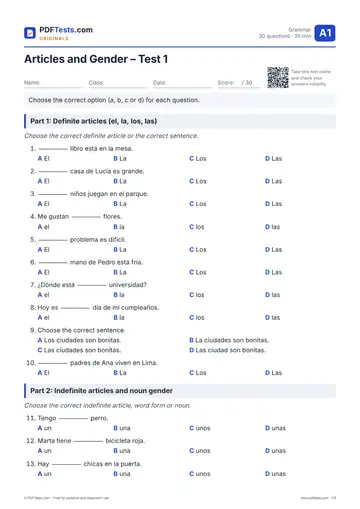
Now put the rules into practice: test yourself with our A1 Possessive Adjectives test, paying special attention to agreement with nuestro and vuestro and to the many meanings of su. If gender is still causing errors, the A1 Articles and Gender test will help, and you can find more practice in our full set of Spanish A1 tests.
Was this page helpful?
What was the problem?
Thank you for your feedback!