PDFTests Originals

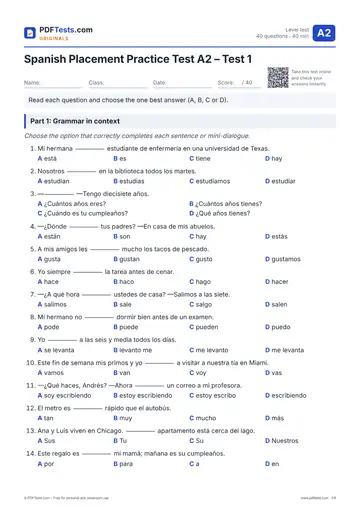
Spanish Placement Practice Test A2 – Test 2

A2 Elementary Level testSpanish

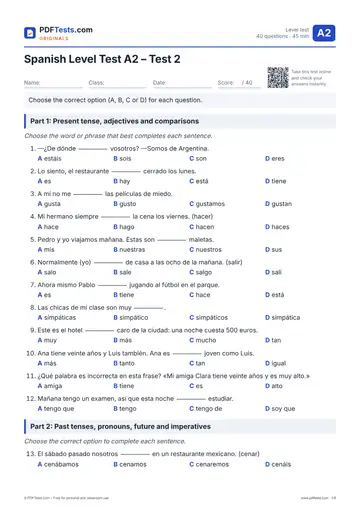
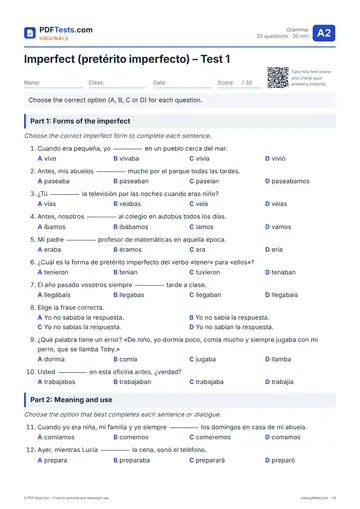
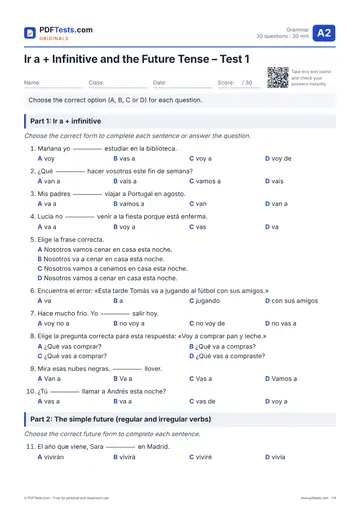
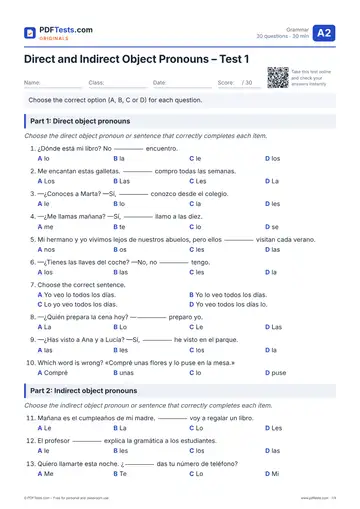
This Spanish placement practice test checks whether a learner is secure at CEFR A2, roughly the level of a Spanish 2 course in a US high school or college. It covers the core grammar and vocabulary of the level, including the preterite and imperfect, object pronouns, comparisons, commands and everyday vocabulary. It ends with a short school notice to read. It is written for English-speaking students choosing the right Spanish course.

Questions
40
Time
40 min
PDF
6 pages
Answer key
Included
  • 100% free
  • No sign-up or email
  • Print-ready A4 PDF
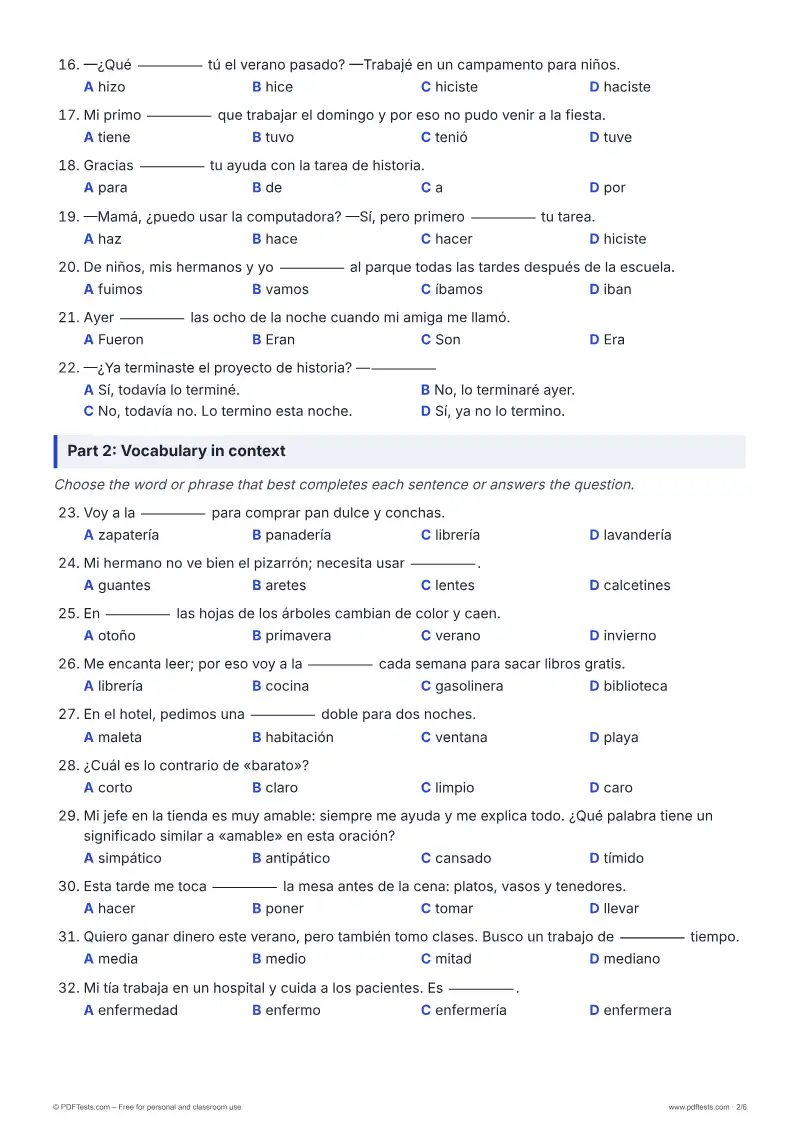
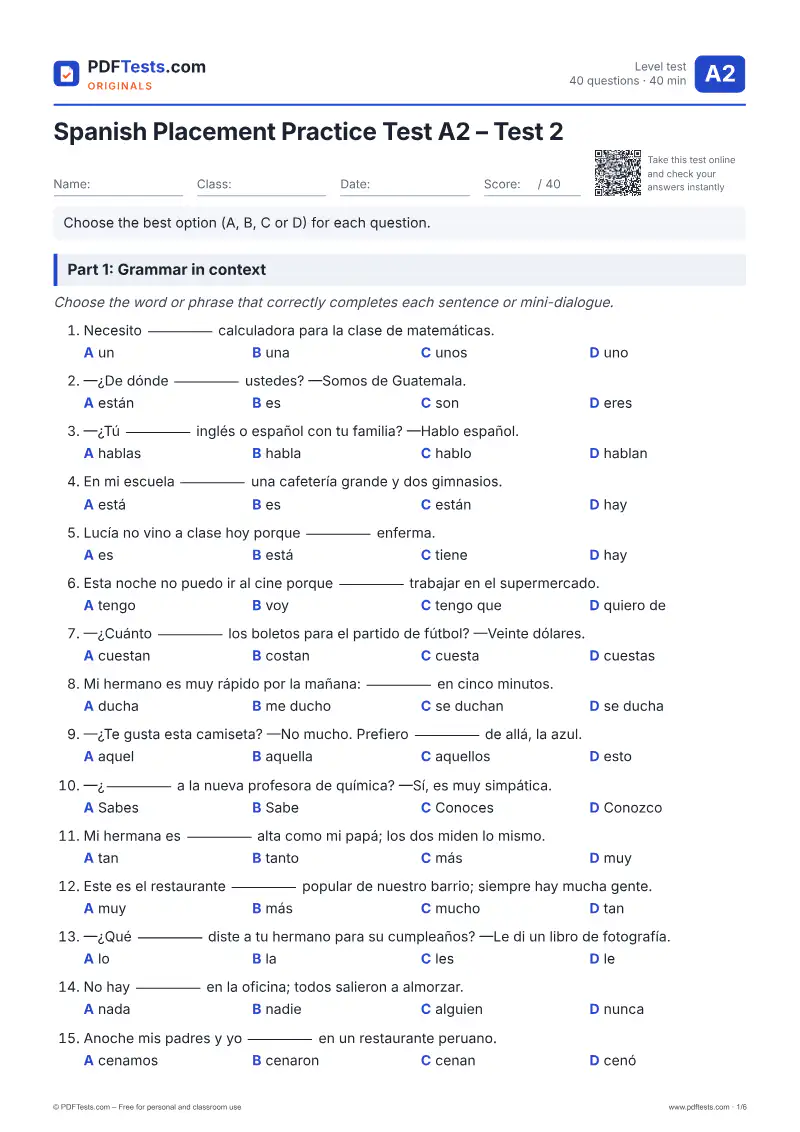
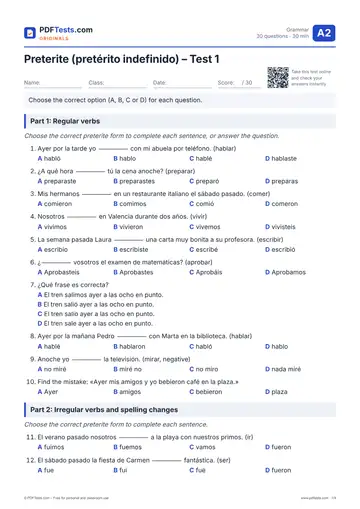
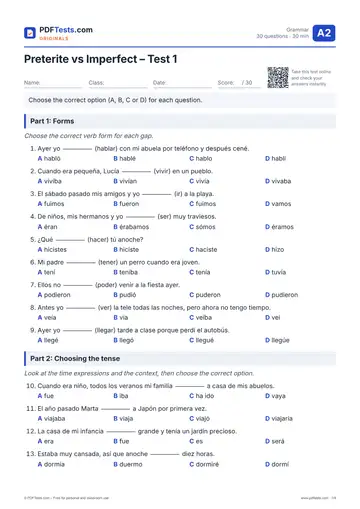
Preview of page 1 of Spanish Placement Practice Test A2 – Test 2 Open PDF
Spanish placement test · all practice tests, levels and tips

Take the test online

Choose the best option (A, B, C or D) for each question. Choose your answers, then press “Check my answers”.

Part 1: Grammar in context

Choose the word or phrase that correctly completes each sentence or mini-dialogue.

  1. Necesito _____ calculadora para la clase de matemáticas.

  2. —¿De dónde _____ ustedes? —Somos de Guatemala.

  3. —¿Tú _____ inglés o español con tu familia? —Hablo español.

  4. En mi escuela _____ una cafetería grande y dos gimnasios.

  5. Lucía no vino a clase hoy porque _____ enferma.

  6. Esta noche no puedo ir al cine porque _____ trabajar en el supermercado.

  7. —¿Cuánto _____ los boletos para el partido de fútbol? —Veinte dólares.

  8. Mi hermano es muy rápido por la mañana: _____ en cinco minutos.

  9. —¿Te gusta esta camiseta? —No mucho. Prefiero _____ de allá, la azul.

  10. —¿_____ a la nueva profesora de química? —Sí, es muy simpática.

  11. Mi hermana es _____ alta como mi papá; los dos miden lo mismo.

  12. Este es el restaurante _____ popular de nuestro barrio; siempre hay mucha gente.

  13. —¿Qué _____ diste a tu hermano para su cumpleaños? —Le di un libro de fotografía.

  14. No hay _____ en la oficina; todos salieron a almorzar.

  15. Anoche mis padres y yo _____ en un restaurante peruano.

  16. —¿Qué _____ tú el verano pasado? —Trabajé en un campamento para niños.

  17. Mi primo _____ que trabajar el domingo y por eso no pudo venir a la fiesta.

  18. Gracias _____ tu ayuda con la tarea de historia.

  19. —Mamá, ¿puedo usar la computadora? —Sí, pero primero _____ tu tarea.

  20. De niños, mis hermanos y yo _____ al parque todas las tardes después de la escuela.

  21. Ayer _____ las ocho de la noche cuando mi amiga me llamó.

  22. —¿Ya terminaste el proyecto de historia? —_____

Part 2: Vocabulary in context

Choose the word or phrase that best completes each sentence or answers the question.

  1. Voy a la _____ para comprar pan dulce y conchas.

  2. Mi hermano no ve bien el pizarrón; necesita usar _____.

  3. En _____ las hojas de los árboles cambian de color y caen.

  4. Me encanta leer; por eso voy a la _____ cada semana para sacar libros gratis.

  5. En el hotel, pedimos una _____ doble para dos noches.

  6. ¿Cuál es lo contrario de «barato»?

  7. Mi jefe en la tienda es muy amable: siempre me ayuda y me explica todo. ¿Qué palabra tiene un significado similar a «amable» en esta oración?

  8. Esta tarde me toca _____ la mesa antes de la cena: platos, vasos y tenedores.

  9. Quiero ganar dinero este verano, pero también tomo clases. Busco un trabajo de _____ tiempo.

  10. Mi tía trabaja en un hospital y cuida a los pacientes. Es _____.

  11. Mañana tengo una entrevista de trabajo. Tengo que llevar mi _____ con mi experiencia y mis estudios.

  12. El 2 de noviembre, muchas familias mexicanas celebran el Día de _____ con altares, flores y fotos de familiares que murieron.

Part 3: Reading

Read the school notice and choose the best answer to each question.

Club de Español – ¡Buscamos voluntarios para el Festival de la Familia!

¡Hola, estudiantes! El Club de Español de la Escuela Secundaria Lincoln busca voluntarios para el Festival de la Familia del Centro Comunitario Las Palmas. El festival es el sábado 12 de octubre, de las diez de la mañana a las cuatro de la tarde. Cada año vienen más de trescientas personas del barrio. Hay música, bailes folclóricos, comida de varios países y juegos para niños.

Necesitamos ayuda en tres áreas. En la mesa de información, los voluntarios dan mapas del festival y contestan preguntas en inglés y en español. En el área de niños, ayudan con las actividades de arte. En la cocina, preparan aguas frescas y limpian las mesas. No necesitas hablar español perfectamente, pero es una buena oportunidad para practicar.

Cada voluntario trabaja un turno de tres horas: por la mañana (de 10:00 a 1:00) o por la tarde (de 1:00 a 4:00). Los voluntarios reciben una camiseta del festival y un almuerzo gratis. Además, el festival cuenta como tres horas de servicio comunitario para la escuela.

Si quieres participar, habla con la profesora Herrera en el salón 204 antes del viernes 4 de octubre. Los estudiantes menores de dieciséis años necesitan un permiso firmado por sus padres.

El año pasado, quince estudiantes del club ayudaron en el festival. ¡Este año queremos ser veinte!

  1. ¿Qué es este texto?

  2. ¿Cuántas horas dura el festival?

  3. ¿Qué hacen los voluntarios en la mesa de información?

  4. Según el anuncio, ¿qué es verdad?

  5. Carlos tiene quince años y quiere ayudar en el festival. ¿Qué tiene que hacer?

  6. ¿Qué quiere decir la frase «¡Este año queremos ser veinte!»?

Was this page helpful?

Report a mistake

Spotted a wrong answer, a typo or an unclear explanation? Tell us and we will fix it.

Preview

About this test

This Spanish placement practice test checks whether a learner is secure at CEFR A2, roughly the level of a Spanish 2 course in a US high school or college. It covers the core grammar and vocabulary of the level, including the preterite and imperfect, object pronouns, comparisons, commands and everyday vocabulary. It ends with a short school notice to read. It is written for English-speaking students choosing the right Spanish course.

Topics covered

Ser, estar and hayPresent tense and stem-changing verbsPreterite and imperfectObject pronounsComparatives and superlativesTú commandsEveryday and school vocabularyReading a school notice

How to use this test

  1. Download the PDF and print it, or take the test online below.
  2. Answer every question without a dictionary or time pressure.
  3. Check your answers and note the topics you need to review.

Notes for teachers

Give the test without dictionaries. As a rough guide, a score of 32/40 or more suggests the learner is secure at A2 and ready for a B1 (Spanish 3) course. A score of 22–31 suggests the learner should consolidate A2, and a lower score points to an A1/Spanish 1 review. Common errors to watch for are ser vs. estar, hay vs. estar, lo/le confusion, preterite vs. imperfect, and false friends such as librería/biblioteca. For follow-up, ask students to explain their wrong answers aloud or rewrite them as their own sentences.