Spanish conditional sentences link a condition introduced by si (if) to its result. The tense after si shows how real the condition is: likely, unlikely or already impossible. At B2 you need all three main patterns, mixed forms, and the connectors that can replace si.
The three main patterns at a glance
| Type | Meaning | Si clause | Result clause |
|---|---|---|---|
| Real | possible or likely | present indicative | present, future or imperative |
| Unreal (present/future) | hypothetical or unlikely | imperfect subjunctive | conditional |
| Impossible (past) | did not happen | pluperfect subjunctive | conditional perfect (or pluperfect subjunctive) |
- Si llueve, me quedo en casa. If it rains, I stay at home.
- Si lloviera, me quedaría en casa. If it rained, I would stay at home.
- Si hubiera llovido, me habría quedado en casa. If it had rained, I would have stayed at home.
The two clauses can go in either order. Use a comma when the si clause comes first: Me quedo en casa si llueve. I stay at home if it rains.
Type 1: real conditions
Use si + present indicative when the condition is possible or likely. The result can be in the present, the future or the imperative.
- Si terminas pronto, iremos al cine. If you finish early, we’ll go to the cinema.
- Si calientas el agua a cien grados, hierve. If you heat water to a hundred degrees, it boils.
- Si ves a Marta, dile que me llame. If you see Marta, tell her to call me.
- Si quieres, puedo ayudarte con la mudanza. If you like, I can help you with the move.
Real conditions can also refer to the past when the speaker doesn’t know what happened, so other indicative tenses are possible:
- Si has terminado el informe, puedes irte. If you’ve finished the report, you can go.
- Si Luis dijo eso, se equivocó. If Luis said that, he was wrong.
The key rule: after conditional si, never use the present subjunctive, the future or the conditional.
Type 2: unreal or unlikely conditions
Use si + imperfect subjunctive, with the conditional in the result, for situations that are contrary to present facts or that you see as unlikely.
- Si tuviera más tiempo, aprendería a tocar la guitarra. If I had more time, I’d learn to play the guitar. (I don’t have time.)
- Si me tocara la lotería, dejaría de trabajar. If I won the lottery, I’d stop working.
- Si yo fuera tú, no le diría nada. If I were you, I wouldn’t tell him anything.
The choice between type 1 and type 2 often depends on how the speaker sees the situation:
- Si me llama, se lo diré. If she calls me, I’ll tell her. (quite possible)
- Si me llamara, se lo diría. If she called me, I’d tell her. (I doubt it will happen)
Forms you need
The imperfect subjunctive comes from the ellos form of the preterite: remove -ron and add -ra or -se.
| Infinitive | Preterite (ellos) | Imperfect subjunctive (yo) | Conditional (yo) |
|---|---|---|---|
| hablar | hablaron | hablara / hablase | hablaría |
| tener | tuvieron | tuviera / tuviese | tendría |
| hacer | hicieron | hiciera / hiciese | haría |
| poder | pudieron | pudiera / pudiese | podría |
| decir | dijeron | dijera / dijese | diría |
| ser / ir | fueron | fuera / fuese | sería / iría |
The -ra and -se forms are interchangeable in the si clause. The -ra form is more common overall, while -se is still widely used in Spain. In the result clause, use the conditional. Only a few -ra forms (quisiera, pudiera, debiera) can replace it. If these forms are still shaky, review our guides to the imperfect subjunctive and the conditional tense.
Type 3: impossible conditions in the past
Use si + pluperfect subjunctive to talk about something that did not happen and its imagined result. The result clause normally uses the conditional perfect.
- Si hubiera salido antes, no habría perdido el vuelo. If I had left earlier, I wouldn’t have missed the flight.
- Si me lo hubieras dicho, te habría ayudado. If you had told me, I would have helped you.
- Si hubiésemos reservado, habríamos conseguido mesa. If we had booked, we would have got a table.
In the result clause, hubiera + participle is also correct and very common: Si lo hubiera sabido, no hubiera venido. If I had known, I wouldn’t have come. The reverse is not possible: habría never goes after si.
| Person | Pluperfect subjunctive (si clause) | Conditional perfect (result) |
|---|---|---|
| yo | hubiera / hubiese + participle | habría + participle |
| tú | hubieras / hubieses | habrías |
| él, ella, usted | hubiera / hubiese | habría |
| nosotros | hubiéramos / hubiésemos | habríamos |
| vosotros | hubierais / hubieseis | habríais |
| ellos, ellas, ustedes | hubieran / hubiesen | habrían |
Mixed conditionals
Time does not have to match in both halves. Combine the patterns when the logic requires it.
Past condition, present result: pluperfect subjunctive + conditional.
- Si hubiera aceptado aquel trabajo, ahora viviría en Madrid. If I had accepted that job, I’d be living in Madrid now.
- Si no hubieras perdido el tren, ya estarías aquí. If you hadn’t missed the train, you’d be here by now.
Present condition, past result: imperfect subjunctive + conditional perfect.
- Si no fuera tan despistado, no habría olvidado las llaves. If he weren’t so absent-minded, he wouldn’t have forgotten the keys.
- Si hablara alemán, me habrían dado el puesto. If I spoke German, they would have given me the job.
Si with indicative past tenses
Not every past si clause is hypothetical. For real past habits, use the imperfect indicative in both clauses. Here si is close to cuando:
- Si llovía, nos quedábamos en casa jugando a las cartas. Whenever it rained, we stayed at home playing cards.
In reported speech, a type 1 sentence shifts back to imperfect indicative + conditional. This is correct and different from type 2: «Si puedo, iré» → Dijo que si podía, iría. He said that if he could, he would go. See our reported speech guide for the full set of tense changes.
In informal speech in Spain you will also hear Si lo sé, no vengo. If I’d known, I wouldn’t have come. Recognise it, but use the standard type 3 form in writing and exams.
Other ways to express a condition
Several connectors introduce conditions. Unlike si, they take the present subjunctive for present or future reference.
| Connector | Meaning | Example |
|---|---|---|
| como + subjunctive | if (warning or threat) | Como no te des prisa, perderemos el tren. If you don’t hurry up, we’ll miss the train. |
| a menos que, a no ser que | unless | No iré a menos que me invites. I won’t go unless you invite me. |
| en caso de que | in case, if | En caso de que haya problemas, llámame. If there are any problems, call me. |
| siempre que, con tal de que | as long as, provided that | Te lo presto siempre que me lo devuelvas mañana. I’ll lend it to you as long as you give it back tomorrow. |
| de + infinitive | if, had I… | De haberlo sabido, habría venido antes. Had I known, I would have come earlier. |
For hypothetical or past contexts, these connectors take the imperfect or pluperfect subjunctive: Me dijo que vendría con tal de que lo recogiéramos. He told me he would come provided we picked him up.
Si vs cuando
Si presents an uncertain condition. Cuando refers to a time you expect to arrive. The moods also differ: cuando takes the present subjunctive for the future, but conditional si never does.
- Cuando llegues, llámame. When you arrive, call me. (You will arrive.)
- Si llegas tarde, llámame. If you’re late, call me. (Maybe you will, maybe not.)
When si means whether in an indirect question, the future and conditional are allowed: No sé si vendrá. I don’t know whether he’ll come. For more on mood choice after connectors, see our guide to subjunctive vs indicative.
Common mistakes
- ✗ Si tendría dinero, viajaría. → ✓ Si tuviera dinero, viajaría. The conditional never goes after si.
- ✗ Si llueva mañana, no saldremos. → ✓ Si llueve mañana, no saldremos. Conditional si never takes the present subjunctive.
- ✗ Si vendrás, avísame. → ✓ Si vienes, avísame. Use the present, not the future, after si.
- ✗ Si habría sabido la verdad, te lo habría dicho. → ✓ Si hubiera sabido la verdad, te lo habría dicho. Past hypotheses need the pluperfect subjunctive.
- ✗ Si tuviese tiempo, te ayudase. → ✓ Si tuviese tiempo, te ayudaría. The -se form cannot replace the conditional.
- ✗ No iré a menos que me invitas. → ✓ No iré a menos que me invites. A menos que always takes the subjunctive.
- ✗ Sí tienes hambre, come algo. → ✓ Si tienes hambre, come algo. Sí with an accent means yes; conditional si has no accent.
Quick check
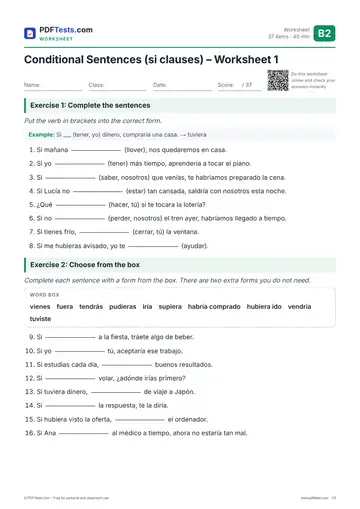
Complete each sentence with the correct form of the verb in brackets.
- Si (tener, yo) ___ tiempo mañana, te llamaré.
- Si yo (ser) ___ tú, no firmaría ese contrato.
- Si (saber, yo) ___ que estabas enferma, te habría visitado.
- Como no (estudiar, tú) ___, suspenderás el examen.
- Si no hubieras perdido el tren, ahora (estar, tú) ___ aquí.
Answers
- tengo: real condition, present indicative.
- fuera / fuese: unreal present, imperfect subjunctive.
- hubiera / hubiese sabido: impossible past, pluperfect subjunctive.
- estudies: como as a warning takes the present subjunctive.
- estarías: mixed conditional, with a past condition and a present result.
Next step
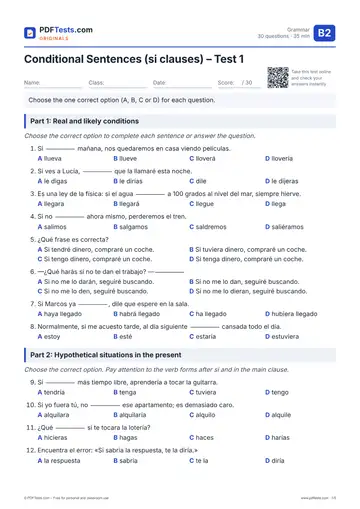
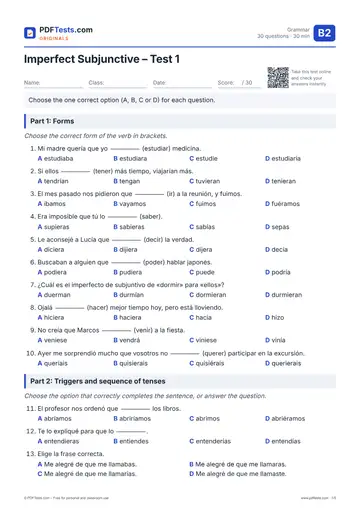
Put the rules into practice with our B2 Conditional Sentences (si clauses) test. It mixes all three types, mixed conditionals and connectors like como and a menos que. If the verb forms slow you down, take the B2 Imperfect Subjunctive test first, then return to the si clauses test until you can choose the right pattern without hesitating.
Was this page helpful?
What was the problem?
Thank you for your feedback!