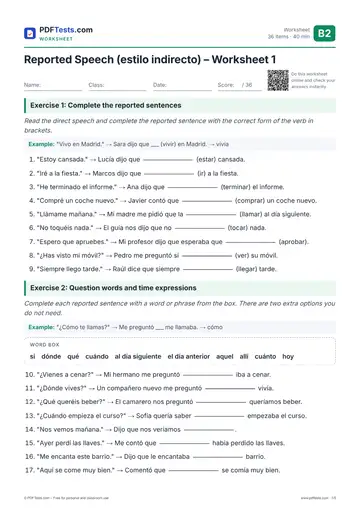
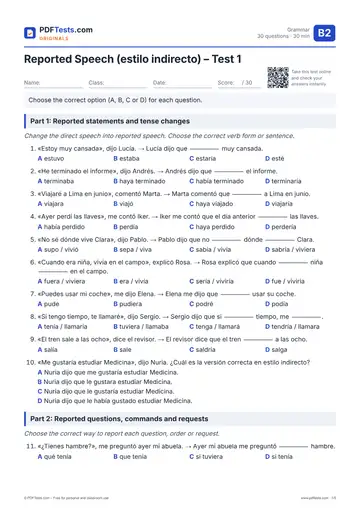
Reported speech (estilo indirecto) is how you tell someone what another person said, asked or ordered without quoting their exact words. In Spanish it is built with a reporting verb such as decir, preguntar or pedir, followed by que, si or a question word. At B2, the key skills are shifting tenses after a past reporting verb and using the subjunctive for reported commands and requests.
Direct speech vs reported speech
- Direct: Marta dijo: «Estoy cansada». Marta said, “I’m tired.”
- Reported: Marta dijo que estaba cansada. Marta said (that) she was tired.
Unlike English that, the Spanish que cannot be left out: ✗ Marta dijo estaba cansada.
When you move from direct to reported speech, up to three things can change:
- Verb tense (if the reporting verb is in the past)
- Person: pronouns, possessives and verb endings
- Time and place words: hoy, aquí, mañana, etc.
When do the tenses change?
Reporting verb in the present, present perfect or future
The tense stays the same. Only the person changes.
- «Tengo hambre». → Dice que tiene hambre. He says he’s hungry.
- «Llegaré tarde». → Ha dicho que llegará tarde. She’s said she’ll be late.
Reporting verb in the past
After a past reporting verb (dijo, comentó, explicó, preguntó, decía, había dicho), the verb in the reported clause normally moves one step back in time. This is the backshift shown in the table below.
Keeping the original tense
If the information is still true or relevant now, you can keep the original tense:
- Me dijo que es de Bogotá. / Me dijo que era de Bogotá. He told me he’s / he was from Bogotá.
Both are correct. Backshifting is always the safe choice after a past reporting verb; keeping the tense stresses that the fact still applies.
Tense changes after a past reporting verb
| Direct speech | Reported speech (after dijo que) | Translation |
|---|---|---|
| Presente: «Vivo en Sevilla». | Imperfecto: Dijo que vivía en Sevilla. | She said she lived in Seville. |
| Pretérito perfecto: «He perdido las llaves». | Pluscuamperfecto: Dijo que había perdido las llaves. | He said he had lost the keys. |
| Indefinido: «Vi la película». | Pluscuamperfecto (or no change): Dijo que había visto / vio la película. | She said she had seen the film. |
| Imperfecto: «Estaba lloviendo». | No change: Dijo que estaba lloviendo. | He said it was raining. |
| Pluscuamperfecto: «Ya había salido». | No change: Dijo que ya había salido. | She said she had already left. |
| Futuro: «Te llamaré». | Condicional: Me dijo que me llamaría. | He told me he would call me. |
| Futuro perfecto: «Habré terminado a las seis». | Condicional compuesto: Dijo que habría terminado a las seis. | She said she would have finished by six. |
| Condicional: «Me gustaría ir». | No change: Dijo que le gustaría ir. | He said he would like to go. |
| Ir a + infinitive: «Voy a mudarme». | Iba a + infinitive: Dijo que iba a mudarse. | She said she was going to move. |
| Presente de subjuntivo: «Espero que apruebes». | Imperfecto de subjuntivo: Me dijo que esperaba que aprobara. | She told me she hoped I would pass. |
| Perfecto de subjuntivo: «Me alegro de que hayas venido». | Pluscuamperfecto de subjuntivo: Dijo que se alegraba de que hubiera venido. | He said he was glad I had come. |
| Imperativo: «Cierra la puerta». | Imperfecto de subjuntivo: Me dijo que cerrara la puerta. | He told me to close the door. |
A useful shortcut: tenses that already look “backwards” (imperfect, pluperfect, conditional, imperfect subjunctive) do not change. If the conditional forms are shaky, review the conditional tense guide; for -ara/-iera forms, see the imperfect subjunctive guide.
Reporting commands, requests and advice
An imperative never survives into reported speech. It becomes que + subjunctive. The tense of the subjunctive depends on the reporting verb.
| Direct speech | Present reporting verb | Past reporting verb |
|---|---|---|
| «Ven pronto». | Dice que vengas pronto. | Dijo que vinieras pronto. |
| «No toques nada». | Te pide que no toques nada. | Te pidió que no tocaras nada. |
| «Hablad más bajo». | Os dice que habléis más bajo. | Os dijo que hablarais más bajo. |
Translations: Come soon. / He says / said you should come soon. — Don’t touch anything. / She asks / asked you not to touch anything. — Speak more quietly. / He tells / told you (all) to speak more quietly.
Common verbs for this pattern: decir, pedir, rogar, ordenar, aconsejar, recomendar, sugerir, exigir, insistir en.
- Mi jefa me pidió que revisara el informe. My boss asked me to check the report.
- El médico le aconsejó que durmiera más. The doctor advised him to sleep more.
If you need to revise the original commands, the imperative guide covers affirmative and negative forms.
Decir + indicative or subjunctive
Decir changes meaning with the mood that follows it:
- Me dijo que llegaba a las ocho. He told me he was arriving at eight. (information → indicative)
- Me dijo que llegara a las ocho. He told me to arrive at eight. (instruction → subjunctive)
This contrast is a classic exam point; the subjunctive vs indicative guide explains the wider logic.
A note on present subjunctive after a past verb
When the request is still pending at the moment of speaking, many speakers use the present subjunctive even after a past verb:
- Ayer me pidió que te llame. / Ayer me pidió que te llamara. Yesterday she asked me to call you.
Both are heard, especially in Latin America. In exams, the imperfect subjunctive is the standard answer.
Reporting questions
Yes/no questions: si
Use si (if, whether), without an accent:
- «¿Tienes coche?» → Me preguntó si tenía coche. She asked me if I had a car.
- «¿Habéis comido ya?» → Nos preguntó si habíamos comido ya. He asked us if we had already eaten.
Questions with a question word
Keep the question word, with its accent:
- «¿Dónde trabajas?» → Me preguntó dónde trabajaba. He asked me where I worked.
- «¿Cuándo vais a volver?» → Nos preguntaron cuándo íbamos a volver. They asked us when we were going to come back.
- «¿Qué has comprado?» → Le preguntó qué había comprado. She asked him what he had bought.
The subject often comes after the verb, as in the original question: Me preguntó dónde estaba la estación (He asked me where the station was).
In everyday speech you will also hear que si and que dónde: Me preguntó que si tenía coche. This is normal in conversation but best avoided in formal writing.
Other verbs that introduce indirect questions: querer saber, no saber, preguntarse.
- Quería saber cuánto costaba. She wanted to know how much it cost.
Person, time and place changes
Pronouns, possessives and verb endings change to match the new speaker:
- «Mi hermano vive aquí». → Dijo que su hermano vivía allí. He said his brother lived there.
When the time or place of reporting is different from the original, these words usually shift:
| Direct speech | Reported speech |
|---|---|
| hoy | ese día / aquel día |
| ayer | el día anterior |
| mañana | al día siguiente |
| ahora | en ese momento / entonces |
| la semana que viene | la semana siguiente |
| el año pasado | el año anterior |
| hace dos días | dos días antes |
| aquí | allí / ahí |
| este, esta | ese, esa / aquel, aquella |
| venir / traer | ir / llevar |
- «Mañana vendré aquí con mi novia». → Dijo que al día siguiente iría allí con su novia. He said he would go there with his girlfriend the next day.
Only change these words if the frame has really changed. If you report something said this morning, Dijo que mañana viene is perfectly natural.
Useful reporting verbs
Varying the reporting verb makes your Spanish sound more precise:
- afirmar, asegurar, explicar, comentar, contar + que + indicative: Aseguró que no sabía nada. He insisted he knew nothing.
- reconocer, admitir + que + indicative: Reconoció que se había equivocado. She admitted she had been wrong.
- prometer + que + conditional, or + infinitive: Prometió que llamaría. / Prometió llamar. He promised to call.
- negar + que + subjunctive (usually): Negó que hubiera roto el jarrón. He denied having broken the vase.
- sugerir, proponer + que + subjunctive: Propuso que saliéramos antes. She suggested we leave earlier.
A negated communication verb often takes the subjunctive: No dije que fuera fácil. I didn’t say it was easy.
Common mistakes
- ✗ Me dijo de llamarlo. → ✓ Me dijo que lo llamara. — Reported commands need que + subjunctive, not de + infinitive.
- ✗ Ana me pidió que la ayudo. → ✓ Ana me pidió que la ayudara. — Pedir que always takes the subjunctive.
- ✗ Me preguntó que vivía en Madrid. → ✓ Me preguntó si vivía en Madrid. — Yes/no questions are reported with si.
- ✗ Me preguntó donde trabajaba. → ✓ Me preguntó dónde trabajaba. — The question word keeps its accent in indirect questions.
- ✗ Dijo que iré a Lima. → ✓ Dijo que iría a Lima. — The future becomes conditional, and the person changes from yo to él.
- ✗ Dijo estaba enfermo. → ✓ Dijo que estaba enfermo. — Que cannot be omitted in Spanish.
- ✗ El lunes dijo que había llegado ayer. → ✓ El lunes dijo que había llegado el día anterior. — Shift time words when the time frame has changed.
Quick check
Complete the reported sentences (reporting verb in the past).
- «Estoy en casa». → Luis dijo que ___ en casa.
- «¿Has visto a Pedro?» → Me preguntó ___ a Pedro.
- «Llámame esta noche». → Me pidió que lo ___ esa noche.
- «Iremos a la playa». → Dijeron que ___ a la playa.
- «¿Dónde está el museo?» → Nos preguntó ___ el museo.
Answers: 1. estaba 2. si había visto 3. llamara 4. irían 5. dónde estaba
Next step
Reported speech combines several B2 skills at once: tense sequencing, the conditional and the imperfect subjunctive. The best way to make the changes automatic is to transform lots of sentences under time pressure, so test yourself with our B2 Reported Speech test and check which tense shifts still slow you down. When you are confident, explore the other Spanish B2 tests to see how reported speech fits into wider upper-intermediate grammar.
Was this page helpful?
What was the problem?
Thank you for your feedback!