The Spanish conditional (el condicional simple) is the tense that usually translates English would + verb: hablaría means I would speak. You use it to talk about imagined situations, to make polite requests and give advice, to report what someone said about the future, and to guess about the past. It is one of the easiest tenses to form, because the same endings work for all verbs.
When to use the conditional
1. Imagined or hypothetical situations
Use the conditional for things that are not real now but that you imagine.
- Con más dinero, viajaría por todo el mundo. — With more money, I would travel all over the world.
- ¿Vivirías en otro país? — Would you live in another country?
- Yo nunca haría eso. — I would never do that.
Very often the condition is expressed with si + imperfect subjunctive, and the result is in the conditional:
- Si tuviera tiempo, aprendería japonés. — If I had time, I would learn Japanese.
At B1 you mainly need to recognise this pattern. For the full picture, see our guide to conditional sentences with si clauses.
2. Polite requests and wishes
The conditional softens a request or a wish, just like would or could in English.
- ¿Podrías ayudarme con esta maleta? — Could you help me with this suitcase?
- Me gustaría reservar una mesa para dos. — I would like to book a table for two.
- ¿Le importaría cerrar la ventana? — Would you mind closing the window?
- Querría hablar con la directora, por favor. — I would like to speak to the director, please.
3. Advice and suggestions
Use deberías (you should), podrías (you could) or the fixed expressions yo que tú / yo en tu lugar (if I were you).
- Deberías descansar un poco. — You should rest a bit.
- Yo que tú, llamaría al médico. — If I were you, I would call the doctor.
- Podríamos ir al cine esta noche. — We could go to the cinema tonight.
4. The future seen from the past
When you report something that was future at a past moment, the future tense becomes conditional.
- Dijo que vendría a las ocho. — He said he would come at eight.
- Pensaba que el examen sería más fácil. — I thought the exam would be easier.
- Me prometieron que me llamarían. — They promised me they would call me.
This shift is a key part of reported speech in Spanish.
5. Guessing about the past
The conditional can express probability or a guess about a past moment, like English must have or probably.
- ¿Qué hora era cuando llegaste? — Serían las dos. — What time was it when you arrived? — It must have been about two.
- Tendría unos treinta años. — He was probably about thirty.
How to form the conditional
Regular verbs
Take the whole infinitive and add the endings. The endings are the same for -ar, -er and -ir verbs.
| Subject | hablar | comer | vivir |
|---|---|---|---|
| yo | hablaría | comería | viviría |
| tú | hablarías | comerías | vivirías |
| él / ella / usted | hablaría | comería | viviría |
| nosotros/as | hablaríamos | comeríamos | viviríamos |
| vosotros/as | hablaríais | comeríais | viviríais |
| ellos / ellas / ustedes | hablarían | comerían | vivirían |
- Comería pizza todos los días. — I would eat pizza every day.
In Latin America, ustedes + -ían is used instead of the vosotros form.
Irregular verbs
Twelve common verbs have an irregular stem. These are exactly the same stems as in the future tense, so if you know the future tense, you already know them. The endings never change.
| Infinitive | Stem | yo form | English |
|---|---|---|---|
| decir | dir- | diría | I would say |
| hacer | har- | haría | I would do/make |
| poder | podr- | podría | I could / would be able to |
| poner | pondr- | pondría | I would put |
| querer | querr- | querría | I would want |
| saber | sabr- | sabría | I would know |
| salir | saldr- | saldría | I would leave / go out |
| tener | tendr- | tendría | I would have |
| venir | vendr- | vendría | I would come |
| valer | valdr- | valdría | it would be worth |
| caber | cabr- | cabría | it would fit |
| haber | habr- | habría | there would be |
The stems follow three patterns:
- Vowel drops out: poder → podr-, querer → querr-, saber → sabr-, caber → cabr-, haber → habr-
- Vowel replaced by d: poner → pondr-, tener → tendr-, salir → saldr-, venir → vendr-, valer → valdr-
- Shortened stem: decir → dir-, hacer → har-
Verbs built on these keep the same irregularity: mantener → mantendría, proponer → propondría, deshacer → desharía, suponer → supondría.
- ¿Qué harías tú en mi lugar? — What would you do in my place?
- No sabría qué decir. — I wouldn’t know what to say.
- Habría más gente el sábado. — There would be more people on Saturday.
Negatives and questions
Negatives put no before the verb (and before any object pronouns). Questions use the same word order, with question marks and rising intonation.
| Type | Example | Translation |
|---|---|---|
| Affirmative | Te lo diría. | I would tell you. |
| Negative | No te lo diría. | I wouldn’t tell you. |
| Question | ¿Me lo dirías? | Would you tell me? |
| Negative question | ¿No vendrías con nosotros? | Wouldn’t you come with us? |
Spelling notes
- Every form has a written accent on the í: comería, comerías, comeríamos. Without it, the word is misspelled.
- Yo and él/ella/usted forms are identical (hablaría). Add the subject pronoun if the context is unclear: Ella lo compraría, pero yo no. — She would buy it, but I wouldn’t.
- Stem-changing verbs in the present (dormir, pedir, volver) are regular in the conditional: dormiría, pediría, volvería.
Signal words and typical phrases
These expressions often appear with the conditional:
- me gustaría / me encantaría — I would like / I would love
- ¿podrías…? / ¿te importaría…? — could you…? / would you mind…?
- deberías / tendrías que — you should / you ought to
- yo que tú / yo en tu lugar — if I were you
- en ese caso — in that case
- dijo que / pensaba que / prometió que — said that / thought that / promised that
- si + imperfect subjunctive — if…
- nunca / jamás — never (for things you would never do)
Conditional vs future and imperfect
Conditional vs future
Both use the infinitive (or the same irregular stem), but the endings are different. The future describes what will happen; the conditional describes what would happen.
- Iré a la fiesta. — I will go to the party. (a decision)
- Iría a la fiesta, pero estoy cansado. — I would go to the party, but I’m tired. (imagined)
Conditional vs imperfect
Regular -er and -ir verbs in the imperfect also end in -ía, so learners mix them up. The difference is the stem: the imperfect drops the infinitive ending, the conditional keeps it.
- comía (imperfect) — I was eating / I used to eat
- comería (conditional) — I would eat
This matters because English would can also describe past habits (When I was a child, I would play outside). In Spanish, past habits use the imperfect, not the conditional:
- De niño, jugaba en la calle. — As a child, I would play in the street.
Common mistakes
- ✗ Si tendría tiempo, viajaría. → ✓ Si tuviera tiempo, viajaría. — If I had time, I would travel. Never use the conditional directly after si meaning if.
- ✗ Yo hacería la cena. → ✓ Yo haría la cena. — I would make dinner. Hacer has the irregular stem har-.
- ✗ ¿Podería ayudarme? → ✓ ¿Podría ayudarme? — Could you help me? Poder loses its e: podr-.
- ✗ Querería un café. → ✓ Querría un café. — I would like a coffee. The stem is querr-, with double r.
- ✗ Cuando era pequeño, iría a la playa cada verano. → ✓ Cuando era pequeño, iba a la playa cada verano. — When I was little, I would go to the beach every summer. Past habits take the imperfect.
- ✗ Comeria más fruta. → ✓ Comería más fruta. — I would eat more fruit. All conditional forms need the accent on í.
- ✗ Tú deberías de estudiar más. → ✓ Tú deberías estudiar más. — You should study more. For advice, deber goes directly before the infinitive.
Quick check
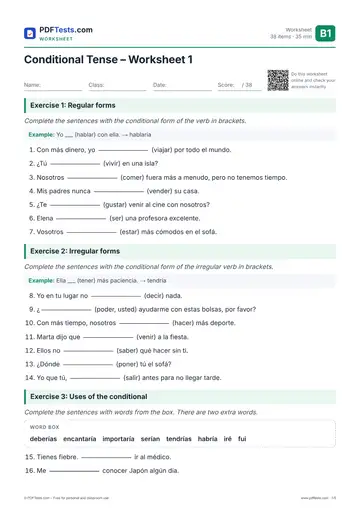
Complete each sentence with the conditional of the verb in brackets.
- ¿(Poder, tú) ______ abrir la puerta? — Could you open the door?
- Yo que tú, no le (decir) ______ nada. — If I were you, I wouldn’t tell him anything.
- Nos dijeron que (venir, ellos) ______ mañana. — They told us they would come tomorrow.
- Me (gustar) ______ vivir cerca del mar. — I would like to live near the sea.
- ¿Qué (hacer, vosotros) ______ con un millón de euros? — What would you do with a million euros?
Answers: 1. podrías 2. diría 3. vendrían 4. gustaría 5. haríais
Next step
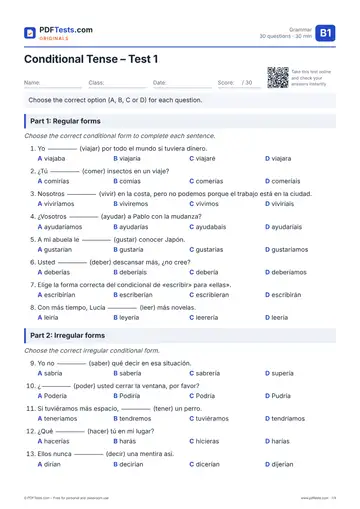
Now put the forms into practice: test yourself with our B1 Conditional Tense test, paying close attention to the twelve irregular stems and the written accents. Once you are comfortable, move on to the imperfect subjunctive, which you need for full si sentences such as Si pudiera, lo haría — If I could, I would do it.
Was this page helpful?
What was the problem?
Thank you for your feedback!