The imperfect subjunctive (imperfecto de subjuntivo) is the past form of the Spanish subjunctive: hablara, comiera, viviera. You use it in the same kinds of clauses as the present subjunctive (wishes, requests, emotions, doubts) when the main verb is in a past or conditional tense. It is also the form for unreal situations, as in Si tuviera tiempo, viajaría (If I had time, I would travel).
It has two sets of endings, -ra and -se, which mean the same thing in almost every context.
How to form the imperfect subjunctive
The rule is the same for every verb, regular or irregular:
- Take the ellos/ellas form of the preterite: hablaron, comieron, tuvieron.
- Remove -ron: habla-, comie-, tuvie-.
- Add the endings below.
Endings
| Person | -ra endings | -se endings |
|---|---|---|
| yo | -ra | -se |
| tú | -ras | -ses |
| él / ella / usted | -ra | -se |
| nosotros/as | -ramos | -semos |
| vosotros/as | -rais | -seis |
| ellos / ellas / ustedes | -ran | -sen |
Regular verbs
| Person | hablar | comer | vivir |
|---|---|---|---|
| yo | hablara / hablase | comiera / comiese | viviera / viviese |
| tú | hablaras / hablases | comieras / comieses | vivieras / vivieses |
| él / ella / usted | hablara / hablase | comiera / comiese | viviera / viviese |
| nosotros/as | habláramos / hablásemos | comiéramos / comiésemos | viviéramos / viviésemos |
| vosotros/as | hablarais / hablaseis | comierais / comieseis | vivierais / vivieseis |
| ellos / ustedes | hablaran / hablasen | comieran / comiesen | vivieran / viviesen |
Notice that yo and él/ella/usted are identical. Add a subject pronoun if the context is unclear: Querían que yo fuera (They wanted me to go).
Spelling and accent notes
- The nosotros form always takes a written accent on the vowel before the ending: habláramos, tuviéramos, fuésemos.
- Stems ending in -j- do not add an i: dijeron → dijera, trajeron → trajera, condujeron → condujera.
- Verbs with -y- in the preterite keep it: leyeron → leyera, oyeron → oyera, construyeron → construyera.
Irregular verbs
If you know the preterite, you already know the irregular stems. The imperfect subjunctive copies every irregularity of the ellos form.
| Infinitive | Preterite (ellos) | Imperfect subjunctive (yo) |
|---|---|---|
| ser / ir | fueron | fuera / fuese |
| tener | tuvieron | tuviera |
| estar | estuvieron | estuviera |
| hacer | hicieron | hiciera |
| poder | pudieron | pudiera |
| poner | pusieron | pusiera |
| saber | supieron | supiera |
| querer | quisieron | quisiera |
| venir | vinieron | viniera |
| decir | dijeron | dijera |
| dar | dieron | diera |
| haber | hubieron | hubiera |
| pedir | pidieron | pidiera |
| dormir | durmieron | durmiera |
Ser and ir share the same forms, so fuera can mean were or went; context makes it clear.
Negative and question forms
As with all Spanish tenses, put no before the verb for the negative, and use intonation or question marks for questions.
| Type | Example |
|---|---|
| Affirmative | Quería que vinieras. I wanted you to come. |
| Negative | No quería que vinieras. I didn’t want you to come. |
| Question | ¿Querías que viniera? Did you want me to come? |
When to use the imperfect subjunctive
1. After a past or conditional main verb
The triggers that require the present subjunctive (wishes, requests, advice, emotions, doubt, denial) take the imperfect subjunctive when the main verb is in the preterite, imperfect, pluperfect or conditional.
- Mi jefa me pidió que llegara antes. My boss asked me to arrive earlier.
- Mis padres querían que estudiara medicina. My parents wanted me to study medicine.
- Me sorprendió que no te llamaran. I was surprised they didn’t call you.
- No creía que fuera tan difícil. I didn’t think it would be so hard.
- Me gustaría que vinieras a la cena. I’d like you to come to the dinner.
This is called the sequence of tenses:
| Main clause | Subordinate clause |
|---|---|
| Present / future / imperative: Quiero que… | Present subjunctive: …vengas |
| Past / conditional: Quería que… / Querría que… | Imperfect subjunctive: …vinieras |
A present main verb can also take the imperfect subjunctive when the subordinate action is in the past:
- No creo que lo supiera. I don’t think he knew.
- Es posible que ayer llegaran tarde. It’s possible they arrived late yesterday.
2. In hypothetical si clauses
For situations that are unlikely or contrary to fact in the present or future, use si + imperfect subjunctive and a conditional in the main clause. See our full guide to conditional sentences with si for all the types.
- Si tuviera más dinero, me compraría un coche eléctrico. If I had more money, I’d buy an electric car.
- Si fueras yo, ¿qué harías? If you were me, what would you do?
- Yo no lo haría si no estuviera seguro. I wouldn’t do it if I weren’t sure.
3. With ojalá for unlikely or impossible wishes
Ojalá + present subjunctive expresses a wish that may come true. Ojalá + imperfect subjunctive expresses a wish that is unlikely or impossible right now.
- Ojalá llueva mañana. I hope it rains tomorrow. (possible)
- Ojalá lloviera más en esta región. I wish it rained more in this region. (unlikely)
- Ojalá pudiéramos quedarnos más tiempo. I wish we could stay longer.
4. After como si
Como si (as if) is always followed by the imperfect subjunctive (or the pluperfect subjunctive), whatever the tense of the main verb.
- Habla como si fuera el jefe. He talks as if he were the boss.
- Me miró como si no me conociera. She looked at me as if she didn’t know me.
5. Polite requests and softened statements
The -ra forms of querer, poder and deber work like a polite conditional. Only the -ra form is used this way.
- Quisiera reservar una mesa para dos. I’d like to book a table for two.
- ¿Pudiera ayudarme con esto? Could you help me with this? (very formal)
- Debieras hablar con ella. You ought to talk to her.
6. Past purpose, time and concession clauses
Conjunctions that always take the subjunctive, such as para que, antes de que, sin que and a menos que, use the imperfect subjunctive in past narratives.
- Te lo expliqué para que lo entendieras. I explained it to you so that you’d understand.
- Salimos antes de que empezara a llover. We left before it started to rain.
- Entró sin que nadie lo viera. He came in without anyone seeing him.
-ra or -se: which should you use?
In most contexts the two forms are interchangeable: Si tuviera / tuviese tiempo, iría. The -ra form is the more common choice in everyday speech, especially in Latin America. The -se form appears more in writing and is still heard in Spain.
Two practical rules:
- Use -ra for politeness: Quisiera un café, not Quisiese un café.
- Stay consistent within one sentence or text.
At B2, actively using the -ra forms and recognising the -se forms is enough.
Imperfect subjunctive vs present subjunctive
Learners often mix these up because the trigger is the same. The difference is the time frame set by the main verb, or the degree of reality.
| Present subjunctive | Imperfect subjunctive |
|---|---|
| Te pido que me ayudes. I’m asking you to help me. | Te pedí que me ayudaras. I asked you to help me. |
| Es raro que no conteste. It’s odd that he isn’t answering. | Era raro que no contestara. It was odd that he wasn’t answering. |
| Ojalá venga. I hope she comes. | Ojalá viniera. I wish she would come. |
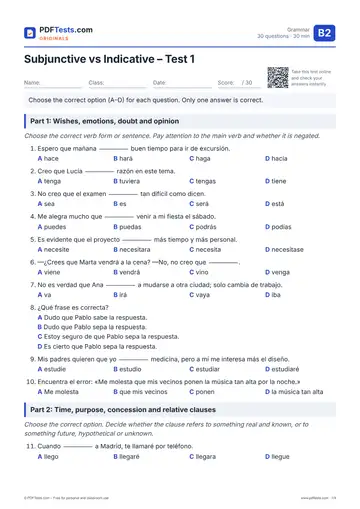
If you are unsure whether you need a subjunctive at all, review our guide to the subjunctive vs the indicative.
Signal words and triggers
Watch for these combinations, which usually call for the imperfect subjunctive:
- Past verbs of influence: quería que, pidió que, me dijo que (as an order), recomendó que, prohibió que
- Past emotion or judgement: me alegró que, le molestaba que, era importante que, fue una pena que
- Conditional main verbs: me gustaría que, preferiría que, sería mejor que
- Fixed expressions: si (hypothetical), como si, ojalá (unlikely wish)
- Past conjunctions: para que, antes de que, sin que, a menos que
Common mistakes
✗ Si tendría tiempo, iría al gimnasio. → ✓ Si tuviera tiempo, iría al gimnasio. The conditional never goes after hypothetical si; use the imperfect subjunctive.
✗ Si sea posible, llámame. → ✓ Si es posible, llámame. The present subjunctive never follows si; use the indicative for real conditions.
✗ Mis padres querían que estudio medicina. → ✓ Mis padres querían que estudiara medicina. A past verb of wanting needs the subjunctive, and the past tense requires the imperfect form.
✗ Me gustaría que vienes conmigo. → ✓ Me gustaría que vinieras conmigo. A conditional main verb triggers the imperfect subjunctive.
✗ Me dijo que no lo dijiera. → ✓ Me dijo que no lo dijera. Stems ending in -j- do not add an i.
✗ Si hablaramos más, nos entenderíamos. → ✓ Si habláramos más, nos entenderíamos. The nosotros form always carries a written accent.
✗ Actúa como si es el dueño. → ✓ Actúa como si fuera el dueño. Como si is always followed by the subjunctive.
✗ Quisiese un billete de ida y vuelta. → ✓ Quisiera un billete de ida y vuelta. Only the -ra form is used for polite requests.
Quick check
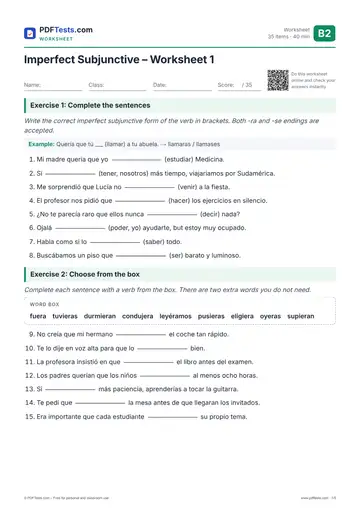
Complete each sentence with the imperfect subjunctive (-ra form).
- Si yo ___ (tener) más tiempo, aprendería a tocar la guitarra.
- Mi jefa me pidió que ___ (llegar) antes.
- Habla como si lo ___ (saber) todo.
- Ojalá ___ (poder, nosotros) ir contigo.
- Me gustaría que ellos ___ (decir) la verdad.
Answers
- tuviera – If I had more time, I’d learn to play the guitar.
- llegara – My boss asked me to arrive earlier.
- supiera – He talks as if he knew everything.
- pudiéramos – I wish we could go with you.
- dijeran – I’d like them to tell the truth.
Next step
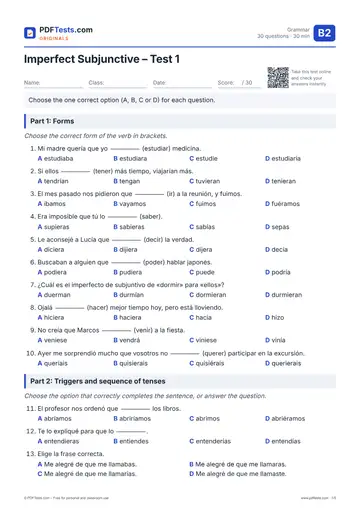
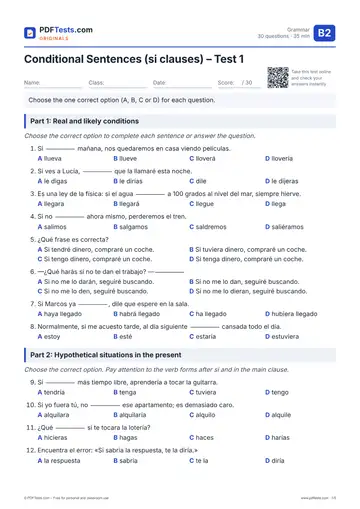
Once the forms feel automatic, put them under pressure with our B2 Imperfect Subjunctive test, which mixes sequence of tenses, ojalá, como si and irregular stems. Then practise the most common context for this tense with the B2 conditional sentences test, where you combine si + imperfect subjunctive with the conditional in full sentences.
Practise this topic: Spanish Imperfect Subjunctive
Was this page helpful?
What was the problem?
Thank you for your feedback!