Spanish has two main ways to form the passive: the ser passive (La ley fue aprobada) and the passive se (Se aprobó la ley). Both put the focus on the action or its result rather than on who did it. The passive se is far more common in everyday speech, while the ser passive belongs mostly to news, history and formal writing, especially when the agent is mentioned with por.
The two passives at a glance
| Ser passive | Passive se | |
|---|---|---|
| Form | ser + past participle (+ por + agent) | se + verb in 3rd person |
| Agreement | ser and the participle agree with the subject | the verb agrees with the subject (singular or plural) |
| Agent | can be mentioned with por | normally not mentioned |
| Register | formal, written, journalistic | neutral, very common in speech |
| Example | El puente fue inaugurado por la alcaldesa. | Se inauguró el puente. |
The bridge was opened by the mayor. / The bridge was opened.
The ser passive
Form
Use ser in any tense + past participle. The participle behaves like an adjective: it agrees in gender and number with the subject.
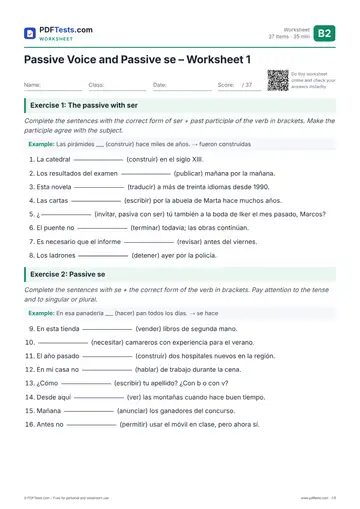
- La novela fue escrita en 1967. — The novel was written in 1967.
- Los resultados fueron publicados ayer. — The results were published yesterday.
- Las candidatas han sido seleccionadas. — The candidates have been selected.
To say who performed the action, add por + agent:
- El cuadro fue pintado por Frida Kahlo. — The painting was painted by Frida Kahlo.
Tenses
| Tense | Example | Translation |
|---|---|---|
| Present | El proyecto es revisado por un comité. | The project is reviewed by a committee. |
| Preterite | La catedral fue construida en el siglo XIII. | The cathedral was built in the 13th century. |
| Imperfect | Este método era utilizado por los romanos. | This method was used by the Romans. |
| Present perfect | La propuesta ha sido aprobada. | The proposal has been approved. |
| Future | El estadio será inaugurado en marzo. | The stadium will be opened in March. |
| Present subjunctive | Espero que el informe sea publicado pronto. | I hope the report is published soon. |
The preterite is by far the most frequent tense for the ser passive. In the present tense it sounds formal and appears mainly in headlines and reports.
Affirmative, negative and question
| Example | Translation | |
|---|---|---|
| Affirmative | Los sospechosos fueron detenidos. | The suspects were arrested. |
| Negative | Los sospechosos no fueron detenidos. | The suspects were not arrested. |
| Question | ¿Fueron detenidos los sospechosos? | Were the suspects arrested? |
When to use it
- When the agent matters and you want to name it: La vacuna fue desarrollada por un equipo español. — The vaccine was developed by a Spanish team.
- In news, history and academic writing: El acuerdo fue firmado en Ginebra. — The agreement was signed in Geneva.
- When the subject is a person and passive se would sound reflexive: El ministro fue entrevistado. — The minister was interviewed.
An important limit
In English, an indirect object can become the subject (I was told, She was given a prize). Spanish does not allow this. Use an active sentence with a third-person plural verb, or rephrase:
- Me dijeron que esperara. — I was told to wait.
- Le dieron un premio. / Recibió un premio. — She was given a prize.
The passive se
Form
Use se + verb in the third person. The verb agrees with the grammatical subject, which is usually a thing and very often comes after the verb.
| Subject | Example | Translation |
|---|---|---|
| Singular | Se habla inglés. | English is spoken. |
| Plural | Se alquilan bicicletas. | Bicycles for rent. |
| Singular (past) | Se vendió la casa. | The house was sold. |
| Plural (past) | Se vendieron todas las entradas. | All the tickets were sold. |
| Infinitive as subject | Se prohíbe fumar. | Smoking is forbidden. |
When the subject is an infinitive or a clause, the verb is always singular: Se dice que va a llover. — It is said that it’s going to rain.
Negative and question
| Example | Translation | |
|---|---|---|
| Negative | No se aceptan devoluciones. | Returns are not accepted. |
| Question | ¿Dónde se compran los billetes? | Where are the tickets bought? |
| Question | ¿Cómo se escribe tu apellido? | How is your surname spelt? |
No always goes before se.
With modal verbs and periphrases
The main verb agrees with the subject, and se can go before the conjugated verb or be attached to the infinitive:
- Se pueden reservar mesas online. / Pueden reservarse mesas online. — Tables can be booked online.
- Se deben respetar las normas. — The rules must be respected.
- Se van a construir dos hospitales. — Two hospitals are going to be built.
The placement rules are the same as for other pronouns; see our guide to direct and indirect object pronouns if you need a refresher.
When to use it
- The agent is unknown, obvious or unimportant: Se robaron tres cuadros del museo. — Three paintings were stolen from the museum.
- Signs, adverts and notices: Se busca camarero con experiencia. — Experienced waiter wanted.
- Instructions and recipes: Primero se cortan las cebollas. — First the onions are chopped.
- General statements about customs: En España se cena tarde. — In Spain people have dinner late.
Ser passive or passive se?
Ask two questions:
- Do I want to name the agent? If yes, use the ser passive or an active sentence. The passive se with por + agent is considered unnatural in modern Spanish.
- Is the subject a person? With people, the passive se can be misread as reflexive or reciprocal. Se ayudaron los vecinos means The neighbours helped each other, not The neighbours were helped. Use the ser passive or an active sentence instead: Los vecinos fueron ayudados.
In conversation, the active voice with a third-person plural verb is also very common: Han abierto un restaurante nuevo. — A new restaurant has been opened.
Confusing structures
Ser passive vs estar + participle
Ser + participle describes an action; estar + participle describes the resulting state.
- La tienda fue cerrada en 2020. — The shop was closed (down) in 2020. (event)
- La tienda está cerrada. — The shop is closed. (state)
- Cuando llegué, la puerta ya estaba abierta. — When I arrived, the door was already open.
For more on this contrast, read our Ser and Estar guide.
Passive se vs impersonal se
The impersonal se has no subject at all, so the verb is always singular. It appears with intransitive verbs and with people introduced by personal a:
- Se vive bien aquí. — People live well here. (no subject)
- Se respeta a los mayores. — Older people are respected. (a los mayores is an object, so singular)
- Se venden coches usados. — Used cars for sale. (passive se: coches is the subject, so plural)
The deeper analysis of these constructions is covered in our guide to impersonal and passive constructions.
Passive se vs reflexive se
A reflexive verb means the subject acts on itself: Ana se lava — Ana washes herself. Passive se does not: Se lavan los platos a mano — The dishes are washed by hand. Dishes cannot wash themselves, so the meaning is passive. Compare with our reflexive verbs guide.
Context clues
These clues often point to a passive structure:
- por + agent → ser passive: fue diseñado por…
- dates and historical facts → ser passive or passive se: en 1492, en el siglo XIX
- signs and adverts → passive se: Se alquila, Se vende, Se necesita
- recipes and instructions → passive se: primero, a continuación, después
- general habits → passive or impersonal se: aquí, en este país, normalmente
Common mistakes
- ✗ Se vende pisos. → ✓ Se venden pisos. — In the passive se, the verb agrees with the plural subject.
- ✗ La carta fue escrito por Luis. → ✓ La carta fue escrita por Luis. — The participle agrees with the subject in gender and number.
- ✗ Se construyó el puente por el ayuntamiento. → ✓ El puente fue construido por el ayuntamiento. — Avoid naming the agent with passive se.
- ✗ Fui dicho que esperara. → ✓ Me dijeron que esperara. — Indirect objects cannot become passive subjects in Spanish.
- ✗ Se fue construida la casa. → ✓ Se construyó la casa. / La casa fue construida. — Don’t combine the two passives.
- ✗ Se buscan a los responsables. → ✓ Se busca a los responsables. — With personal a the construction is impersonal, so the verb is singular.
- ✗ El museo es cerrado los lunes. → ✓ El museo está cerrado los lunes. — A state is expressed with estar, not the ser passive.
Quick check
- En esta tienda ___ (vender) productos ecológicos.
- La catedral ___ (construir, preterite) por arquitectos franceses.
- Correct the error: Se alquila apartamentos en la playa.
- Rewrite with the ser passive: La policía detuvo a dos sospechosos.
- Choose: Cuando llegué, la ventana ya ___ rota. (estaba / fue)
Answers
- se venden — Organic products are sold in this shop.
- fue construida — The cathedral was built by French architects.
- Se alquilan apartamentos en la playa. — Beach apartments for rent.
- Dos sospechosos fueron detenidos por la policía. — Two suspects were arrested by the police.
- estaba — When I arrived, the window was already broken. (a state, not an action)
Next step
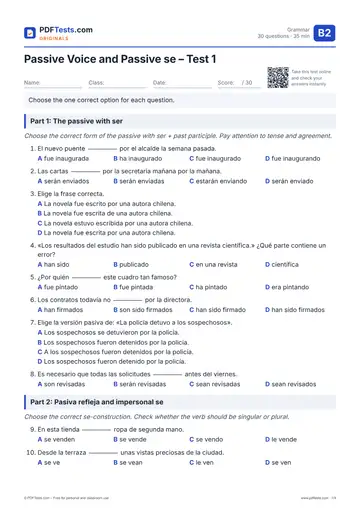
Now put the rules into practice: test yourself with our B2 Passive Voice and Passive se test, paying special attention to verb agreement and to the choice between ser and se. When you score consistently well, move on to the C1 Impersonal and Passive Constructions test, which adds impersonal se, personal a and more formal registers.
Was this page helpful?
What was the problem?
Thank you for your feedback!