Spanish uses the indicative to present information as fact: something you know, believe or report. It uses the subjunctive for what is wished, doubted, felt, required, still unknown or not yet real. At B2, the challenge is less about forms and more about choosing the right mood after a given trigger, and seeing when one word, such as cuando, aunque or creo, can take either mood.
The core idea: asserting vs not asserting
Ask yourself one question: is the speaker stating this as real information?
- If yes, use the indicative: Sé que Marta vive en Sevilla. I know Marta lives in Seville.
- If no (it is a wish, a doubt, a reaction, a possibility or something in the future that has not happened), use the subjunctive: Quiero que Marta viva en Sevilla. I want Marta to live in Seville.
The subjunctive almost always appears in a subordinate clause, usually after que or a conjunction. The trigger is in the main clause or in the conjunction itself.
Form recap
You need the present and imperfect subjunctive. If the forms are not yet automatic, review our Present Subjunctive guide and our Imperfect Subjunctive guide.
| Verb | Present indicative | Present subjunctive | Imperfect subjunctive |
|---|---|---|---|
| hablar (yo) | hablo | hable | hablara / hablase |
| comer (tú) | comes | comas | comieras / comieses |
| vivir (él) | vive | viva | viviera / viviese |
| tener (nosotros) | tenemos | tengamos | tuviéramos / tuviésemos |
| ser (ellos) | son | sean | fueran / fuesen |
Uses: when each mood is required
1. Wishes, requests and influence → subjunctive
Verbs such as querer, esperar, pedir, necesitar, preferir, recomendar, prohibir and permitir take the subjunctive when the subjects are different.
- Espero que lleguéis a tiempo. I hope you arrive on time.
- Te pido que no digas nada. I’m asking you not to say anything.
With the same subject, use the infinitive: Quiero ir. I want to go. (not Quiero que yo vaya).
Ojalá always takes the subjunctive: Ojalá haga sol mañana. I hope it’s sunny tomorrow.
2. Emotions and value judgements → subjunctive
After me alegra, me molesta, siento, me sorprende, es una pena, es normal, es importante and similar expressions:
- Me molesta que hables tan alto. It bothers me that you talk so loudly.
- Es una pena que no puedas venir. It’s a shame you can’t come.
Notice that the second example is true information, yet it takes the subjunctive. The focus is on the reaction, not on informing.
3. Certainty vs doubt and denial
This is the contrast learners test most often.
| Indicative (certainty, belief) | Subjunctive (doubt, denial) |
|---|---|
| creo que, pienso que | no creo que, no pienso que |
| estoy seguro de que | no estoy seguro de que |
| es verdad / cierto / evidente que | no es verdad / cierto que |
| está claro que | no está claro que |
| no dudo que | dudo que |
| me parece que | no me parece que |
- Creo que tienes razón. I think you’re right.
- No creo que tengas razón. I don’t think you’re right.
- Dudo que el tren salga puntual. I doubt the train will leave on time.
Possibility and probability expressions take the subjunctive: Es posible que llueva. It may rain.
4. Time clauses: cuando, hasta que, en cuanto, mientras, después de que
The mood depends on whether the action is real (habitual or past) or still in the future.
- Cuando llego a casa, me ducho. When I get home, I shower. (habit → indicative)
- Cuando llegué, ya se habían ido. When I arrived, they had already left. (past → indicative)
- Cuando llegues, llámame. When you arrive, call me. (future → subjunctive)
Spanish never uses the future tense after cuando in these clauses: cuando llegues, not cuando llegarás.
Antes de que always takes the subjunctive, because the action has not happened yet at that point: Sal antes de que empiece a llover. Leave before it starts raining.
5. Relative clauses: known vs unknown antecedent
If the person or thing exists and is identified, use the indicative. If it is hypothetical, unknown or nonexistent, use the subjunctive.
- Tengo un compañero que habla japonés. I have a colleague who speaks Japanese.
- Busco un compañero que hable japonés. I’m looking for a colleague who speaks Japanese. (any one, not identified)
- No hay nadie que sepa la respuesta. There’s nobody who knows the answer.
- Haz lo que quieras. Do whatever you like.
For more on que, quien and lo que, see our Relative Pronouns guide.
6. Aunque: fact vs hypothesis
- Aunque llueve, vamos a salir. Although it’s raining, we’re going out. (it is raining: a fact)
- Aunque llueva, vamos a salir. Even if it rains, we’re going out. (it may rain, or it doesn’t matter)
The subjunctive can also be used with a known fact when the speaker treats it as irrelevant: Aunque sea tu jefe, no tiene derecho a gritarte. Even if he is your boss, he has no right to shout at you.
7. Purpose vs cause
- para que, a fin de que → always subjunctive: Te lo explico para que lo entiendas. I’m explaining it so that you understand it.
- porque, ya que, puesto que → indicative (giving a real reason): Me voy porque es tarde. I’m leaving because it’s late.
Other conjunctions that always take the subjunctive: sin que, a menos que, con tal de que, en caso de que.
8. Quizás, tal vez, probablemente
These allow both moods. The subjunctive suggests more doubt; the indicative more confidence.
- Quizás viene mañana. Maybe he’s coming tomorrow. (fairly likely)
- Quizás venga mañana. Maybe he’ll come tomorrow. (less sure)
A lo mejor takes the indicative: A lo mejor viene.
Verbs that change meaning with the mood
Some verbs take either mood with a change in meaning.
| Verb | + Indicative | + Subjunctive |
|---|---|---|
| decir | report information | give an instruction |
| sentir | sense, perceive | be sorry, regret |
| insistir | insist that something is true | insist that someone does something |
- Dice que viene. He says he’s coming.
- Dice que vengas. He says you should come.
- Siento que alguien me mira. I feel someone is watching me.
- Siento que no puedas venir. I’m sorry you can’t come.
Sequence of tenses
The tense of the main verb decides which subjunctive tense you need.
| Main clause | Subordinate clause | Example |
|---|---|---|
| Present, future, imperative | Present subjunctive | Quiero que vengas. I want you to come. |
| Past (preterite, imperfect) | Imperfect subjunctive | Quería que vinieras. I wanted you to come. |
| Conditional | Imperfect subjunctive | Me gustaría que vinieras. I’d like you to come. |
The same logic applies in hypothetical si sentences (Si tuviera tiempo, iría). These are covered fully in our Conditional Sentences guide.
Signal words at a glance
| Always indicative | Always subjunctive | Depends on meaning |
|---|---|---|
| creo que, sé que, es verdad que | ojalá, quiero que, espero que | cuando, mientras, hasta que |
| está claro que, es evidente que | dudo que, no creo que | aunque |
| porque, ya que, puesto que | para que, sin que, antes de que | quizás, tal vez |
| a lo mejor | a menos que, en caso de que | decir, sentir |
| es posible / importante / una pena que | relative clauses (que) |
Common mistakes
- ✗ Creo que sea una buena idea. → ✓ Creo que es una buena idea. Affirmative creer states a belief, so it takes the indicative.
- ✗ No creo que es verdad. → ✓ No creo que sea verdad. Negated belief expresses doubt.
- ✗ Cuando llegarás, llámame. → ✓ Cuando llegues, llámame. Future time clauses use the present subjunctive, never the future.
- ✗ Quiero que yo vaya al concierto. → ✓ Quiero ir al concierto. Same subject means infinitive.
- ✗ Espero que vienes pronto. → ✓ Espero que vengas pronto. Esperar que expresses a wish.
- ✗ Me pidió que lo ayude. → ✓ Me pidió que lo ayudara. A past main verb normally requires the imperfect subjunctive.
- ✗ Necesito a alguien que sabe programar. → ✓ Necesito a alguien que sepa programar. The person is not identified.
- ✗ Antes de que llegas, limpio la casa. → ✓ Antes de que llegues, limpio la casa. Antes de que always takes the subjunctive.
- ✗ Es evidente que tenga problemas. → ✓ Es evidente que tiene problemas. Expressions of certainty take the indicative.
Quick check
Choose the correct form of the verb in brackets.
- No pienso que ese restaurante ___ (ser) caro.
- Cuando ___ (terminar, yo) la carrera, viajaré por Asia.
- Está claro que ellos ___ (saber) la respuesta.
- La empresa busca un empleado que ___ (hablar) chino.
- Mi madre me dijo que ___ (llevar, yo) un paraguas. (She told me to take one.)
Answers
- sea (negated belief → subjunctive)
- termine (future time clause → subjunctive)
- saben (certainty → indicative)
- hable (unidentified person → subjunctive)
- llevara or llevase (instruction after a past verb → imperfect subjunctive)
Next step
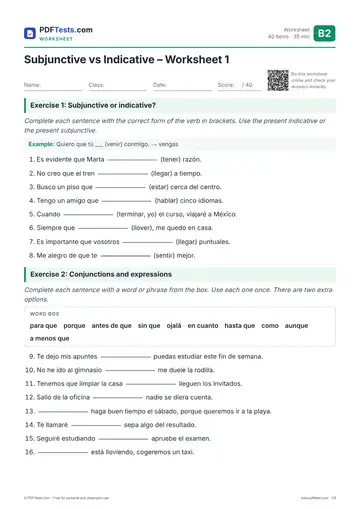
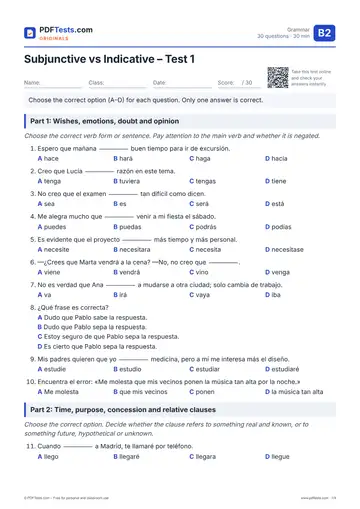
Put the contrast into practice with our B2 Subjunctive vs Indicative test, which mixes all the triggers covered here. Note which triggers you get wrong and reread those sections. When certainty vs doubt and the cuando and aunque contrasts feel automatic, move on to our Advanced Subjunctive guide, which covers concessive, temporal and relative clauses in more depth.
Was this page helpful?
What was the problem?
Thank you for your feedback!