PDFTests Originals

Formelles und informelles Register – Arbeitsblatt 1

C1 Fortgeschritten ArbeitsblattEnglisch

Mit diesem C1-Arbeitsblatt lernen die Schülerinnen und Schüler, sicher zwischen informellem und formellem Englisch zu wechseln. Geübt werden formelle Entsprechungen alltäglicher Wörter, feste Wendungen in formellen E-Mails, wichtige Kollokationen und die Wortbildung. Es eignet sich für fortgeschrittene Lernende, die sich auf Prüfungen oder das berufliche Schreiben vorbereiten.
Aufgaben
40
Zeit
40 Min.
PDF
5 Seiten
Lösungen
Enthalten
  • 100 % kostenlos
  • Ohne Anmeldung
  • Druckfertiges A4-PDF
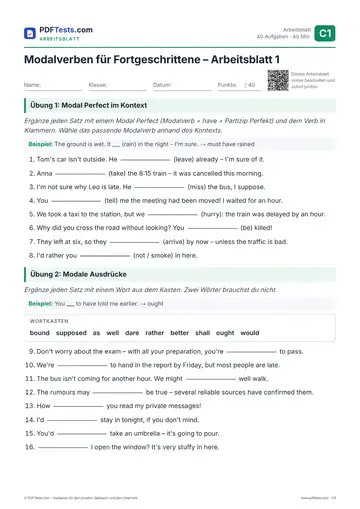
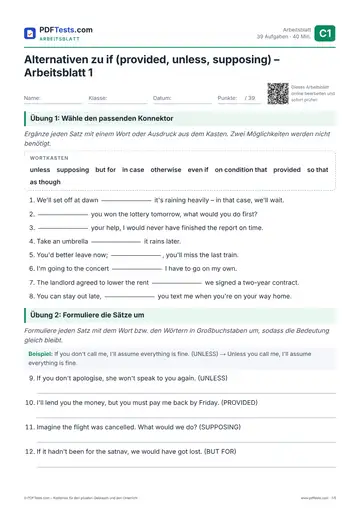
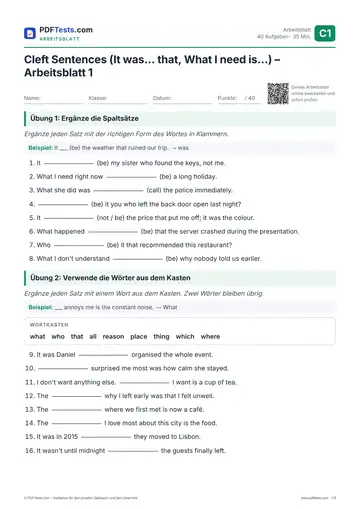
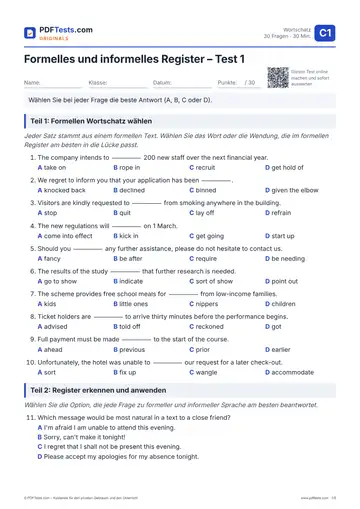
Vorschau von Seite 1: Formelles und informelles Register – Arbeitsblatt 1 PDF öffnen

Arbeitsblatt online bearbeiten

Tippen Sie Ihre Antworten ein und klicken Sie auf „Antworten prüfen“. Alternative richtige Antworten werden akzeptiert.

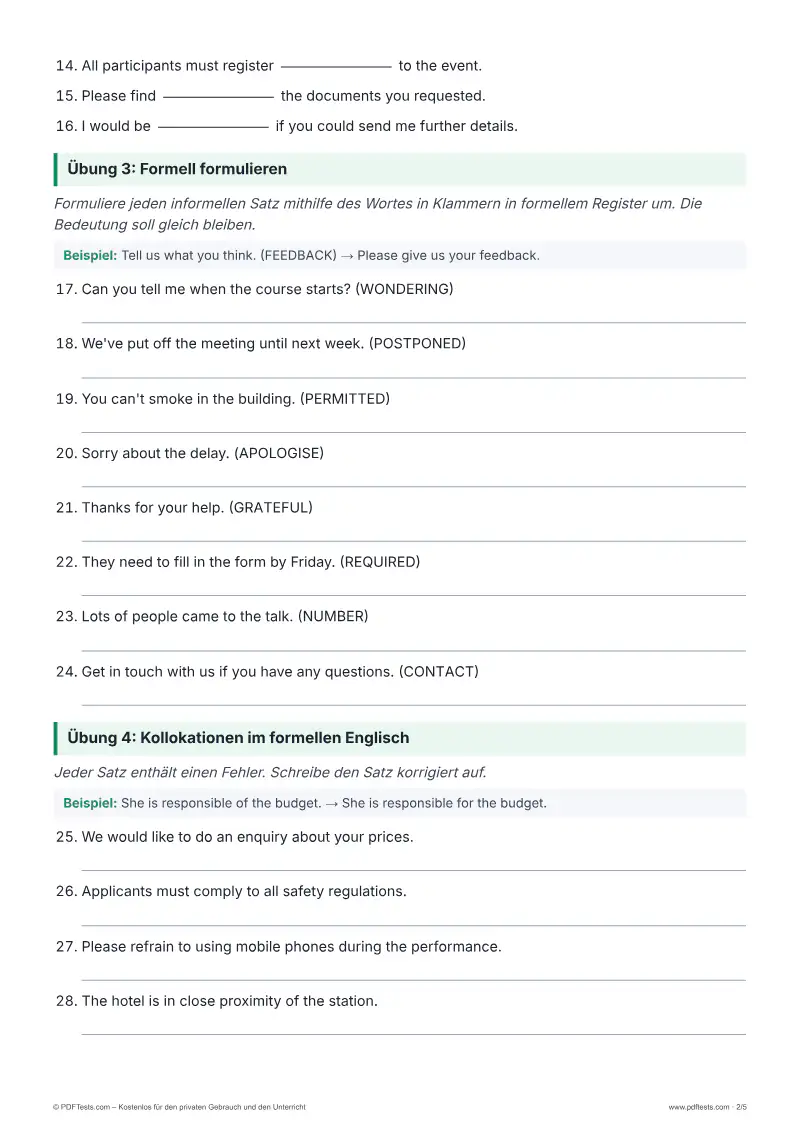
Übung 1: Formelle Entsprechungen

Ordne jedem informellen Wort bzw. jeder informellen Wendung die formelle Entsprechung aus dem Kasten zu. Zwei Wörter bleiben übrig.

Beispiel: finish (a contract) → terminate

Wortkasten commenceassistrequirepostponesufficientresideobtainenquireterminateendeavour

  1. start (the meeting)

  2. help (a customer)

  3. need (more information)

  4. put off (the event)

  5. enough (funds)

  6. live (in the area)

  7. get (a visa)

  8. ask (about a vacancy)

Übung 2: Wendungen in formellen E-Mails

Vervollständige die Sätze aus formellen E-Mails mit Wörtern aus dem Kasten. Zwei Wörter bleiben übrig.

Beispiel: Yours ___ (ending an email to a named person) → sincerely

Wortkasten regardinghesitateinconvenienceforwardconveniencepriorattachedgratefulnotwithstandinghenceforth

  1. I am writing your advertisement in Tuesday's newspaper.

  2. Please do not to contact me should you require further information.

  3. We apologise for any this delay may cause.

  4. I look to hearing from you.

  5. Please reply at your earliest .

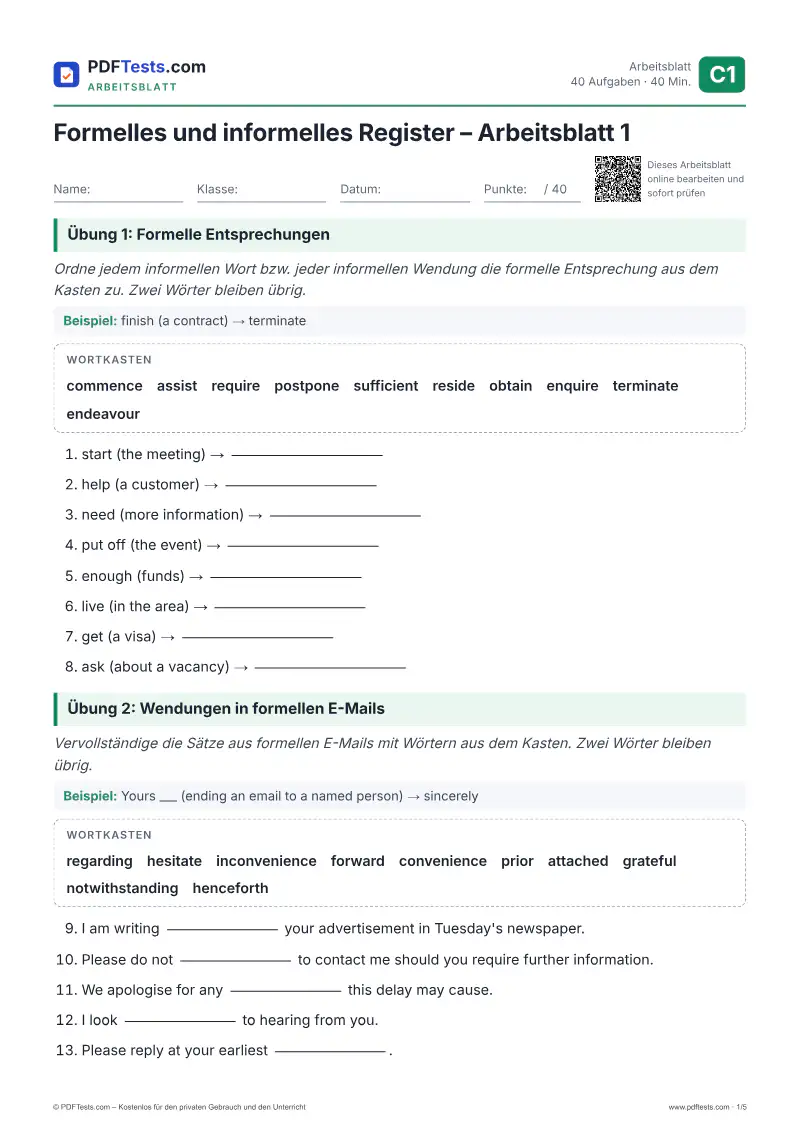
  6. All participants must register to the event.

  7. Please find the documents you requested.

  8. I would be if you could send me further details.

Übung 3: Formell formulieren

Formuliere jeden informellen Satz mithilfe des Wortes in Klammern in formellem Register um. Die Bedeutung soll gleich bleiben.

Beispiel: Tell us what you think. (FEEDBACK) → Please give us your feedback.

  1. Can you tell me when the course starts? (WONDERING)

  2. We've put off the meeting until next week. (POSTPONED)

  3. You can't smoke in the building. (PERMITTED)

  4. Sorry about the delay. (APOLOGISE)

  5. Thanks for your help. (GRATEFUL)

  6. They need to fill in the form by Friday. (REQUIRED)

  7. Lots of people came to the talk. (NUMBER)

  8. Get in touch with us if you have any questions. (CONTACT)

Übung 4: Kollokationen im formellen Englisch

Jeder Satz enthält einen Fehler. Schreibe den Satz korrigiert auf.

Beispiel: She is responsible of the budget. → She is responsible for the budget.

  1. We would like to do an enquiry about your prices.

  2. Applicants must comply to all safety regulations.

  3. Please refrain to using mobile phones during the performance.

  4. The hotel is in close proximity of the station.

  5. I would be grateful if you would provide me further details.

  6. Further from our conversation yesterday, I am attaching the contract.

  7. The new policy will come into affect on 1 March.

  8. Customers are kindly requested to adhere with the guidelines.

Übung 5: Wortbildung

Bilde aus dem großgeschriebenen Wort ein Wort, das in die Lücke passt.

Beispiel: Your ___ is greatly appreciated. (PATIENT) → patience

  1. Thank you for your in this matter. (ASSIST)

  2. Attendance at the training session is for all staff. (COMPEL)

  3. Your for the conference has been confirmed. (REGISTER)

  4. Please accept our sincere for the error. (APOLOGISE)

  5. Such behaviour is completely in a professional environment. (ACCEPT)

  6. The of the new system will take place next month. (IMPLEMENT)

  7. Visitors must show proof of at reception. (IDENTIFY)

  8. The proposal was approved by the board. (UNANIMOUS)

War diese Seite hilfreich?

Fehler melden

Falsche Lösung, Tippfehler oder unklare Erklärung? Schreiben Sie uns, wir korrigieren es.

Vorschau

Über diesen Test

Arbeitsblatt Englisch C1 PDF: formelles und informelles Register – Wortschatz, Kollokationen, Wortbildung, Umformulieren. Mit Lösungen.

Themen

Formeller und informeller WortschatzWendungen für formelle E-MailsFeste Präpositionen und KollokationenWortbildungUmformulieren in ein anderes Register

Hinweise für Lehrkräfte

Beginnen Sie mit Übung 1 als Einstieg und fragen Sie die Lernenden, wo ihnen die einzelnen formellen Wörter begegnen würden, etwa in Briefen, Aushängen oder Berichten. Typische Fehler sind falsche Präpositionen (comply to, refrain to, adhere with) sowie die Vermischung von Registern innerhalb eines Textes, zum Beispiel „Dear Sir“ gefolgt von „Thanks a lot“. Als Anschlussaufgabe erhalten Paare eine kurze informelle E-Mail und schreiben sie in eine formelle Beschwerde oder Anfrage um, wobei sie mindestens sechs der Zielausdrücke verwenden.

Alle Englisch-Tests C1 →