PDFTests Originals

Formal and Informal Register – Worksheet 1

C1 Advanced WorksheetEnglish

This C1 worksheet helps learners move confidently between informal and formal English. It practises formal equivalents of everyday words, fixed phrases in formal emails, key collocations and word formation. It suits upper-intermediate and advanced students preparing for exams or professional writing.
items
40
Time
40 min
PDF
5 pages
Answer key
Included
  • 100% free
  • No sign-up or email
  • Print-ready A4 PDF
Preview of page 1 of Formal and Informal Register – Worksheet 1 Open PDF

Do the worksheet online

Type your answers, then press “Check my answers”. Alternative correct answers are accepted.

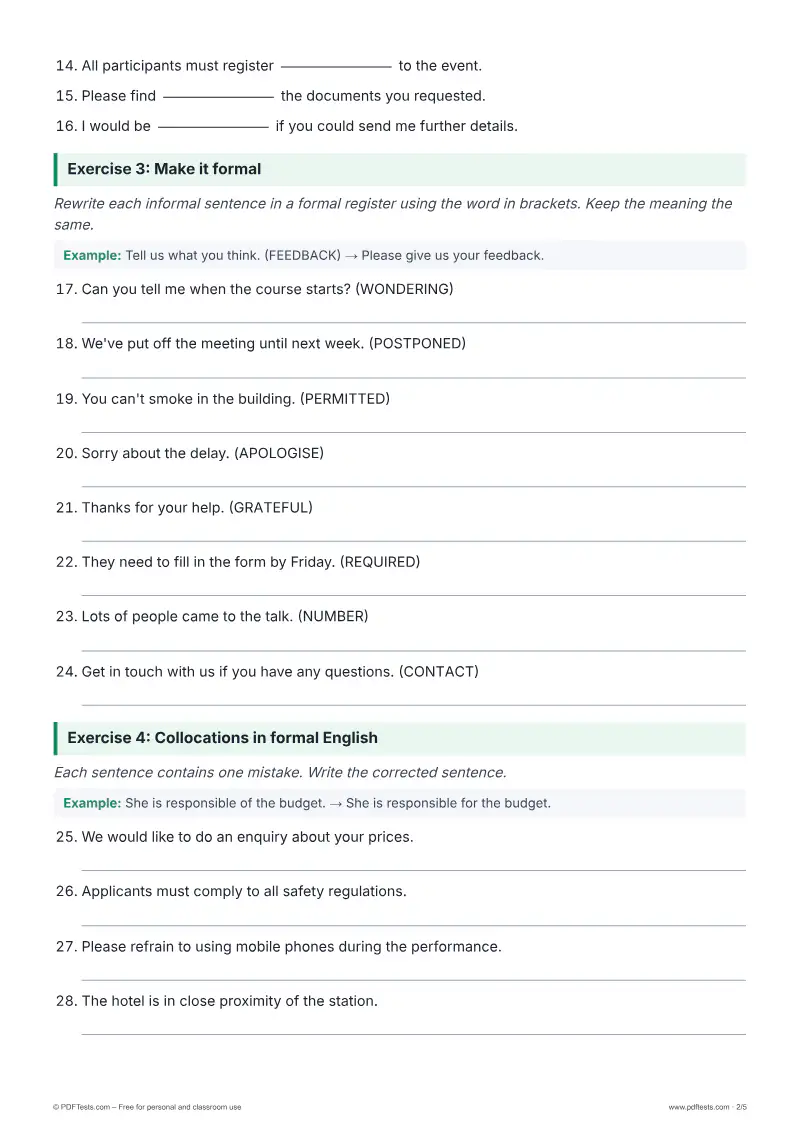
Exercise 1: Formal equivalents

Match each informal word or phrase with its formal equivalent from the box. There are two extra words you do not need.

Example: finish (a contract) → terminate

Word box commenceassistrequirepostponesufficientresideobtainenquireterminateendeavour

  1. start (the meeting)

  2. help (a customer)

  3. need (more information)

  4. put off (the event)

  5. enough (funds)

  6. live (in the area)

  7. get (a visa)

  8. ask (about a vacancy)

Exercise 2: Formal email phrases

Complete the sentences from formal emails with words from the box. There are two extra words you do not need.

Example: Yours ___ (ending an email to a named person) → sincerely

Word box regardinghesitateinconvenienceforwardconveniencepriorattachedgratefulnotwithstandinghenceforth

  1. I am writing your advertisement in Tuesday's newspaper.

  2. Please do not to contact me should you require further information.

  3. We apologise for any this delay may cause.

  4. I look to hearing from you.

  5. Please reply at your earliest .

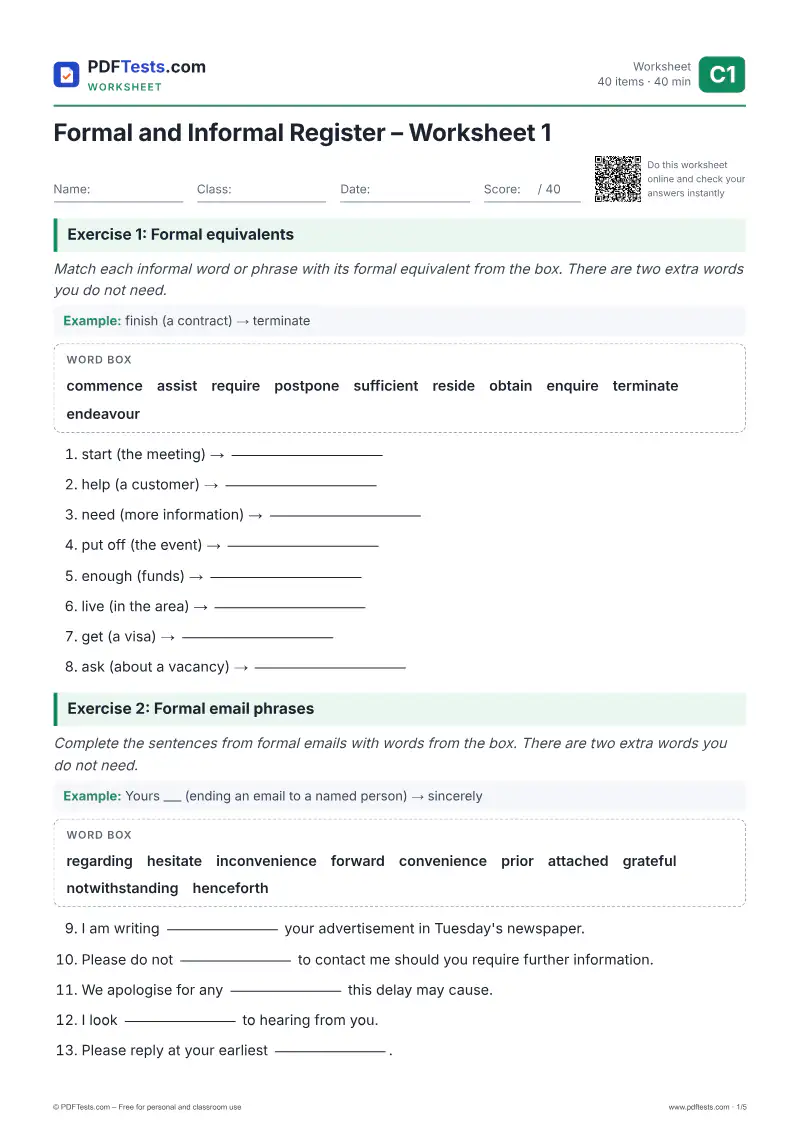
  6. All participants must register to the event.

  7. Please find the documents you requested.

  8. I would be if you could send me further details.

Exercise 3: Make it formal

Rewrite each informal sentence in a formal register using the word in brackets. Keep the meaning the same.

Example: Tell us what you think. (FEEDBACK) → Please give us your feedback.

  1. Can you tell me when the course starts? (WONDERING)

  2. We've put off the meeting until next week. (POSTPONED)

  3. You can't smoke in the building. (PERMITTED)

  4. Sorry about the delay. (APOLOGISE)

  5. Thanks for your help. (GRATEFUL)

  6. They need to fill in the form by Friday. (REQUIRED)

  7. Lots of people came to the talk. (NUMBER)

  8. Get in touch with us if you have any questions. (CONTACT)

Exercise 4: Collocations in formal English

Each sentence contains one mistake. Write the corrected sentence.

Example: She is responsible of the budget. → She is responsible for the budget.

  1. We would like to do an enquiry about your prices.

  2. Applicants must comply to all safety regulations.

  3. Please refrain to using mobile phones during the performance.

  4. The hotel is in close proximity of the station.

  5. I would be grateful if you would provide me further details.

  6. Further from our conversation yesterday, I am attaching the contract.

  7. The new policy will come into affect on 1 March.

  8. Customers are kindly requested to adhere with the guidelines.

Exercise 5: Word formation

Use the word in capitals to form a word that fits the gap.

Example: Your ___ is greatly appreciated. (PATIENT) → patience

  1. Thank you for your in this matter. (ASSIST)

  2. Attendance at the training session is for all staff. (COMPEL)

  3. Your for the conference has been confirmed. (REGISTER)

  4. Please accept our sincere for the error. (APOLOGISE)

  5. Such behaviour is completely in a professional environment. (ACCEPT)

  6. The of the new system will take place next month. (IMPLEMENT)

  7. Visitors must show proof of at reception. (IDENTIFY)

  8. The proposal was approved by the board. (UNANIMOUS)

Was this page helpful?

Report a mistake

Spotted a wrong answer, a typo or an unclear explanation? Tell us and we will fix it.

Preview

About this test

C1 worksheet on formal and informal register: formal vocabulary, collocations, word forms and rewriting informal sentences. Printable, with answers.

Topics covered

Formal vs informal vocabularyFormal email phrasesDependent prepositions and collocationsWord formationRewriting for register

Notes for teachers

Start with Exercise 1 as a warm-up and ask students where they would see each formal word, such as in letters, notices or reports. Common mistakes include wrong prepositions (comply to, refrain to, adhere with) and mixing registers within one text, for example 'Dear Sir' followed by 'Thanks a lot'. As a follow-up, give pairs a short informal email and ask them to rewrite it as a formal complaint or enquiry using at least six target expressions.

All English C1 tests →