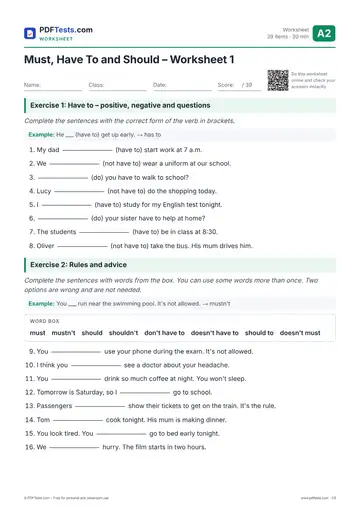
Must, have to and should are verbs we use to talk about obligation and advice. Use must and have to when something is necessary, and use should when you give advice or say that something is a good idea. All three are followed by the base form of the verb: You must wear a helmet. I have to work tomorrow. You should see a doctor.
Overview: the six forms you need
| Form | Meaning | Example |
|---|---|---|
| must | strong obligation, often a written rule or the speaker’s own feeling | I must call my mum tonight. |
| have to | obligation from outside (a law, a job, a school rule) | I have to wear a uniform at work. |
| should | advice, a good idea | You should drink more water. |
| mustn’t | prohibition: it is not allowed | You mustn’t park here. |
| don’t have to | no obligation: it is not necessary | You don’t have to pay. It’s free. |
| shouldn’t | advice not to do something | You shouldn’t stay up so late. |
The most important thing to remember: mustn’t and don’t have to mean very different things. We look at this below.
Must
Uses
Use must for:
- Rules and instructions, especially on signs, notices and forms: Passengers must show their tickets. Visitors must sign in at reception.
- Strong personal obligation, when you decide that something is necessary: I must remember to buy milk. We must visit Grandma soon.
- Strong recommendations: You must try this restaurant. The pizza is amazing.
Form
Must is a modal verb, like can. It has the same form for every person, it never takes -s, and it is never followed by to. If you know how can and can’t work, must follows the same pattern.
| Affirmative | Negative | Question |
|---|---|---|
| I / you / he / she / we / they must go. | I / you / he / she / we / they mustn’t go. (must not) | Must I go? |
Questions with must are possible but sound formal or old-fashioned. In everyday English, people usually ask Do I have to…? instead.
Have to
Uses
Use have to when the obligation comes from outside you: a rule, a law, your boss, your school or the situation.
- In the UK, you have to drive on the left.
- My sister has to start work at 7 a.m.
- We have to finish this project by Friday.
Have to is also the normal way to talk about obligation in questions, and in the past and future (see below).
Form
Have to works like a normal verb in the present simple. That means you need has for he/she/it, and do/does in negatives and questions.
| Subject | Affirmative | Negative | Question |
|---|---|---|---|
| I / you / we / they | have to work | don’t have to work | Do I have to work? |
| he / she / it | has to work | doesn’t have to work | Does she have to work? |
Short answers use do/does: Do you have to wear a tie? – Yes, I do. / No, I don’t.
Wh- questions: What time do you have to leave? Where does he have to go?
Must or have to?
In many affirmative sentences, both are correct and the meaning is almost the same:
- I must leave now. / I have to leave now.
There is a small difference, especially in British English:
- must = the speaker thinks it is necessary. I must get more exercise. (I feel this is important.)
- have to = someone else or a rule makes it necessary. I have to get up early for work. (My job says so.)
In American English, have to is much more common in speech, and must sounds quite strong or formal. If you are not sure, have to is almost always a safe choice in conversation. Use must for written rules and notices.
Mustn’t or don’t have to?
This is where most learners make mistakes. In the affirmative, must and have to are similar. In the negative, they are completely different.
| Meaning | Example | |
|---|---|---|
| mustn’t | Don’t do it. It is forbidden. | You mustn’t use your phone during the exam. |
| don’t have to | You can do it if you want, but it is not necessary. | You don’t have to bring a pen. We have lots. |
Compare:
- You mustn’t wear jeans to the interview. (Jeans are a bad idea. Don’t wear them.)
- You don’t have to wear a suit to the interview. (A suit is OK, but it’s not necessary.)
A helpful test: if you can add “but you can if you want”, use don’t have to. If you can add “it’s not allowed”, use mustn’t.
Should
Uses
Use should to:
- Give advice: You should take an umbrella. It’s going to rain.
- Ask for advice: Should I call him? What should I wear to the wedding?
- Say what is right or a good idea: People should recycle more.
Should is much softer than must. It is a suggestion, not a rule. You should see a doctor is friendly advice. You must see a doctor means it is really serious.
Form
Like must, should is a modal verb: same form for all persons, no -s, no to.
| Affirmative | Negative | Question |
|---|---|---|
| I / you / he / she / we / they should go. | I / you / he / she / we / they shouldn’t go. (should not) | Should I go? |
We often use should with I think and I don’t think:
- I think you should apply for the job.
- I don’t think you should tell her. (more natural than I think you shouldn’t tell her)
Past and future
Must has no past form and no future form. Use have to instead.
Past: had to
| Affirmative | Negative | Question |
|---|---|---|
| I had to wait an hour. | I didn’t have to wait. | Did you have to wait? |
- The train was cancelled, so we had to take a taxi.
- I didn’t have to cook last night. My partner made dinner.
The rules are the same as for any verb in the past simple: didn’t and did + base form have.
Future: will have to
- You’ll have to wait until Monday.
- We won’t have to pay for parking.
For fixed future arrangements, the present form is also fine: I have to work on Saturday.
Pronunciation notes
- have to usually sounds like /ˈhæftə/ (haf-ta). has to sounds like /ˈhæstə/ (has-ta).
- mustn’t is /ˈmʌsnt/. The first t is silent: say mus-unt, not must-unt.
- should is /ʃʊd/. The l is silent, as in could and would.
- In fast speech, must is often weak: I must go sounds like /aɪ məs ɡəʊ/.
Clues in the situation
There are no fixed signal words, but the context usually tells you which form to use:
- Signs, notices, official rules → must / mustn’t: Dogs must be on a lead.
- Jobs, school, daily routines, laws → have to / don’t have to: Nurses have to work at night.
- Problems and advice; phrases like I think, maybe, What do you think? → should / shouldn’t: Maybe you should talk to your teacher.
- Things that are free, optional or unnecessary → don’t have to: It’s optional, so you don’t have to come.
Note: at B1 you will also meet must for deduction, as in She must be tired (I’m sure she is tired). That is a different meaning, covered in our guide to modals of deduction.
Common mistakes
- ✗ She musts go. → ✓ She must go. Must is a modal verb; it never takes -s.
- ✗ You must to wear a seatbelt. → ✓ You must wear a seatbelt. No to after must or should.
- ✗ You should to try this cake. → ✓ You should try this cake. Same rule: modal + base form.
- ✗ He have to work late. → ✓ He has to work late. Use has with he/she/it.
- ✗ Does she has to leave? → ✓ Does she have to leave? After does, use the base form have.
- ✗ Do I must pay? → ✓ Do I have to pay? Must doesn’t use do in questions.
- ✗ Yesterday I must stay at home. → ✓ Yesterday I had to stay at home. Must has no past form.
- ✗ It’s Sunday, so I mustn’t get up early. → ✓ It’s Sunday, so I don’t have to get up early. It is not necessary, not forbidden.
- ✗ You don’t have to touch the cooker. It’s hot. → ✓ You mustn’t touch the cooker. It’s dangerous, so it is forbidden.
- ✗ You should going home. → ✓ You should go home. Use the base form, not -ing.
Quick check
Choose or write the correct form.
- My brother ___ (have to) wear a suit at work.
- You ___ touch that plate. It’s very hot. (mustn’t / don’t have to)
- You ___ bring any food to the party. We have lots. (mustn’t / don’t have to)
- You look really tired. I think you ___ go to bed early tonight. (should / have to)
- Correct the sentence: Last week I must work every evening.
Answers
- has to – he/she/it takes has.
- mustn’t – touching it is dangerous, so it is forbidden.
- don’t have to – bringing food is not necessary.
- should – this is advice, not a rule.
- Last week I had to work every evening. – use had to for the past.
Next step
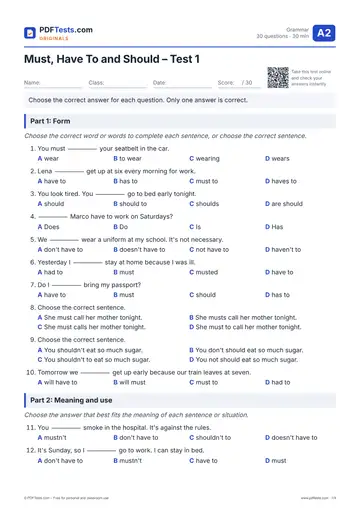
Now put the rules into practice: test yourself with our A2 Must, Have To and Should test, and pay special attention to the items with mustn’t and don’t have to, because that is where most points are lost. If you get any wrong, come back to the comparison tables above, then try the test again. When you feel confident, check your overall progress with the English Level Test A2.
Was this page helpful?
What was the problem?
Thank you for your feedback!