Modals of deduction are modal verbs such as must, might, may, could and can’t that we use to guess or draw a conclusion about a present situation. They show how sure we are, from almost certain (must) to possible (might) to almost certain it’s not true (can’t). You use them when you don’t know a fact for certain but have some evidence or a reason for your opinion.
How sure are you? The certainty scale
The modal you choose shows how confident you are. Think of it as a line from “definitely yes” to “definitely no”.
| How sure? | Modal | Example |
|---|---|---|
| Almost certain it’s true | must | She must be at work. Her car isn’t here. |
| Possible (maybe yes) | might / may / could | He might be in the library. |
| Possible (maybe no) | might not / may not | They might not know about the meeting. |
| Almost certain it’s not true | can’t / couldn’t | That can’t be Jack. He’s in Spain this week. |
If you know something is 100% true, you don’t need a modal at all: She is at work. I’ve just spoken to her.
Uses
Must: you are almost sure something is true
Use must when you have strong evidence and you are drawing a logical conclusion.
- You’ve been travelling all day. You must be exhausted.
- The restaurant is always full. The food must be really good.
- He’s wearing a suit and tie. He must have a job interview today.
- Listen to that noise. The neighbours must be having a party.
Might, may, could: something is possible
Use might, may or could when you think something is possible but you are not sure. The meaning is very similar; in everyday conversation might is the most common.
- I can’t find my keys. They might be in my other jacket.
- Don’t call Sara now. She may be asleep.
- Ask Tom. He could know the answer.
- Is that your phone? It might be your boss.
Can’t and couldn’t: you are almost sure something is not true
Use can’t (or couldn’t) when the evidence tells you something is impossible.
- You can’t be hungry. You’ve just had a huge lunch.
- This can’t be the right address. It’s an empty car park.
- She couldn’t be his mother. She looks about twenty-five.
Might not and may not: possibly not true
Use might not or may not when you think something is possibly not true.
- Bring a jacket. It might not be warm later.
- He may not want to come. He’s very busy at the moment.
Note: couldn’t is not the same as might not. She couldn’t be at home means you are almost certain she isn’t there. She might not be at home means maybe she isn’t.
Form
Modals of deduction follow the normal rules for modal verbs: they are the same for every person, there is no -s in the third person, and they are followed by the base form of the verb without to.
Basic patterns
| Pattern | Example |
|---|---|
| modal + base verb | He must know the answer. |
| modal + be + adjective/noun/place | She might be tired. / It can’t be Paul. / They may be at the gym. |
| modal + be + -ing (happening now) | He must be working late. |
Affirmative, negative and questions
| must | might / may / could | can’t | |
|---|---|---|---|
| Affirmative | She must be ill. | She might be ill. | — |
| Negative | — (use can’t) | She might not / may not be ill. | She can’t be ill. |
| Question | — (rare) | Could she be ill? / Might she be ill? | Can she really be ill? |
A few points about the table:
- The negative of deduction must is can’t, not mustn’t. (More on this below.)
- In questions, could is the most natural choice: Could it be a mistake? Who could that be at the door?
- Might in questions sounds quite formal. In conversation, people often say Do you think…? instead: Do you think she’s ill?
- Can in questions usually shows surprise or disbelief: Can it really be true?
- Contractions: can’t, couldn’t and mightn’t (British, less common). We don’t normally contract may not.
The continuous form
When you are guessing about something happening right now, use modal + be + -ing.
- Why isn’t Anna answering? She might be driving.
- The kids are very quiet. They must be watching something.
- He can’t be sleeping. I can hear him on the phone.
Clues and signal words
Deduction usually comes with evidence. Look for the clue in the sentence or the situation, and then decide how strong it is.
- Strong evidence → must / can’t: The lights are off and the car has gone. They must be out.
- Weak or no evidence → might / may / could: I’m not sure where Ben is. He could be at the gym.
You can often rewrite sentences with maybe, perhaps, I’m sure or it’s impossible using a modal:
| Without a modal | With a modal |
|---|---|
| Maybe she’s busy. | She might be busy. |
| Perhaps they don’t know. | They may not know. |
| I’m sure he’s at home. | He must be at home. |
| It’s impossible that this is your bag. | This can’t be your bag. |
Must vs can’t: the true opposites
This is the most important point for B1 learners. When must is used for deduction, its opposite is can’t.
- He must be rich. He drives a Ferrari. (almost sure: yes)
- He can’t be rich. He borrows money from everyone. (almost sure: no)
Mustn’t has a completely different meaning. It is about rules and prohibition, not guessing:
- You mustn’t use your phone during the exam. (It’s not allowed.)
So He mustn’t be rich is wrong when you mean “I’m sure he isn’t rich.”
Deduction must vs obligation must
Must has two main meanings, and the context tells you which one is used.
| Meaning | Example | Paraphrase |
|---|---|---|
| Obligation | You must wear a helmet. | It’s necessary / a rule. |
| Deduction | You must be cold. | I’m sure you are cold. |
A useful tip: deduction must is very often followed by be (must be tired, must be at home, must be working). If you want to review the obligation meaning, read our guide to must, have to and should.
Might vs may vs could
For present possibility, these three are usually interchangeable.
- She might / may / could be at the station.
Small differences:
- Might is the most common in speech.
- May sounds slightly more formal or written.
- Could is not used in the negative for “possibly not”. She couldn’t be there means it’s impossible, so use might not or may not for “maybe not”.
Can vs might for possibility
Learners often use can for a specific guess. Don’t. Can describes ability (see our guide to can and can’t for ability) or general possibility – things that are sometimes true.
- General: It can be very cold in Scotland in April. (This sometimes happens.)
- Specific guess: Take a coat. It might be cold this evening. (Not It can be cold this evening.)
Only the negative can’t is used for specific deductions.
Common mistakes
✗ He must to be tired. → ✓ He must be tired. Modal verbs are followed by the base form without to.
✗ She mustn’t be at home – her car isn’t there. → ✓ She can’t be at home – her car isn’t there. The opposite of deduction must is can’t; mustn’t means “not allowed”.
✗ I don’t know where Leo is. He can be in his office. → ✓ He might be in his office. Use might/may/could for a specific guess, not can.
✗ That might is true. → ✓ That might be true. After a modal, use be, not is/are.
✗ They must working. → ✓ They must be working. The continuous form needs be + -ing.
✗ She musts be Italian. → ✓ She must be Italian. Modals never take -s in the third person.
✗ He doesn’t might know. → ✓ He might not know. Make the negative by adding not after the modal, without do/does.
✗ I’m not sure, but she can’t be at home. → ✓ I’m not sure, but she might not be at home. Can’t shows strong certainty; if you’re unsure, use might not.
✗ Maybe he might be late. → ✓ Maybe he’s late. / He might be late. Maybe and might say the same thing, so one is enough.
What about the past?
This guide covers deduction about the present. To guess about the past, English uses modal + have + past participle: She must have missed the bus. He can’t have seen us. This is a B2 topic explained in our guide to modals of deduction in the past, and you can practise it with the B2 Modals of Deduction in the Past test.
Quick check
Choose the best modal: must, might, or can’t.
- You’ve been running for two hours. You ___ be tired.
- I’m not sure where Mia is. She ___ be in the garden.
- That ___ be Daniel’s car. He sold it last month.
- He’s not answering his phone. He ___ be driving – I don’t know.
- The baby is crying and it’s three hours since she ate. She ___ be hungry.
Answers
- must – strong evidence that it’s true.
- might – a possibility, no evidence.
- can’t – strong evidence that it’s not true.
- might – “I don’t know” shows you are guessing.
- must – the evidence makes you almost sure.
Next step
Now put the rules into practice: test yourself with our B1 Modals of Deduction test, which mixes must, might, may, could and can’t in real contexts. Pay special attention to sentences that need can’t instead of mustn’t, and to continuous forms like must be working. When you feel confident, explore more practice at the same level on our English B1 tests page.
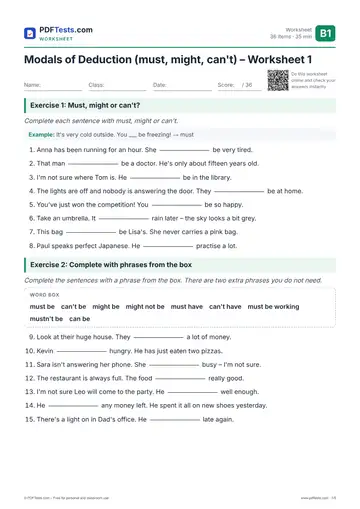
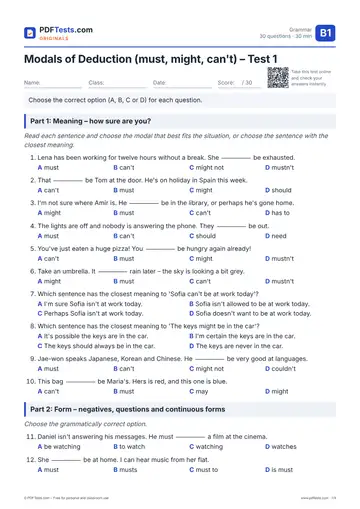
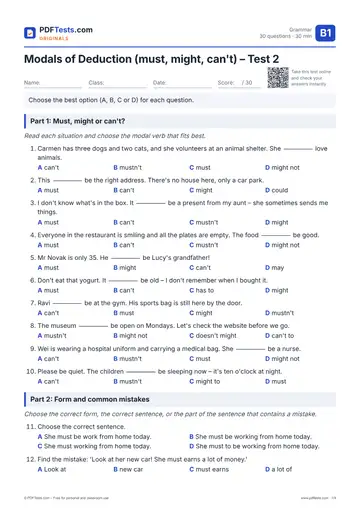
Practise this topic: Modals of Deduction (must, might, can't)
Was this page helpful?
What was the problem?
Thank you for your feedback!