PDFTests Originals

Use of English B1 – Test 1

B1 Intermediate GrammarEnglish

This B1 Use of English test has 32 multiple-choice questions in four exam-style parts: a vocabulary cloze, a grammar cloze, word formation and key word transformations. It is for intermediate learners preparing for B1 exams and for teachers who need a ready-to-print practice paper.
Questions
32
Time
40 min
PDF
6 pages
Answer key
Included
  • 100% free
  • No sign-up or email
  • Print-ready A4 PDF
Preview of page 1 of Use of English B1 – Test 1 Open PDF
Use of English B1–C2 · all exam-style tests, task types and tips

Take the test online

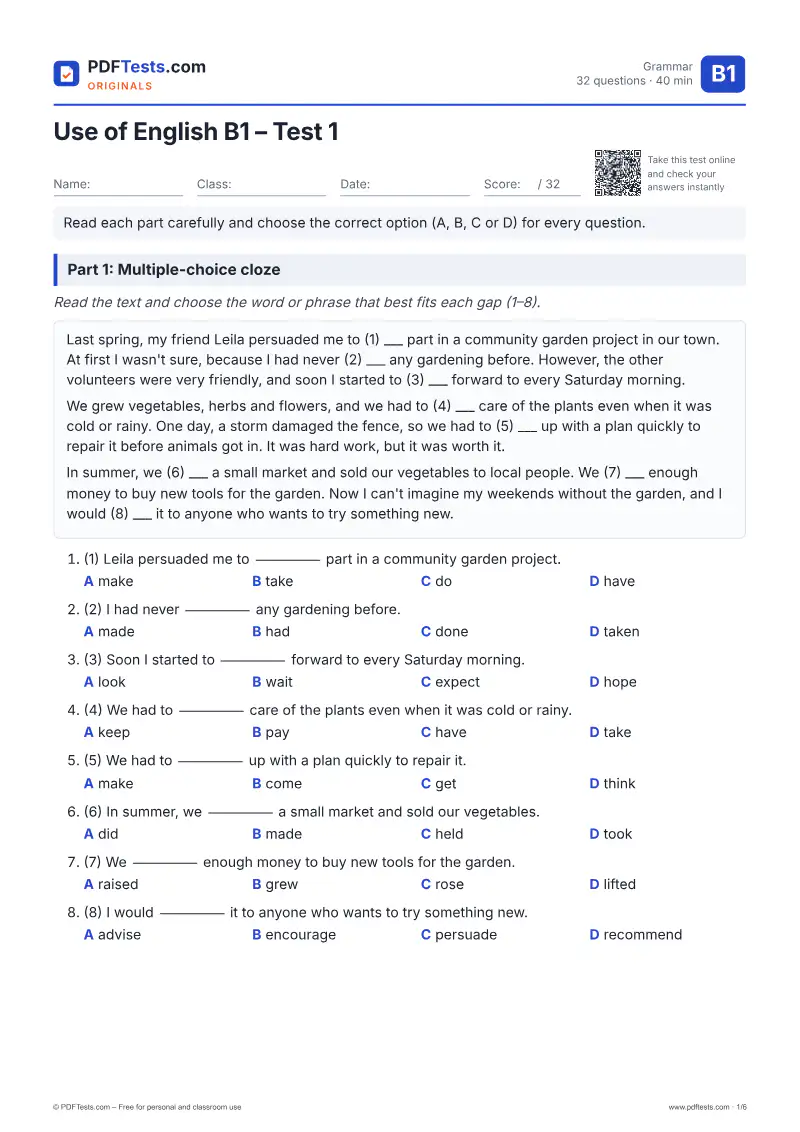
Read each part carefully and choose the correct option (A, B, C or D) for every question. Choose your answers, then press “Check my answers”.

Part 1: Multiple-choice cloze

Read the text and choose the word or phrase that best fits each gap (1–8).

Last spring, my friend Leila persuaded me to (1) ___ part in a community garden project in our town. At first I wasn't sure, because I had never (2) ___ any gardening before. However, the other volunteers were very friendly, and soon I started to (3) ___ forward to every Saturday morning.

We grew vegetables, herbs and flowers, and we had to (4) ___ care of the plants even when it was cold or rainy. One day, a storm damaged the fence, so we had to (5) ___ up with a plan quickly to repair it before animals got in. It was hard work, but it was worth it.

In summer, we (6) ___ a small market and sold our vegetables to local people. We (7) ___ enough money to buy new tools for the garden. Now I can't imagine my weekends without the garden, and I would (8) ___ it to anyone who wants to try something new.

  1. (1) Leila persuaded me to _____ part in a community garden project.

  2. (2) I had never _____ any gardening before.

  3. (3) Soon I started to _____ forward to every Saturday morning.

  4. (4) We had to _____ care of the plants even when it was cold or rainy.

  5. (5) We had to _____ up with a plan quickly to repair it.

  6. (6) In summer, we _____ a small market and sold our vegetables.

  7. (7) We _____ enough money to buy new tools for the garden.

  8. (8) I would _____ it to anyone who wants to try something new.

Part 2: Grammar cloze

Read the text and choose the word that best fits each gap (9–16).

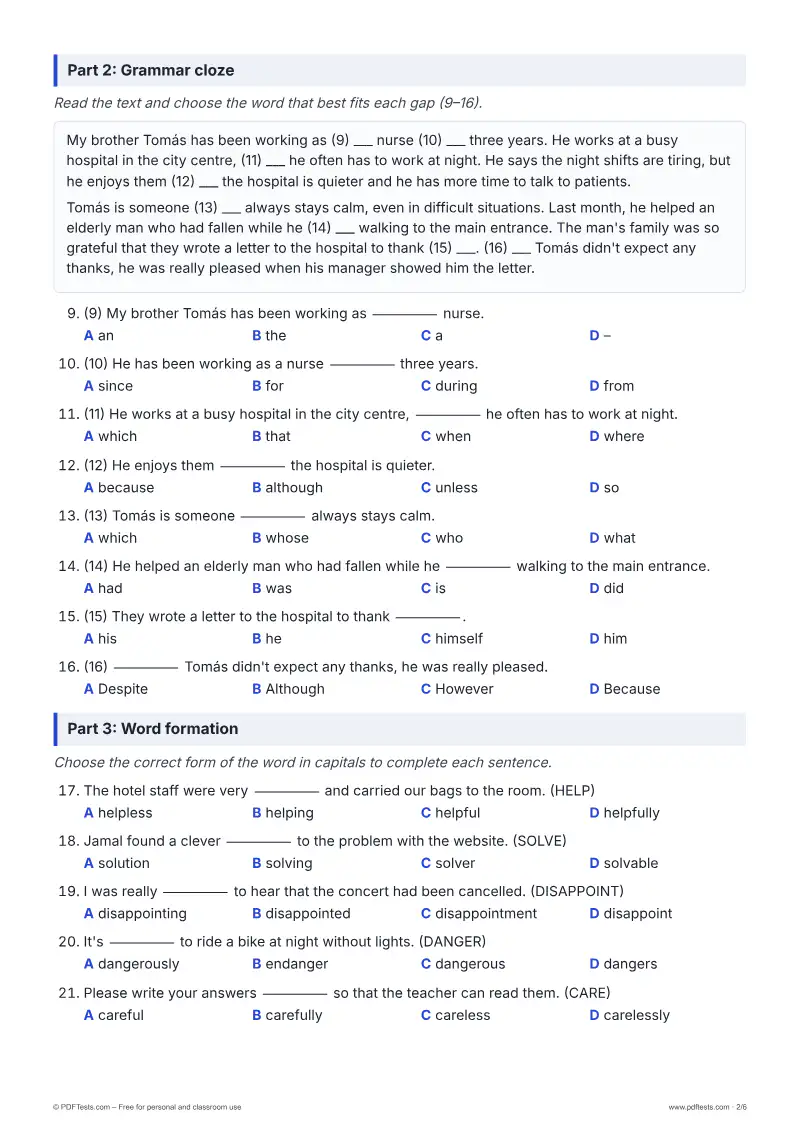
My brother Tomás has been working as (9) ___ nurse (10) ___ three years. He works at a busy hospital in the city centre, (11) ___ he often has to work at night. He says the night shifts are tiring, but he enjoys them (12) ___ the hospital is quieter and he has more time to talk to patients.

Tomás is someone (13) ___ always stays calm, even in difficult situations. Last month, he helped an elderly man who had fallen while he (14) ___ walking to the main entrance. The man's family was so grateful that they wrote a letter to the hospital to thank (15) ___. (16) ___ Tomás didn't expect any thanks, he was really pleased when his manager showed him the letter.

  1. (9) My brother Tomás has been working as _____ nurse.

  2. (10) He has been working as a nurse _____ three years.

  3. (11) He works at a busy hospital in the city centre, _____ he often has to work at night.

  4. (12) He enjoys them _____ the hospital is quieter.

  5. (13) Tomás is someone _____ always stays calm.

  6. (14) He helped an elderly man who had fallen while he _____ walking to the main entrance.

  7. (15) They wrote a letter to the hospital to thank _____.

  8. (16) _____ Tomás didn't expect any thanks, he was really pleased.

Part 3: Word formation

Choose the correct form of the word in capitals to complete each sentence.

  1. The hotel staff were very _____ and carried our bags to the room. (HELP)

  2. Jamal found a clever _____ to the problem with the website. (SOLVE)

  3. I was really _____ to hear that the concert had been cancelled. (DISAPPOINT)

  4. It's _____ to ride a bike at night without lights. (DANGER)

  5. Please write your answers _____ so that the teacher can read them. (CARE)

  6. We are waiting for the _____ of the next train. (ARRIVE)

  7. Many students think the new rules are _____ and should be changed. (FAIR)

  8. Sofia showed great _____ when she rescued the cat from the river. (BRAVE)

Part 4: Key word transformations

Choose the sentence that uses the word in capitals, has the same meaning as the first sentence and is grammatically correct.

  1. I haven't been to the cinema for a month. (LAST)

  2. It isn't necessary for you to bring any food. (HAVE)

  3. Maria started learning Spanish two years ago. (BEEN)

  4. This is the first time I've seen this film. (NEVER)

  5. The bus was so crowded that we couldn't get on. (TOO)

  6. 'I will call you tomorrow,' Ana said to me. (WOULD)

  7. Someone stole my bike last night. (WAS)

  8. I regret not studying harder for the exam. (WISH)

Was this page helpful?

Report a mistake

Spotted a wrong answer, a typo or an unclear explanation? Tell us and we will fix it.

Preview

About this test

This B1 Use of English test has 32 multiple-choice questions in four exam-style parts: a vocabulary cloze, a grammar cloze, word formation and key word transformations. It is for intermediate learners preparing for B1 exams and for teachers who need a ready-to-print practice paper.

Topics covered

Collocations and fixed phrasesPhrasal verbsArticles, prepositions and pronounsLinkers and relative pronounsWord formationKey word transformationsPresent perfect and reported speechPassive and wish

How to use this test

  1. Download the PDF and print it, or take the test online below.
  2. Answer every question without a dictionary or time pressure.
  3. Check your answers and note the topics you need to review.

Notes for teachers

Use this test as a timed mock or split it into four shorter lessons, one part at a time. It targets common B1 errors such as wrong collocations (make/do/take), since vs for, which vs where, confusion between -ed and -ing adjectives, and wrong verb forms after wish and in reported speech. After marking, ask students to correct the wrong options in Part 4 and explain why each one does not work. They can then write their own transformations using the same key words.