PDFTests Originals

Use of English B1 – Test 1

B1 Intermédiaire GrammaireAnglais

Ce test Use of English de niveau B1 comprend 32 questions à choix multiples réparties en quatre parties au format examen : un texte à trous de vocabulaire, un texte à trous de grammaire, la formation des mots et les transformations de phrases avec mot clé (key word transformations). Il s'adresse aux apprenants de niveau intermédiaire qui préparent un examen B1 et aux enseignants à la recherche d'un sujet d'entraînement prêt à imprimer.
Questions
32
Durée
40 min
PDF
6 pages
Corrigé
Inclus
  • 100 % gratuit
  • Sans inscription
  • PDF A4 prêt à imprimer
Aperçu de la page 1 : Use of English B1 – Test 1 Ouvrir le PDF
Use of English B1–C2 · tous les tests au format examen, types de tâches et conseils

Faire le test en ligne

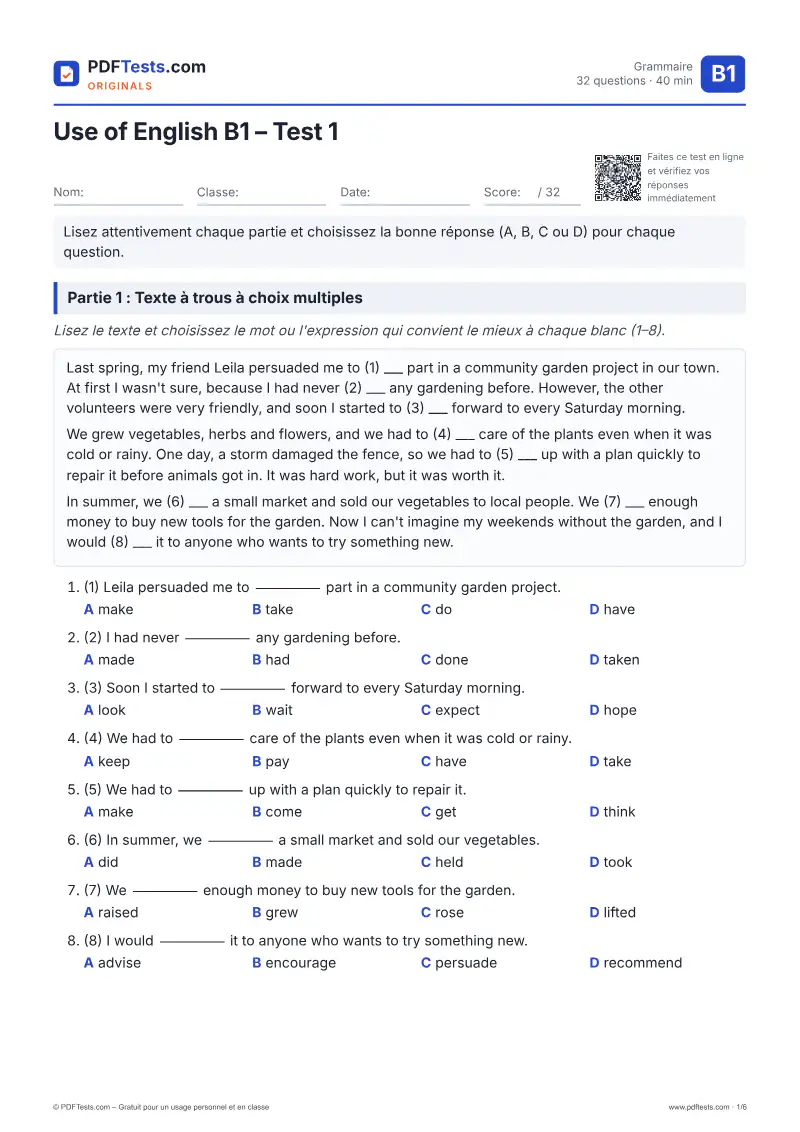
Lisez attentivement chaque partie et choisissez la bonne réponse (A, B, C ou D) pour chaque question. Choisissez vos réponses, puis cliquez sur « Vérifier mes réponses ».

Partie 1 : Texte à trous à choix multiples

Lisez le texte et choisissez le mot ou l'expression qui convient le mieux à chaque blanc (1–8).

Last spring, my friend Leila persuaded me to (1) ___ part in a community garden project in our town. At first I wasn't sure, because I had never (2) ___ any gardening before. However, the other volunteers were very friendly, and soon I started to (3) ___ forward to every Saturday morning.

We grew vegetables, herbs and flowers, and we had to (4) ___ care of the plants even when it was cold or rainy. One day, a storm damaged the fence, so we had to (5) ___ up with a plan quickly to repair it before animals got in. It was hard work, but it was worth it.

In summer, we (6) ___ a small market and sold our vegetables to local people. We (7) ___ enough money to buy new tools for the garden. Now I can't imagine my weekends without the garden, and I would (8) ___ it to anyone who wants to try something new.

  1. (1) Leila persuaded me to _____ part in a community garden project.

  2. (2) I had never _____ any gardening before.

  3. (3) Soon I started to _____ forward to every Saturday morning.

  4. (4) We had to _____ care of the plants even when it was cold or rainy.

  5. (5) We had to _____ up with a plan quickly to repair it.

  6. (6) In summer, we _____ a small market and sold our vegetables.

  7. (7) We _____ enough money to buy new tools for the garden.

  8. (8) I would _____ it to anyone who wants to try something new.

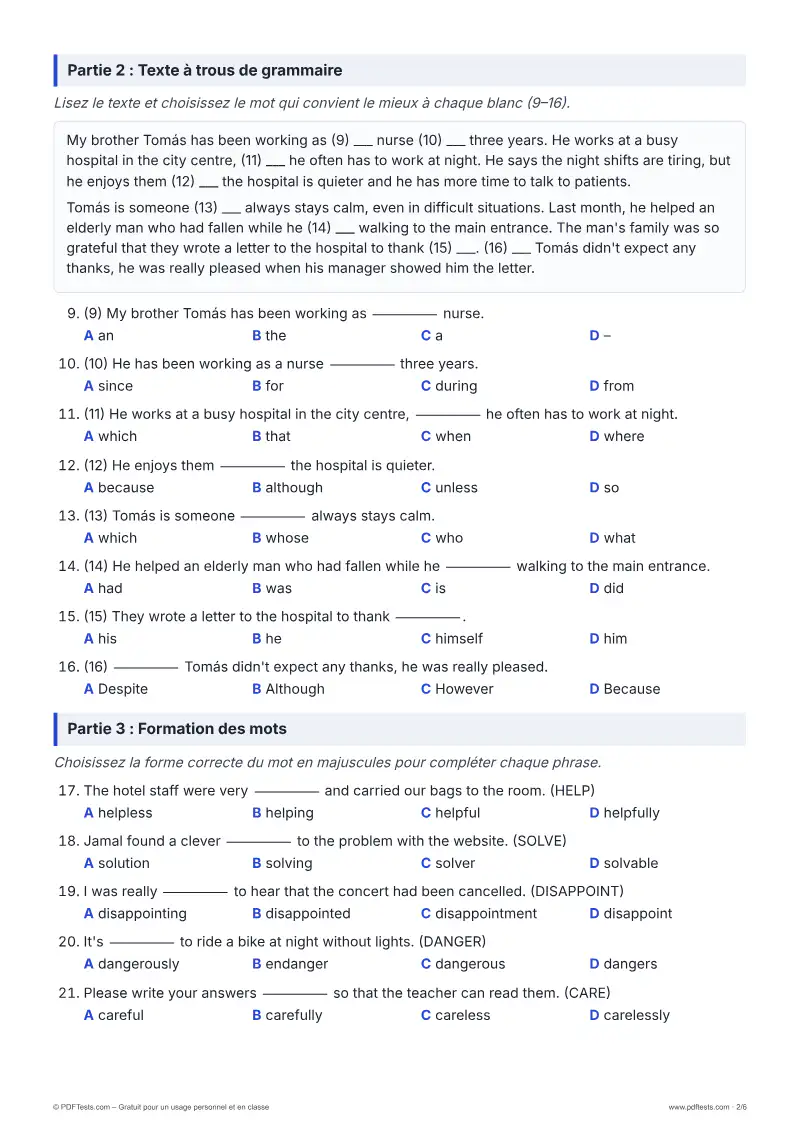
Partie 2 : Texte à trous de grammaire

Lisez le texte et choisissez le mot qui convient le mieux à chaque blanc (9–16).

My brother Tomás has been working as (9) ___ nurse (10) ___ three years. He works at a busy hospital in the city centre, (11) ___ he often has to work at night. He says the night shifts are tiring, but he enjoys them (12) ___ the hospital is quieter and he has more time to talk to patients.

Tomás is someone (13) ___ always stays calm, even in difficult situations. Last month, he helped an elderly man who had fallen while he (14) ___ walking to the main entrance. The man's family was so grateful that they wrote a letter to the hospital to thank (15) ___. (16) ___ Tomás didn't expect any thanks, he was really pleased when his manager showed him the letter.

  1. (9) My brother Tomás has been working as _____ nurse.

  2. (10) He has been working as a nurse _____ three years.

  3. (11) He works at a busy hospital in the city centre, _____ he often has to work at night.

  4. (12) He enjoys them _____ the hospital is quieter.

  5. (13) Tomás is someone _____ always stays calm.

  6. (14) He helped an elderly man who had fallen while he _____ walking to the main entrance.

  7. (15) They wrote a letter to the hospital to thank _____.

  8. (16) _____ Tomás didn't expect any thanks, he was really pleased.

Partie 3 : Formation des mots

Choisissez la forme correcte du mot en majuscules pour compléter chaque phrase.

  1. The hotel staff were very _____ and carried our bags to the room. (HELP)

  2. Jamal found a clever _____ to the problem with the website. (SOLVE)

  3. I was really _____ to hear that the concert had been cancelled. (DISAPPOINT)

  4. It's _____ to ride a bike at night without lights. (DANGER)

  5. Please write your answers _____ so that the teacher can read them. (CARE)

  6. We are waiting for the _____ of the next train. (ARRIVE)

  7. Many students think the new rules are _____ and should be changed. (FAIR)

  8. Sofia showed great _____ when she rescued the cat from the river. (BRAVE)

Partie 4 : Transformations de phrases avec mot clé

Choisissez la phrase qui contient le mot en majuscules, a le même sens que la première phrase et est grammaticalement correcte.

  1. I haven't been to the cinema for a month. (LAST)

  2. It isn't necessary for you to bring any food. (HAVE)

  3. Maria started learning Spanish two years ago. (BEEN)

  4. This is the first time I've seen this film. (NEVER)

  5. The bus was so crowded that we couldn't get on. (TOO)

  6. 'I will call you tomorrow,' Ana said to me. (WOULD)

  7. Someone stole my bike last night. (WAS)

  8. I regret not studying harder for the exam. (WISH)

Cette page vous a-t-elle été utile ?

Signaler une erreur

Une mauvaise réponse, une faute de frappe ou une explication peu claire ? Dites-le-nous, nous corrigerons.

Aperçu

À propos de ce test

Ce test Use of English de niveau B1 comprend 32 questions à choix multiples réparties en quatre parties au format examen : un texte à trous de vocabulaire, un texte à trous de grammaire, la formation des mots et les transformations de phrases avec mot clé (key word transformations). Il s'adresse aux apprenants de niveau intermédiaire qui préparent un examen B1 et aux enseignants à la recherche d'un sujet d'entraînement prêt à imprimer.

Thèmes abordés

Collocations et expressions figéesVerbes à particule (phrasal verbs)Articles, prépositions et pronomsConnecteurs et pronoms relatifsFormation des motsTransformations de phrases avec mot cléPresent perfect et discours indirect (reported speech)Voix passive et « wish »

Comment utiliser ce test

  1. Téléchargez le PDF et imprimez-le, ou faites le test en ligne ci-dessous.
  2. Répondez à toutes les questions sans dictionnaire et sans vous presser.
  3. Vérifiez vos réponses et notez les points à revoir.

Notes pour l’enseignant

Utilisez ce test comme examen blanc chronométré ou répartissez-le sur quatre séances plus courtes, une partie à la fois. Il cible les erreurs fréquentes au niveau B1 : mauvaises collocations (make/do/take), confusion entre « since » et « for », entre « which » et « where », entre adjectifs en -ed et en -ing, ainsi que les formes verbales erronées après « wish » et au discours indirect. Après la correction, demandez aux élèves de corriger les mauvaises réponses de la partie 4 et d'expliquer pourquoi chacune ne convient pas. Ils peuvent ensuite rédiger leurs propres transformations avec les mêmes mots clés.