PDFTests Originals

Use of English B1 – Test 1

B1 Intermedio GramáticaInglés

Este test de Use of English de nivel B1 consta de 32 preguntas de opción múltiple repartidas en cuatro partes con formato de examen: un texto para completar con vocabulario, un texto para completar con gramática, formación de palabras y transformaciones con palabra clave (key word transformations). Está pensado para estudiantes de nivel intermedio que preparan exámenes B1 y para profesores que buscan una hoja de práctica lista para imprimir.
Preguntas
32
Tiempo
40 min
PDF
6 páginas
Soluciones
Incluidas
  • 100 % gratis
  • Sin registro
  • PDF A4 listo para imprimir
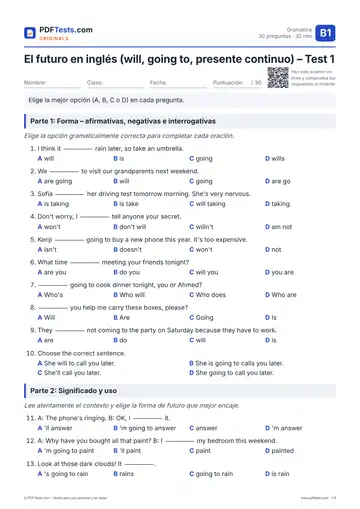
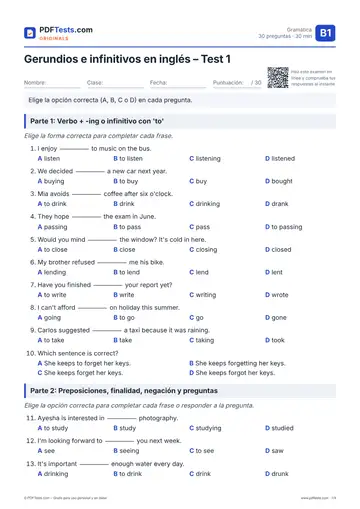
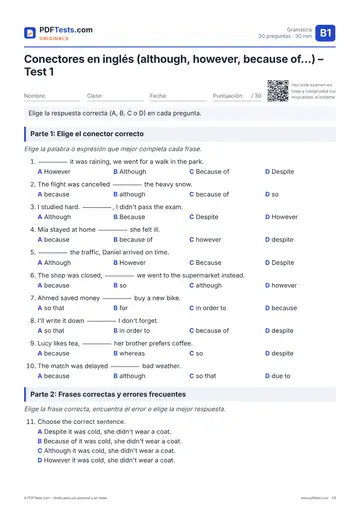
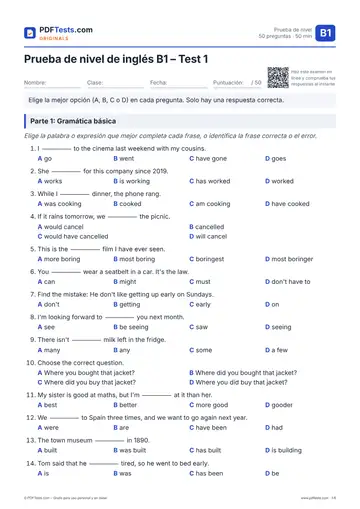
Vista previa de la página 1: Use of English B1 – Test 1 Abrir PDF
Use of English B1–C2 · todos los exámenes con formato de examen, tipos de tarea y consejos

Haz el examen en línea

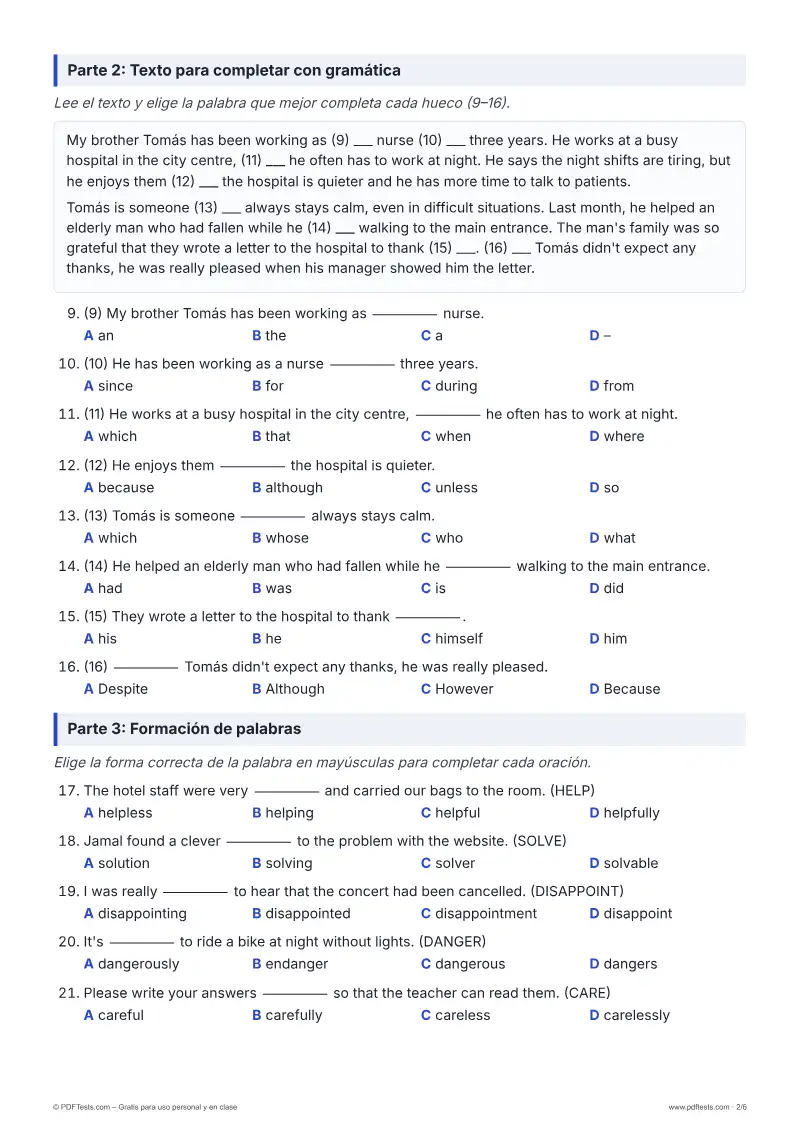
Lee con atención cada parte y elige la opción correcta (A, B, C o D) en cada pregunta. Elige tus respuestas y pulsa «Comprobar respuestas».

Parte 1: Texto para completar de opción múltiple

Lee el texto y elige la palabra o expresión que mejor completa cada hueco (1–8).

Last spring, my friend Leila persuaded me to (1) ___ part in a community garden project in our town. At first I wasn't sure, because I had never (2) ___ any gardening before. However, the other volunteers were very friendly, and soon I started to (3) ___ forward to every Saturday morning.

We grew vegetables, herbs and flowers, and we had to (4) ___ care of the plants even when it was cold or rainy. One day, a storm damaged the fence, so we had to (5) ___ up with a plan quickly to repair it before animals got in. It was hard work, but it was worth it.

In summer, we (6) ___ a small market and sold our vegetables to local people. We (7) ___ enough money to buy new tools for the garden. Now I can't imagine my weekends without the garden, and I would (8) ___ it to anyone who wants to try something new.

  1. (1) Leila persuaded me to _____ part in a community garden project.

  2. (2) I had never _____ any gardening before.

  3. (3) Soon I started to _____ forward to every Saturday morning.

  4. (4) We had to _____ care of the plants even when it was cold or rainy.

  5. (5) We had to _____ up with a plan quickly to repair it.

  6. (6) In summer, we _____ a small market and sold our vegetables.

  7. (7) We _____ enough money to buy new tools for the garden.

  8. (8) I would _____ it to anyone who wants to try something new.

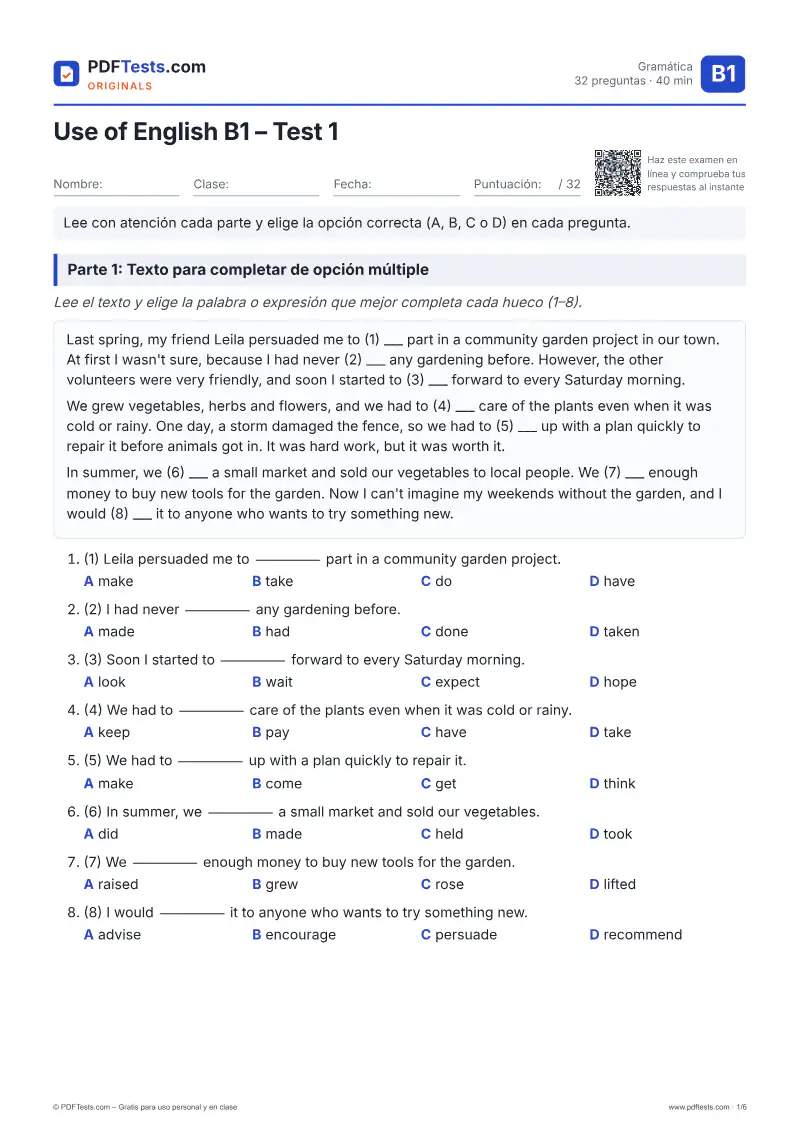
Parte 2: Texto para completar con gramática

Lee el texto y elige la palabra que mejor completa cada hueco (9–16).

My brother Tomás has been working as (9) ___ nurse (10) ___ three years. He works at a busy hospital in the city centre, (11) ___ he often has to work at night. He says the night shifts are tiring, but he enjoys them (12) ___ the hospital is quieter and he has more time to talk to patients.

Tomás is someone (13) ___ always stays calm, even in difficult situations. Last month, he helped an elderly man who had fallen while he (14) ___ walking to the main entrance. The man's family was so grateful that they wrote a letter to the hospital to thank (15) ___. (16) ___ Tomás didn't expect any thanks, he was really pleased when his manager showed him the letter.

  1. (9) My brother Tomás has been working as _____ nurse.

  2. (10) He has been working as a nurse _____ three years.

  3. (11) He works at a busy hospital in the city centre, _____ he often has to work at night.

  4. (12) He enjoys them _____ the hospital is quieter.

  5. (13) Tomás is someone _____ always stays calm.

  6. (14) He helped an elderly man who had fallen while he _____ walking to the main entrance.

  7. (15) They wrote a letter to the hospital to thank _____.

  8. (16) _____ Tomás didn't expect any thanks, he was really pleased.

Parte 3: Formación de palabras

Elige la forma correcta de la palabra en mayúsculas para completar cada oración.

  1. The hotel staff were very _____ and carried our bags to the room. (HELP)

  2. Jamal found a clever _____ to the problem with the website. (SOLVE)

  3. I was really _____ to hear that the concert had been cancelled. (DISAPPOINT)

  4. It's _____ to ride a bike at night without lights. (DANGER)

  5. Please write your answers _____ so that the teacher can read them. (CARE)

  6. We are waiting for the _____ of the next train. (ARRIVE)

  7. Many students think the new rules are _____ and should be changed. (FAIR)

  8. Sofia showed great _____ when she rescued the cat from the river. (BRAVE)

Parte 4: Transformaciones con palabra clave

Elige la oración que contiene la palabra en mayúsculas, tiene el mismo significado que la primera oración y es gramaticalmente correcta.

  1. I haven't been to the cinema for a month. (LAST)

  2. It isn't necessary for you to bring any food. (HAVE)

  3. Maria started learning Spanish two years ago. (BEEN)

  4. This is the first time I've seen this film. (NEVER)

  5. The bus was so crowded that we couldn't get on. (TOO)

  6. 'I will call you tomorrow,' Ana said to me. (WOULD)

  7. Someone stole my bike last night. (WAS)

  8. I regret not studying harder for the exam. (WISH)

¿Te ha resultado útil esta página?

Informar de un error

¿Has visto una respuesta incorrecta, una errata o una explicación poco clara? Avísanos y lo corregiremos.

Vista previa

Sobre este examen

Este test de Use of English de nivel B1 consta de 32 preguntas de opción múltiple repartidas en cuatro partes con formato de examen: un texto para completar con vocabulario, un texto para completar con gramática, formación de palabras y transformaciones con palabra clave (key word transformations). Está pensado para estudiantes de nivel intermedio que preparan exámenes B1 y para profesores que buscan una hoja de práctica lista para imprimir.

Temas

Colocaciones y expresiones fijasPhrasal verbsArtículos, preposiciones y pronombresConectores y pronombres relativosFormación de palabrasTransformaciones con palabra clave (key word transformations)Present perfect y estilo indirecto (reported speech)Voz pasiva y wish

Cómo usar este examen

  1. Descarga el PDF e imprímelo, o haz el examen en línea más abajo.
  2. Responde todas las preguntas sin diccionario y sin prisas.
  3. Comprueba tus respuestas y apunta los temas que debes repasar.

Notas para el profesor

Puedes usar este test como simulacro cronometrado o repartirlo en cuatro sesiones más cortas, una parte por clase. Se centra en errores típicos del nivel B1, como las colocaciones incorrectas (make/do/take), since frente a for, which frente a where, la confusión entre adjetivos en -ed e -ing y las formas verbales incorrectas después de wish y en el estilo indirecto. Después de corregir, pide a los alumnos que corrijan las opciones incorrectas de la Parte 4 y expliquen por qué no funcionan. Luego pueden escribir sus propias transformaciones con las mismas palabras clave.