PDFTests Originals

Use of English B1 – Test 1

B1 Mittelstufe GrammatikEnglisch

Dieser Use-of-English-Test auf Niveau B1 umfasst 32 Multiple-Choice-Aufgaben in vier prüfungsnahen Teilen: ein Wortschatz-Lückentext, ein Grammatik-Lückentext, Wortbildung und Satzumformungen mit Schlüsselwort (Key Word Transformations). Er richtet sich an Lernende auf mittlerem Niveau, die sich auf B1-Prüfungen vorbereiten, und an Lehrkräfte, die einen druckfertigen Übungstest suchen.
Fragen
32
Zeit
40 Min.
PDF
6 Seiten
Lösungen
Enthalten
  • 100 % kostenlos
  • Ohne Anmeldung
  • Druckfertiges A4-PDF
Vorschau von Seite 1: Use of English B1 – Test 1 PDF öffnen
Use of English B1–C2 · alle Tests im Prüfungsformat, Aufgabentypen und Tipps

Test online machen

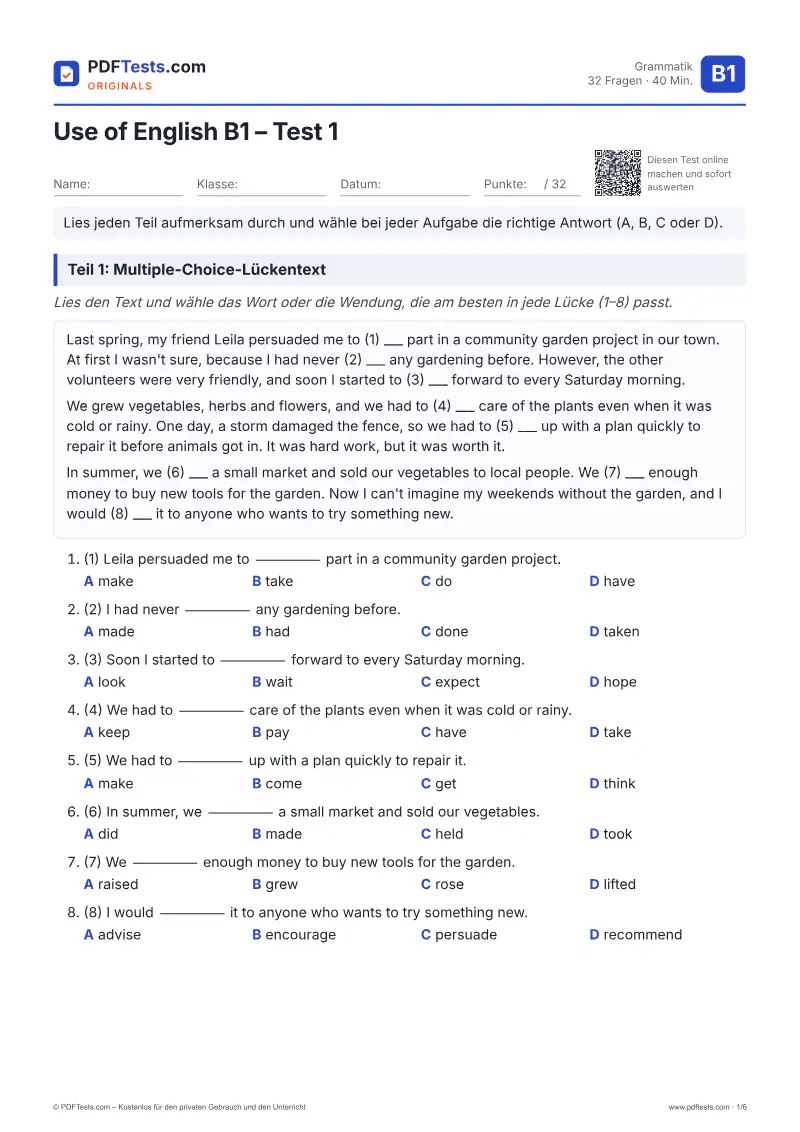
Lies jeden Teil aufmerksam durch und wähle bei jeder Aufgabe die richtige Antwort (A, B, C oder D). Wählen Sie Ihre Antworten und klicken Sie auf „Antworten prüfen“.

Teil 1: Multiple-Choice-Lückentext

Lies den Text und wähle das Wort oder die Wendung, die am besten in jede Lücke (1–8) passt.

Last spring, my friend Leila persuaded me to (1) ___ part in a community garden project in our town. At first I wasn't sure, because I had never (2) ___ any gardening before. However, the other volunteers were very friendly, and soon I started to (3) ___ forward to every Saturday morning.

We grew vegetables, herbs and flowers, and we had to (4) ___ care of the plants even when it was cold or rainy. One day, a storm damaged the fence, so we had to (5) ___ up with a plan quickly to repair it before animals got in. It was hard work, but it was worth it.

In summer, we (6) ___ a small market and sold our vegetables to local people. We (7) ___ enough money to buy new tools for the garden. Now I can't imagine my weekends without the garden, and I would (8) ___ it to anyone who wants to try something new.

  1. (1) Leila persuaded me to _____ part in a community garden project.

  2. (2) I had never _____ any gardening before.

  3. (3) Soon I started to _____ forward to every Saturday morning.

  4. (4) We had to _____ care of the plants even when it was cold or rainy.

  5. (5) We had to _____ up with a plan quickly to repair it.

  6. (6) In summer, we _____ a small market and sold our vegetables.

  7. (7) We _____ enough money to buy new tools for the garden.

  8. (8) I would _____ it to anyone who wants to try something new.

Teil 2: Grammatik-Lückentext

Lies den Text und wähle das Wort, das am besten in jede Lücke (9–16) passt.

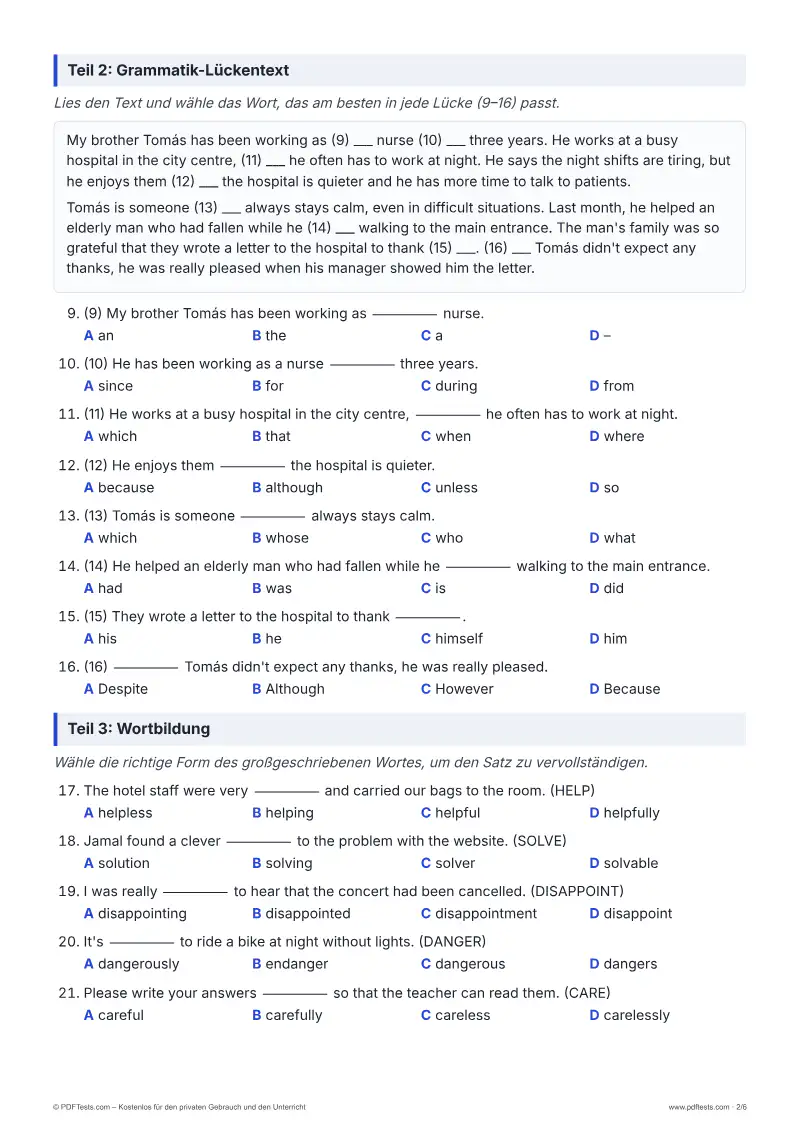
My brother Tomás has been working as (9) ___ nurse (10) ___ three years. He works at a busy hospital in the city centre, (11) ___ he often has to work at night. He says the night shifts are tiring, but he enjoys them (12) ___ the hospital is quieter and he has more time to talk to patients.

Tomás is someone (13) ___ always stays calm, even in difficult situations. Last month, he helped an elderly man who had fallen while he (14) ___ walking to the main entrance. The man's family was so grateful that they wrote a letter to the hospital to thank (15) ___. (16) ___ Tomás didn't expect any thanks, he was really pleased when his manager showed him the letter.

  1. (9) My brother Tomás has been working as _____ nurse.

  2. (10) He has been working as a nurse _____ three years.

  3. (11) He works at a busy hospital in the city centre, _____ he often has to work at night.

  4. (12) He enjoys them _____ the hospital is quieter.

  5. (13) Tomás is someone _____ always stays calm.

  6. (14) He helped an elderly man who had fallen while he _____ walking to the main entrance.

  7. (15) They wrote a letter to the hospital to thank _____.

  8. (16) _____ Tomás didn't expect any thanks, he was really pleased.

Teil 3: Wortbildung

Wähle die richtige Form des großgeschriebenen Wortes, um den Satz zu vervollständigen.

  1. The hotel staff were very _____ and carried our bags to the room. (HELP)

  2. Jamal found a clever _____ to the problem with the website. (SOLVE)

  3. I was really _____ to hear that the concert had been cancelled. (DISAPPOINT)

  4. It's _____ to ride a bike at night without lights. (DANGER)

  5. Please write your answers _____ so that the teacher can read them. (CARE)

  6. We are waiting for the _____ of the next train. (ARRIVE)

  7. Many students think the new rules are _____ and should be changed. (FAIR)

  8. Sofia showed great _____ when she rescued the cat from the river. (BRAVE)

Teil 4: Satzumformungen mit Schlüsselwort

Wähle den Satz, der das großgeschriebene Wort enthält, dieselbe Bedeutung wie der erste Satz hat und grammatisch korrekt ist.

  1. I haven't been to the cinema for a month. (LAST)

  2. It isn't necessary for you to bring any food. (HAVE)

  3. Maria started learning Spanish two years ago. (BEEN)

  4. This is the first time I've seen this film. (NEVER)

  5. The bus was so crowded that we couldn't get on. (TOO)

  6. 'I will call you tomorrow,' Ana said to me. (WOULD)

  7. Someone stole my bike last night. (WAS)

  8. I regret not studying harder for the exam. (WISH)

War diese Seite hilfreich?

Fehler melden

Falsche Lösung, Tippfehler oder unklare Erklärung? Schreiben Sie uns, wir korrigieren es.

Vorschau

Über diesen Test

Dieser Use-of-English-Test auf Niveau B1 umfasst 32 Multiple-Choice-Aufgaben in vier prüfungsnahen Teilen: ein Wortschatz-Lückentext, ein Grammatik-Lückentext, Wortbildung und Satzumformungen mit Schlüsselwort (Key Word Transformations). Er richtet sich an Lernende auf mittlerem Niveau, die sich auf B1-Prüfungen vorbereiten, und an Lehrkräfte, die einen druckfertigen Übungstest suchen.

Themen

Kollokationen und feste WendungenPhrasal VerbsArtikel, Präpositionen und PronomenKonnektoren und RelativpronomenWortbildungSatzumformungen mit Schlüsselwort (Key Word Transformations)Present Perfect und indirekte Rede (Reported Speech)Passiv und Wunschsätze mit „wish“

So nutzen Sie diesen Test

  1. Laden Sie das PDF herunter und drucken Sie es aus – oder machen Sie den Test unten online.
  2. Beantworten Sie alle Fragen ohne Wörterbuch und ohne Zeitdruck.
  3. Prüfen Sie Ihre Antworten und notieren Sie, was Sie wiederholen sollten.

Hinweise für Lehrkräfte

Setzen Sie den Test als zeitlich begrenzte Probeprüfung ein oder verteilen Sie ihn auf vier kürzere Unterrichtseinheiten mit je einem Teil. Er zielt auf typische Fehler auf B1-Niveau ab, etwa falsche Kollokationen (make/do/take), die Verwechslung von since und for bzw. which und where, die Verwechslung von Adjektiven auf -ed und -ing sowie falsche Verbformen nach wish und in der indirekten Rede. Lassen Sie die Lernenden nach der Korrektur die falschen Antwortmöglichkeiten in Teil 4 verbessern und begründen, warum sie jeweils nicht funktionieren. Anschließend können sie mit denselben Schlüsselwörtern eigene Umformungen schreiben.