PDFTests Originals

Use of English B2 – Test 1

B2 Upper-intermediate GrammarEnglish

This exam-style B2 Use of English test has 36 multiple-choice questions in four parts: collocations and phrasal verbs in context, grammar words in a text, word formation, and key word transformations. It suits upper-intermediate learners preparing for B2-level exams and teachers who need a ready-made practice or diagnostic test.
Questions
36
Time
45 min
PDF
6 pages
Answer key
Included
  • 100% free
  • No sign-up or email
  • Print-ready A4 PDF
Preview of page 1 of Use of English B2 – Test 1 Open PDF
Use of English B1–C2 · all exam-style tests, task types and tips

Take the test online

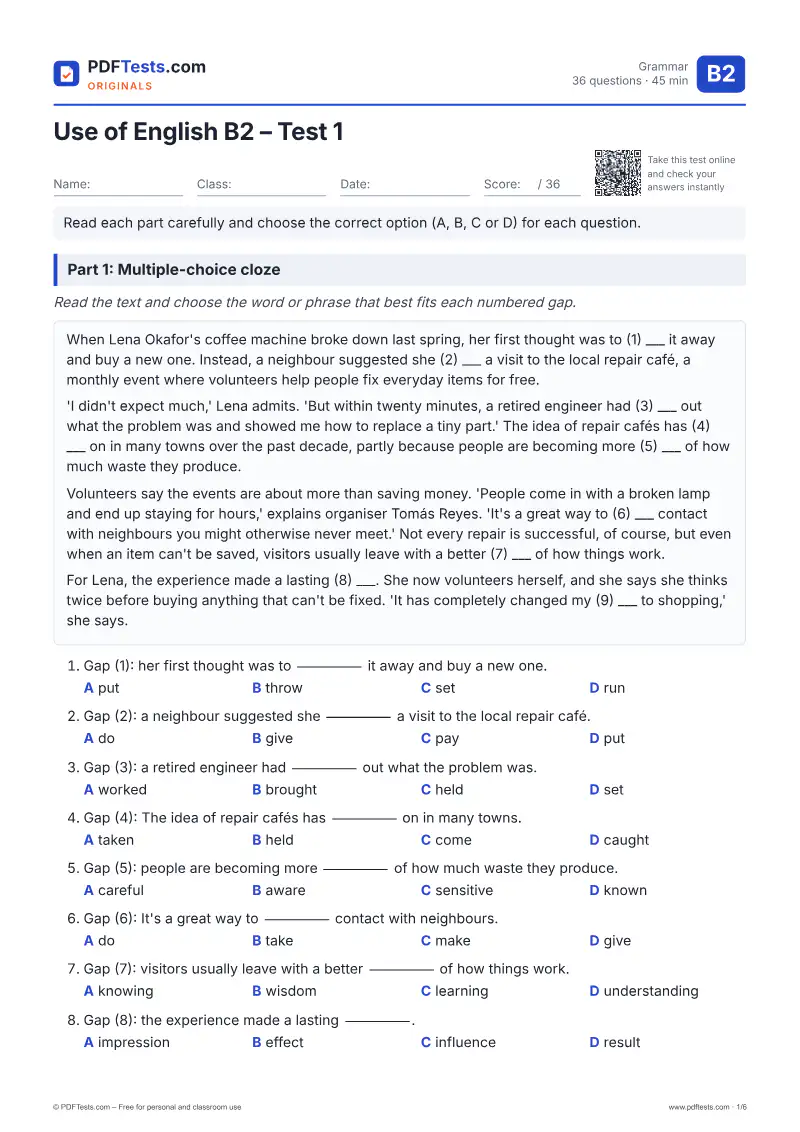
Read each part carefully and choose the correct option (A, B, C or D) for each question. Choose your answers, then press “Check my answers”.

Part 1: Multiple-choice cloze

Read the text and choose the word or phrase that best fits each numbered gap.

When Lena Okafor's coffee machine broke down last spring, her first thought was to (1) ___ it away and buy a new one. Instead, a neighbour suggested she (2) ___ a visit to the local repair café, a monthly event where volunteers help people fix everyday items for free.

'I didn't expect much,' Lena admits. 'But within twenty minutes, a retired engineer had (3) ___ out what the problem was and showed me how to replace a tiny part.' The idea of repair cafés has (4) ___ on in many towns over the past decade, partly because people are becoming more (5) ___ of how much waste they produce.

Volunteers say the events are about more than saving money. 'People come in with a broken lamp and end up staying for hours,' explains organiser Tomás Reyes. 'It's a great way to (6) ___ contact with neighbours you might otherwise never meet.' Not every repair is successful, of course, but even when an item can't be saved, visitors usually leave with a better (7) ___ of how things work.

For Lena, the experience made a lasting (8) ___. She now volunteers herself, and she says she thinks twice before buying anything that can't be fixed. 'It has completely changed my (9) ___ to shopping,' she says.

  1. Gap (1): her first thought was to _____ it away and buy a new one.

  2. Gap (2): a neighbour suggested she _____ a visit to the local repair café.

  3. Gap (3): a retired engineer had _____ out what the problem was.

  4. Gap (4): The idea of repair cafés has _____ on in many towns.

  5. Gap (5): people are becoming more _____ of how much waste they produce.

  6. Gap (6): It's a great way to _____ contact with neighbours.

  7. Gap (7): visitors usually leave with a better _____ of how things work.

  8. Gap (8): the experience made a lasting _____.

  9. Gap (9): It has completely changed my _____ to shopping.

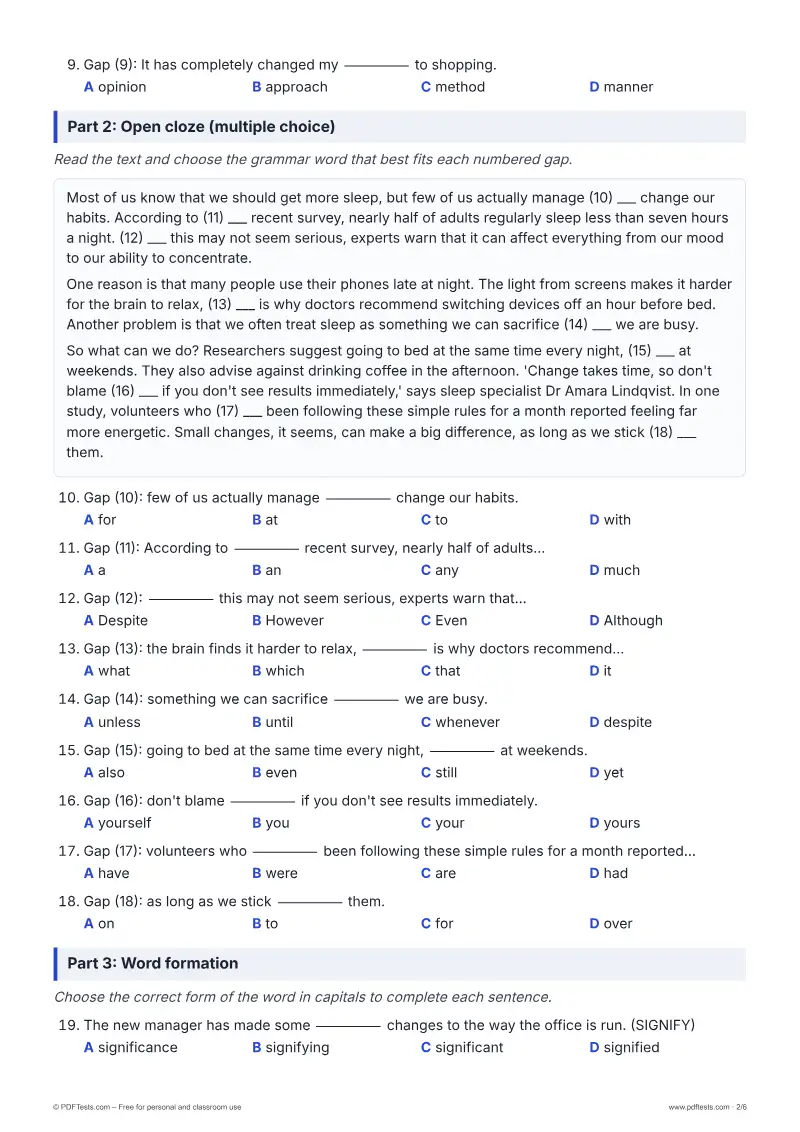
Part 2: Open cloze (multiple choice)

Read the text and choose the grammar word that best fits each numbered gap.

Most of us know that we should get more sleep, but few of us actually manage (10) ___ change our habits. According to (11) ___ recent survey, nearly half of adults regularly sleep less than seven hours a night. (12) ___ this may not seem serious, experts warn that it can affect everything from our mood to our ability to concentrate.

One reason is that many people use their phones late at night. The light from screens makes it harder for the brain to relax, (13) ___ is why doctors recommend switching devices off an hour before bed. Another problem is that we often treat sleep as something we can sacrifice (14) ___ we are busy.

So what can we do? Researchers suggest going to bed at the same time every night, (15) ___ at weekends. They also advise against drinking coffee in the afternoon. 'Change takes time, so don't blame (16) ___ if you don't see results immediately,' says sleep specialist Dr Amara Lindqvist. In one study, volunteers who (17) ___ been following these simple rules for a month reported feeling far more energetic. Small changes, it seems, can make a big difference, as long as we stick (18) ___ them.

  1. Gap (10): few of us actually manage _____ change our habits.

  2. Gap (11): According to _____ recent survey, nearly half of adults...

  3. Gap (12): _____ this may not seem serious, experts warn that...

  4. Gap (13): the brain finds it harder to relax, _____ is why doctors recommend...

  5. Gap (14): something we can sacrifice _____ we are busy.

  6. Gap (15): going to bed at the same time every night, _____ at weekends.

  7. Gap (16): don't blame _____ if you don't see results immediately.

  8. Gap (17): volunteers who _____ been following these simple rules for a month reported...

  9. Gap (18): as long as we stick _____ them.

Part 3: Word formation

Choose the correct form of the word in capitals to complete each sentence.

  1. The new manager has made some _____ changes to the way the office is run. (SIGNIFY)

  2. Several customers complained about the _____ of the staff. (RUDE)

  3. It's completely _____ to expect everyone to finish the work by Friday. (REASON)

  4. The museum is closed for _____ until the end of June. (RENOVATE)

  5. She spoke so _____ that everyone in the room was convinced. (PERSUADE)

  6. There has been a _____ increase in the number of people cycling to work. (DRAMA)

  7. The _____ of the new bridge took nearly three years. (CONSTRUCT)

  8. I'm afraid your answer is _____, so please try again. (CORRECT)

  9. Having a pet can give children a sense of _____. (RESPONSIBLE)

Part 4: Key word transformations

Read the first sentence and the key word in capitals. Choose the rewrite that keeps the same meaning, uses the key word and is grammatically correct.

  1. I'm sure Daniel didn't take your keys. (CAN'T)

  2. It was the first time Priya had flown in a plane. (NEVER)

  3. People say the castle is over 800 years old. (SAID)

  4. I regret not studying harder for the exam. (WISH)

  5. Although it rained heavily, the match continued. (DESPITE)

  6. Someone is going to repair my laptop tomorrow. (HAVING)

  7. 'Did you lock the door?' Maria asked me. (WHETHER)

  8. It isn't necessary for you to bring any food. (HAVE)

  9. If you don't leave now, you'll miss the train. (UNLESS)

Was this page helpful?

Report a mistake

Spotted a wrong answer, a typo or an unclear explanation? Tell us and we will fix it.

Practise with a worksheet: Use of English B2 – Worksheet 1

Preview

About this test

This exam-style B2 Use of English test has 36 multiple-choice questions in four parts: collocations and phrasal verbs in context, grammar words in a text, word formation, and key word transformations. It suits upper-intermediate learners preparing for B2-level exams and teachers who need a ready-made practice or diagnostic test.

Topics covered

Collocations and fixed phrasesPhrasal verbsArticles, prepositions and linkersRelative and reflexive pronounsWord formationModals of deductionPassives and causativesReported speech and wishes

How to use this test

  1. Download the PDF and print it, or take the test online below.
  2. Answer every question without a dictionary or time pressure.
  3. Check your answers and note the topics you need to review.

Notes for teachers

Use the test as a timed exam practice or as a diagnostic at the start of a B2 course. It targets common upper-intermediate errors such as wrong verb–noun collocations (do/make/pay), 'despite' followed by a clause, missing prefixes in word formation, and incorrect tense backshift in reported speech. After marking, ask students to explain why each distractor is wrong, then have them write their own transformations using the same key words.