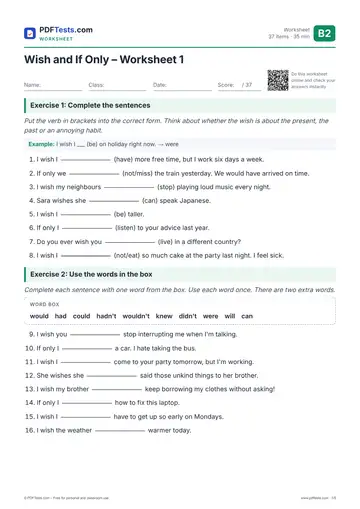
We use wish and if only to talk about situations we would like to be different: things that are not true now, things that happened in the past, or behaviour we want someone to change. The key idea is that the verb after wish moves one step back in time, so a present wish uses a past form and a past regret uses the past perfect. If only works in the same way but sounds stronger and more emotional.
The three main patterns at a glance
| Time of the wish | Structure | Example |
|---|---|---|
| Present (unreal now) | wish + past simple / past continuous | I wish I knew the answer. |
| Past (regret) | wish + past perfect | I wish I hadn’t said that. |
| Change / complaint | wish + would + infinitive | I wish you would listen to me. |
| Ability (now) | wish + could + infinitive | I wish I could swim. |
The same patterns work with if only: If only I knew the answer. / If only I hadn’t said that.
Wish + past simple: wishes about the present
Use wish + past simple when you want a present situation to be different. The situation is real; the wish is imaginary.
- I wish I had more free time. (I don’t have much free time.)
- She wishes she lived closer to the office. (She lives far away.)
- I wish I didn’t have to work this weekend. (I have to work.)
- We wish we were on holiday right now.
Use the past continuous for actions in progress now:
- I wish it wasn’t raining. (It is raining.)
- I wish I was lying on a beach instead of sitting in this meeting.
This is the same “unreal past” you know from the second conditional: If I had more time, I’d learn Japanese. If you need a refresher, read our guide to the first and second conditional.
Form
| Example | |
|---|---|
| Affirmative | I wish I had a car. |
| Negative | I wish I didn’t have so much homework. |
| With be | I wish he were / was here. |
| Continuous | I wish you weren’t leaving tomorrow. |
Notice how a negative wish expresses a positive reality and vice versa: I wish I didn’t have so much homework = I have a lot of homework.
Was or were?
After wish and if only, you can use were with all persons: I wish I were taller. If only she were here. This is the more formal choice and is common in writing and exams. Was is also correct and very common in everyday speech: I wish I was taller. Both are acceptable at B2, but were is safer in formal writing.
Wish + could: abilities and possibilities
Use wish + could when the problem is ability or possibility.
- I wish I could speak Italian. (I can’t.)
- He wishes he could come to the party, but he’s working.
- I wish we could afford a bigger flat.
For past abilities, use could have + past participle: I wish I could have helped you yesterday.
Wish + past perfect: regrets about the past
Use wish + past perfect (had + past participle) to express regret about something that happened or didn’t happen. You cannot change it now.
- I wish I had studied harder for the exam. (I didn’t study hard.)
- She wishes she hadn’t sold her old guitar. (She sold it.)
- I wish you had told me earlier.
- We wish we had booked the tickets in advance.
If the past perfect still feels uncertain, review our Past Perfect guide first. This structure is closely linked to the third conditional: If I had studied harder, I would have passed.
Form
| Example | |
|---|---|
| Affirmative | I wish I had gone to the concert. |
| Negative | I wish I hadn’t eaten so much. |
| Short form | I wish I’d known. |
Wish + would: wanting change and complaining
Use wish + would + infinitive when you want someone or something to change, usually because you are annoyed or impatient.
- I wish you would stop interrupting me.
- I wish my neighbours wouldn’t play music so loudly.
- I wish he would reply to my messages.
- I wish it would stop raining.
- I wish the bus would come. We’ve been waiting for ages.
Rules for wish + would
- It refers to actions or events, not states. Say I wish it would stop raining (an event you want to happen), but I wish I had a bigger kitchen (a state), not ✗ I wish I would have a bigger kitchen.
- Don’t use it with the same subject. We normally don’t say ✗ I wish I would… because you control your own actions. Use the past simple or could instead: I wish I exercised more or I wish I could stop eating chocolate.
- It often sounds like a complaint or a polite request. I wish you would tidy your room is close to Please tidy your room.
Past simple or would?
Compare:
- I wish you were more patient. (a general wish about your character)
- I wish you would be more patient. (I want you to change your behaviour; I’m a little annoyed)
If only
If only follows exactly the same grammar as wish, but it is more emphatic and emotional. It is often used on its own, without a main clause.
| Wish | If only |
|---|---|
| I wish I knew her name. | If only I knew her name. |
| I wish I hadn’t missed the train. | If only I hadn’t missed the train. |
| I wish he would call. | If only he would call. |
| I wish I could help. | If only I could help. |
You can also use if only at the start of a conditional sentence:
- If only I had left earlier, I wouldn’t have got stuck in traffic.
- If only we had more money, we could travel more.
Note: there is no subject before if only. Say If only I had…, not ✗ I if only had…
Wish vs hope
Learners often confuse wish and hope. The difference is about reality.
- Use hope for things that are possible or that you don’t know yet. It takes normal tenses: I hope you pass your exam. I hope she got home safely.
- Use wish for things that are unreal, impossible or already decided: I wish I had passed my exam (I failed).
| Hope (possible) | Wish (unreal) |
|---|---|
| I hope it’s sunny tomorrow. | I wish it was sunny today. |
| I hope you can come. | I wish you could come. (You can’t.) |
| I hope I did well. | I wish I had done better. |
Other uses of wish
Wish + to-infinitive is a formal alternative to want or would like. It does not express an unreal wish:
- I wish to speak to the manager, please.
- Passengers who wish to change their seats should contact the airline.
Wish + object + noun is used for good wishes, often in fixed expressions:
- We wish you a merry Christmas.
- I wished her good luck before the interview.
For other formal structures with unreal meaning, such as It’s time you… and I’d rather you…, see our guide to the subjunctive and formal structures.
Common mistakes
✗ I wish I have more money. → ✓ I wish I had more money. Present wishes need a past form, not the present simple.
✗ I wish I didn’t go to that party last night. → ✓ I wish I hadn’t gone to that party last night. Regrets about the past need the past perfect.
✗ I wish I would be taller. → ✓ I wish I were / was taller. Don’t use would for states or with the same subject.
✗ I wish I would have known. → ✓ I wish I had known. After wish*, use the past perfect, not* would have*.*
✗ I wish you pass your driving test. → ✓ I hope you pass your driving test. Use hope for things that are still possible.
✗ I wish I can come with you. → ✓ I wish I could come with you. Use could*, the past form of* can*.*
✗ If only I knew about it yesterday. → ✓ If only I had known about it yesterday. A past time reference needs the past perfect.
Quick check
Choose or write the correct form.
- I wish I ___ (not / eat) that second pizza. Now I feel sick.
- If only I ___ (know) how to fix this laptop. It keeps crashing.
- I wish my brother ___ (stop) borrowing my clothes without asking.
- I ___ (hope / wish) you have a great time in Lisbon next week.
- She wishes she ___ (can) play the piano like her sister.
Answers
- hadn’t eaten – a regret about the past needs the past perfect.
- knew – a present unreal situation needs the past simple.
- would stop – an annoying behaviour the speaker wants to change.
- hope – the trip is real and possible, so we use hope.
- could – ability in the present takes could.
Next step
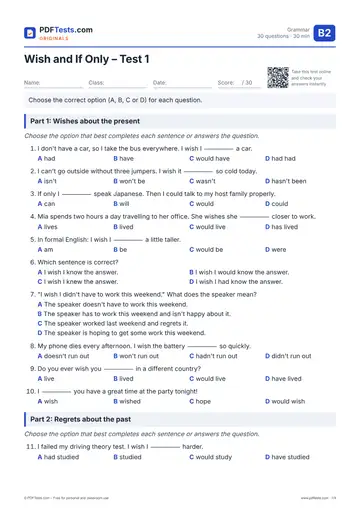
Now put the rules into practice: test yourself with our B2 Wish and If Only test, paying special attention to the difference between past simple, past perfect and would. Because wish for past regrets works like the third conditional, it is also worth trying our B2 Third and Mixed Conditionals test to reinforce the same unreal-past patterns.
Practise this topic: Wish and If Only
Was this page helpful?
What was the problem?
Thank you for your feedback!