PDFTests Originals

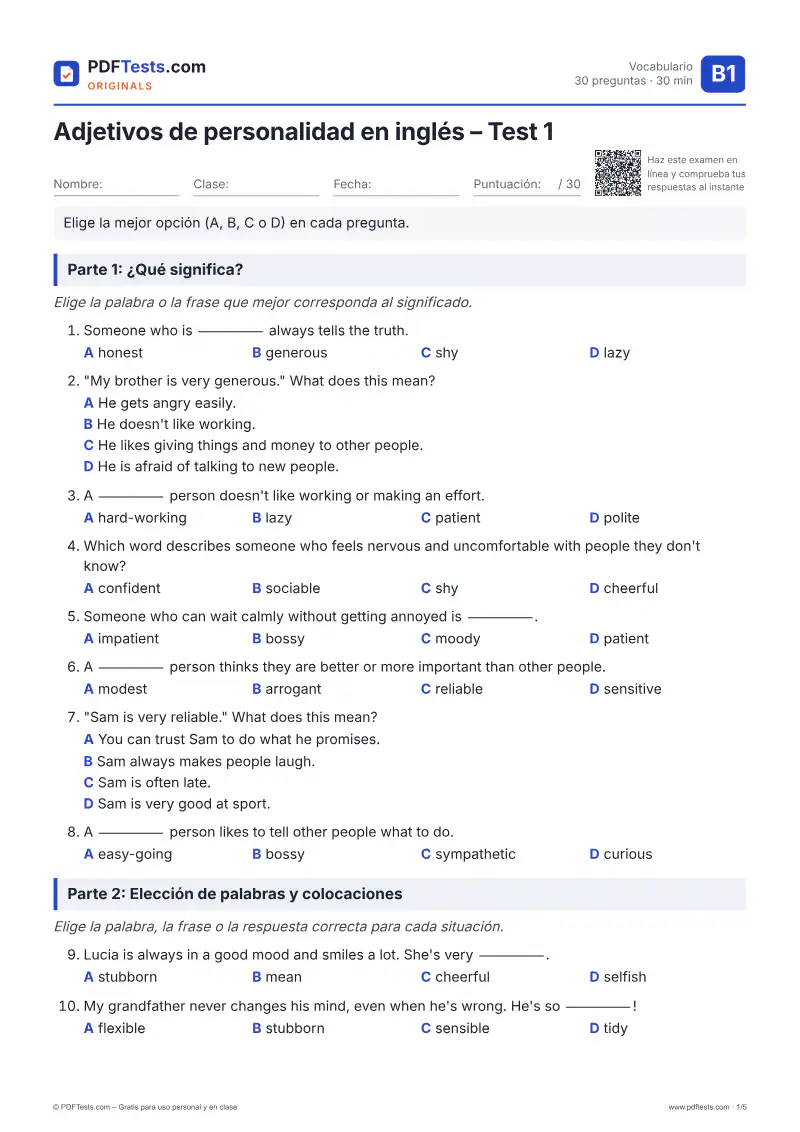
Adjetivos de personalidad en inglés – Test 1

B1 Intermedio VocabularioInglés

Este test de vocabulario de nivel B1 comprueba si conoces los adjetivos ingleses más habituales para describir la personalidad. Trabaja el significado, la elección de la palabra adecuada según el contexto, las colocaciones, los prefijos negativos y las familias de palabras, y termina con un breve texto de lectura. Es ideal para alumnos de nivel intermedio, tanto en clase como en casa.
Preguntas
30
Tiempo
30 min
PDF
5 páginas
Soluciones
Incluidas
  • 100 % gratis
  • Sin registro
  • PDF A4 listo para imprimir
Vista previa de la página 1: Adjetivos de personalidad en inglés – Test 1 Abrir PDF

Haz el examen en línea

Elige la mejor opción (A, B, C o D) en cada pregunta. Elige tus respuestas y pulsa «Comprobar respuestas».

Parte 1: ¿Qué significa?

Elige la palabra o la frase que mejor corresponda al significado.

  1. Someone who is _____ always tells the truth.

  2. "My brother is very generous." What does this mean?

  3. A _____ person doesn't like working or making an effort.

  4. Which word describes someone who feels nervous and uncomfortable with people they don't know?

  5. Someone who can wait calmly without getting annoyed is _____.

  6. A _____ person thinks they are better or more important than other people.

  7. "Sam is very reliable." What does this mean?

  8. A _____ person likes to tell other people what to do.

Parte 2: Elección de palabras y colocaciones

Elige la palabra, la frase o la respuesta correcta para cada situación.

  1. Lucia is always in a good mood and smiles a lot. She's very _____.

  2. My grandfather never changes his mind, even when he's wrong. He's so _____!

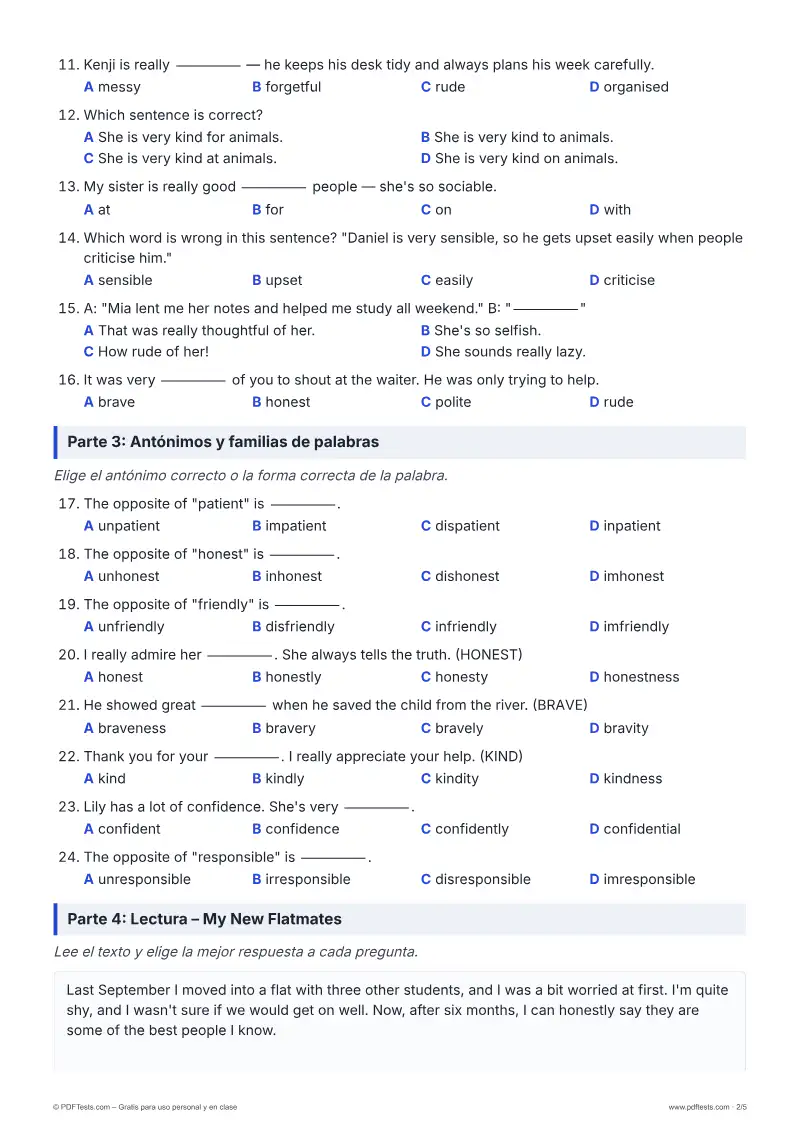
  3. Kenji is really _____ — he keeps his desk tidy and always plans his week carefully.

  4. Which sentence is correct?

  5. My sister is really good _____ people — she's so sociable.

  6. Which word is wrong in this sentence? "Daniel is very sensible, so he gets upset easily when people criticise him."

  7. A: "Mia lent me her notes and helped me study all weekend." B: "_____"

  8. It was very _____ of you to shout at the waiter. He was only trying to help.

Parte 3: Antónimos y familias de palabras

Elige el antónimo correcto o la forma correcta de la palabra.

  1. The opposite of "patient" is _____.

  2. The opposite of "honest" is _____.

  3. The opposite of "friendly" is _____.

  4. I really admire her _____. She always tells the truth. (HONEST)

  5. He showed great _____ when he saved the child from the river. (BRAVE)

  6. Thank you for your _____. I really appreciate your help. (KIND)

  7. Lily has a lot of confidence. She's very _____.

  8. The opposite of "responsible" is _____.

Parte 4: Lectura – My New Flatmates

Lee el texto y elige la mejor respuesta a cada pregunta.

Last September I moved into a flat with three other students, and I was a bit worried at first. I'm quite shy, and I wasn't sure if we would get on well. Now, after six months, I can honestly say they are some of the best people I know.

Tomás is the most sociable person I've ever met. He knows everyone on our street, and he's always inviting people round for dinner. He can be a little impatient — he hates waiting for the bathroom in the morning! — but he's never unkind.

Priya is very hard-working. She studies medicine and spends hours in the library. She's also extremely organised: there's a cleaning timetable on the fridge, and that was her idea. Some people might think she's a bit bossy, but she's usually right, and the flat is always tidy thanks to her.

Then there's Felix. He's very easy-going, and nothing seems to worry him. When I broke his favourite mug, he just laughed and said, 'Don't worry, it's only a mug.' The only problem is that he's quite forgetful. Last week he left his keys inside the flat twice!

Living with them has changed me. I've become more confident, and I'm not as nervous about meeting new people. I think I've learned a lot from each of them.

  1. Why was the writer worried when she moved into the flat?

  2. What shows that Tomás is sociable?

  3. The word "impatient" in paragraph 2 shows that Tomás _____.

  4. Why might some people think Priya is bossy?

  5. How does the story about the mug show that Felix is easy-going?

  6. How has the writer changed since she moved in?

¿Te ha resultado útil esta página?

Informar de un error

¿Has visto una respuesta incorrecta, una errata o una explicación poco clara? Avísanos y lo corregiremos.

Practica con una ficha: Adjetivos de personalidad en inglés – Ficha 1

Vista previa

Sobre este examen

Este test de vocabulario de nivel B1 comprueba si conoces los adjetivos ingleses más habituales para describir la personalidad. Trabaja el significado, la elección de la palabra adecuada según el contexto, las colocaciones, los prefijos negativos y las familias de palabras, y termina con un breve texto de lectura. Es ideal para alumnos de nivel intermedio, tanto en clase como en casa.

Temas

Adjetivos de personalidadSignificado en contextoColocaciones (collocations)Prefijos negativosFormación de palabrasComprensión lectora y vocabulario

Cómo usar este examen

  1. Descarga el PDF e imprímelo, o haz el examen en línea más abajo.
  2. Responde todas las preguntas sin diccionario y sin prisas.
  3. Comprueba tus respuestas y apunta los temas que debes repasar.

Notas para el profesor

Utilice este test después de una unidad sobre la descripción de personas o como prueba diagnóstica antes de empezarla. Se centra en errores frecuentes de los alumnos, como confundir sensible y sensitive (un clásico falso amigo para hispanohablantes: «sensible» en inglés significa «sensato»), elegir un prefijo negativo incorrecto (unpatient, unhonest) o usar la preposición equivocada (kind for, good at people). Como actividad de refuerzo, pida a los alumnos que escriban una breve descripción de un amigo o familiar utilizando al menos ocho adjetivos del test.