PDFTests Originals

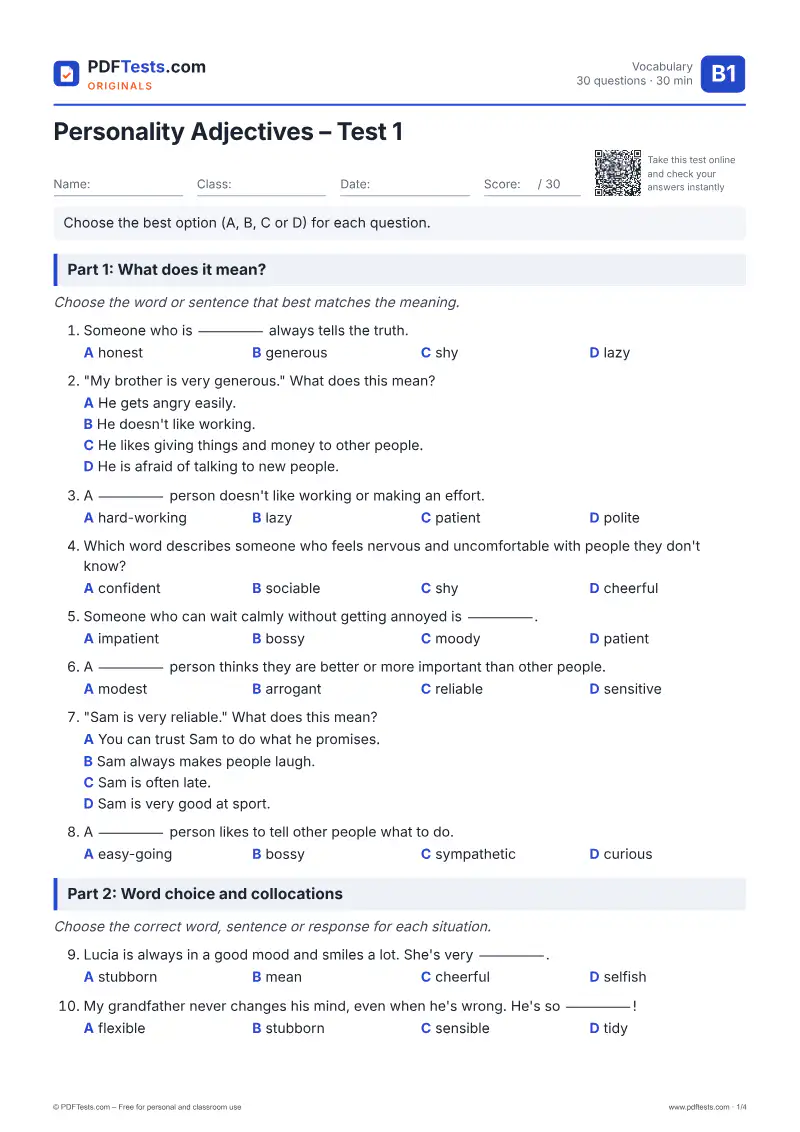
Personality Adjectives – Test 1

B1 Intermediate VocabularyEnglish

This B1 vocabulary test checks how well learners know common English adjectives for describing personality. It covers meaning, word choice in context, collocations, negative prefixes and word families, and ends with a short reading text. It suits intermediate learners in class or at home.
Questions
30
Time
30 min
PDF
4 pages
Answer key
Included
  • 100% free
  • No sign-up or email
  • Print-ready A4 PDF
Preview of page 1 of Personality Adjectives – Test 1 Open PDF

Take the test online

Choose the best option (A, B, C or D) for each question. Choose your answers, then press “Check my answers”.

Part 1: What does it mean?

Choose the word or sentence that best matches the meaning.

  1. Someone who is _____ always tells the truth.

  2. "My brother is very generous." What does this mean?

  3. A _____ person doesn't like working or making an effort.

  4. Which word describes someone who feels nervous and uncomfortable with people they don't know?

  5. Someone who can wait calmly without getting annoyed is _____.

  6. A _____ person thinks they are better or more important than other people.

  7. "Sam is very reliable." What does this mean?

  8. A _____ person likes to tell other people what to do.

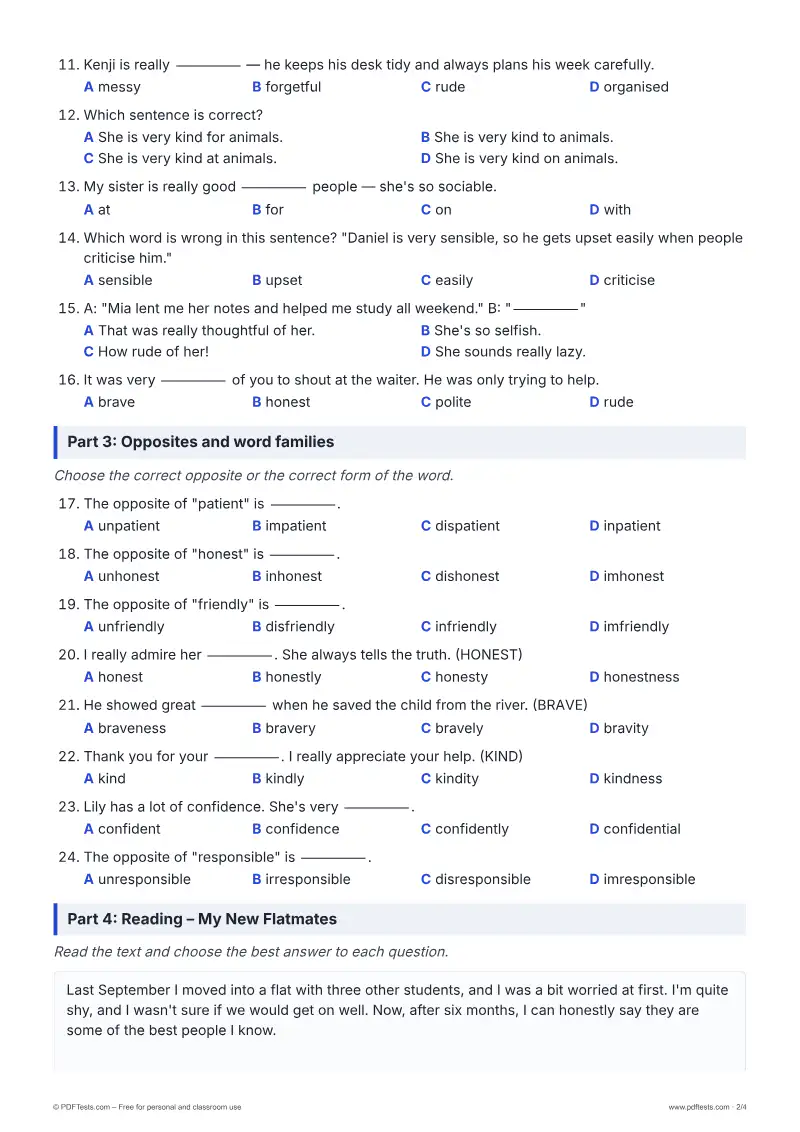
Part 2: Word choice and collocations

Choose the correct word, sentence or response for each situation.

  1. Lucia is always in a good mood and smiles a lot. She's very _____.

  2. My grandfather never changes his mind, even when he's wrong. He's so _____!

  3. Kenji is really _____ — he keeps his desk tidy and always plans his week carefully.

  4. Which sentence is correct?

  5. My sister is really good _____ people — she's so sociable.

  6. Which word is wrong in this sentence? "Daniel is very sensible, so he gets upset easily when people criticise him."

  7. A: "Mia lent me her notes and helped me study all weekend." B: "_____"

  8. It was very _____ of you to shout at the waiter. He was only trying to help.

Part 3: Opposites and word families

Choose the correct opposite or the correct form of the word.

  1. The opposite of "patient" is _____.

  2. The opposite of "honest" is _____.

  3. The opposite of "friendly" is _____.

  4. I really admire her _____. She always tells the truth. (HONEST)

  5. He showed great _____ when he saved the child from the river. (BRAVE)

  6. Thank you for your _____. I really appreciate your help. (KIND)

  7. Lily has a lot of confidence. She's very _____.

  8. The opposite of "responsible" is _____.

Part 4: Reading – My New Flatmates

Read the text and choose the best answer to each question.

Last September I moved into a flat with three other students, and I was a bit worried at first. I'm quite shy, and I wasn't sure if we would get on well. Now, after six months, I can honestly say they are some of the best people I know.

Tomás is the most sociable person I've ever met. He knows everyone on our street, and he's always inviting people round for dinner. He can be a little impatient — he hates waiting for the bathroom in the morning! — but he's never unkind.

Priya is very hard-working. She studies medicine and spends hours in the library. She's also extremely organised: there's a cleaning timetable on the fridge, and that was her idea. Some people might think she's a bit bossy, but she's usually right, and the flat is always tidy thanks to her.

Then there's Felix. He's very easy-going, and nothing seems to worry him. When I broke his favourite mug, he just laughed and said, 'Don't worry, it's only a mug.' The only problem is that he's quite forgetful. Last week he left his keys inside the flat twice!

Living with them has changed me. I've become more confident, and I'm not as nervous about meeting new people. I think I've learned a lot from each of them.

  1. Why was the writer worried when she moved into the flat?

  2. What shows that Tomás is sociable?

  3. The word "impatient" in paragraph 2 shows that Tomás _____.

  4. Why might some people think Priya is bossy?

  5. How does the story about the mug show that Felix is easy-going?

  6. How has the writer changed since she moved in?

Was this page helpful?

Report a mistake

Spotted a wrong answer, a typo or an unclear explanation? Tell us and we will fix it.

Practise with a worksheet: Personality Adjectives – Worksheet 1

Preview

About this test

This B1 vocabulary test checks how well learners know common English adjectives for describing personality. It covers meaning, word choice in context, collocations, negative prefixes and word families, and ends with a short reading text. It suits intermediate learners in class or at home.

Topics covered

Personality adjectivesMeaning in contextCollocationsNegative prefixesWord formationReading for vocabulary

How to use this test

  1. Download the PDF and print it, or take the test online below.
  2. Answer every question without a dictionary or time pressure.
  3. Check your answers and note the topics you need to review.

Notes for teachers

Use this test after a unit on describing people, or as a diagnostic before one. It targets common learner errors such as confusing sensible and sensitive, choosing the wrong negative prefix (unpatient, unhonest) and using the wrong preposition (kind for, good at people). As a follow-up, ask students to write a short description of a friend or family member using at least eight adjectives from the test.