PDFTests Originals

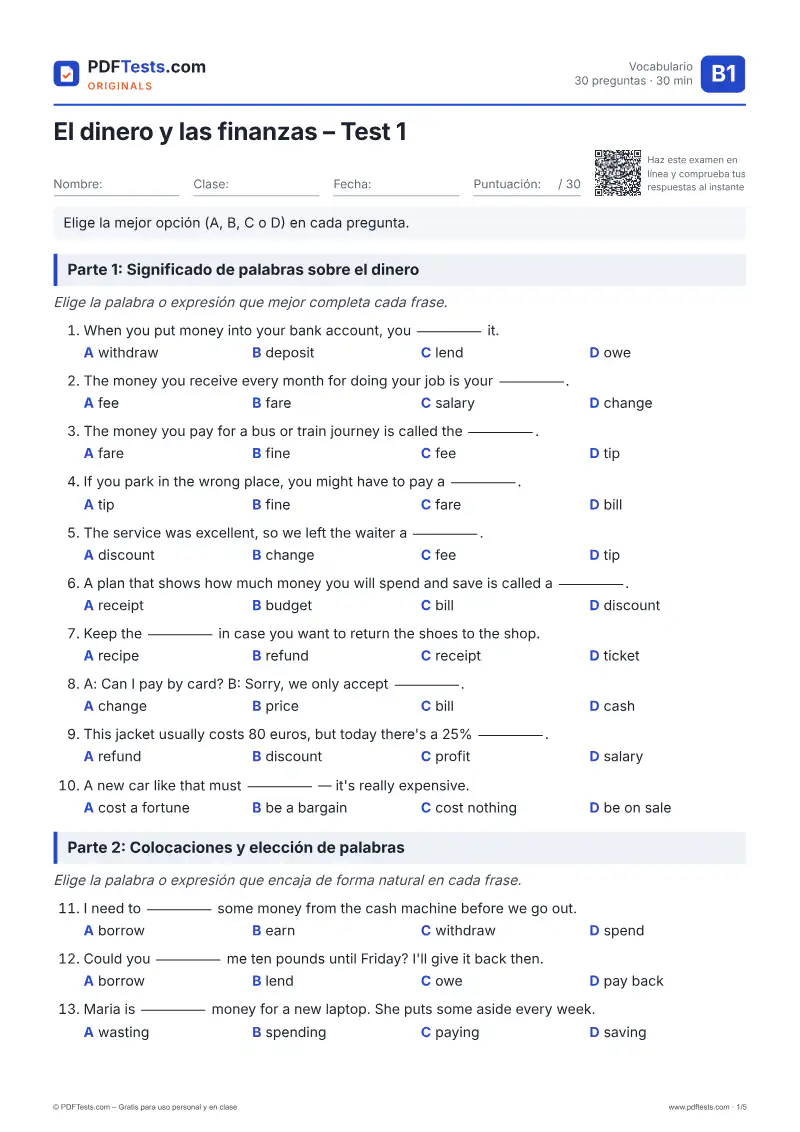
El dinero y las finanzas – Test 1

B1 Intermedio VocabularioInglés

Este test de vocabulario de nivel B1 trata el inglés cotidiano relacionado con el dinero y las finanzas: el banco, las compras, el ahorro, los préstamos y el presupuesto. Trabaja el significado de las palabras, las colocaciones más frecuentes, las familias de palabras y el vocabulario dentro de un breve texto de lectura. Es ideal para alumnos de nivel intermedio, para repasar en clase o para estudiar por tu cuenta.
Preguntas
30
Tiempo
30 min
PDF
5 páginas
Soluciones
Incluidas
  • 100 % gratis
  • Sin registro
  • PDF A4 listo para imprimir
Vista previa de la página 1: El dinero y las finanzas – Test 1 Abrir PDF

Haz el examen en línea

Elige la mejor opción (A, B, C o D) en cada pregunta. Elige tus respuestas y pulsa «Comprobar respuestas».

Parte 1: Significado de palabras sobre el dinero

Elige la palabra o expresión que mejor completa cada frase.

  1. When you put money into your bank account, you _____ it.

  2. The money you receive every month for doing your job is your _____.

  3. The money you pay for a bus or train journey is called the _____.

  4. If you park in the wrong place, you might have to pay a _____.

  5. The service was excellent, so we left the waiter a _____.

  6. A plan that shows how much money you will spend and save is called a _____.

  7. Keep the _____ in case you want to return the shoes to the shop.

  8. A: Can I pay by card? B: Sorry, we only accept _____.

  9. This jacket usually costs 80 euros, but today there's a 25% _____.

  10. A new car like that must _____ — it's really expensive.

Parte 2: Colocaciones y elección de palabras

Elige la palabra o expresión que encaja de forma natural en cada frase.

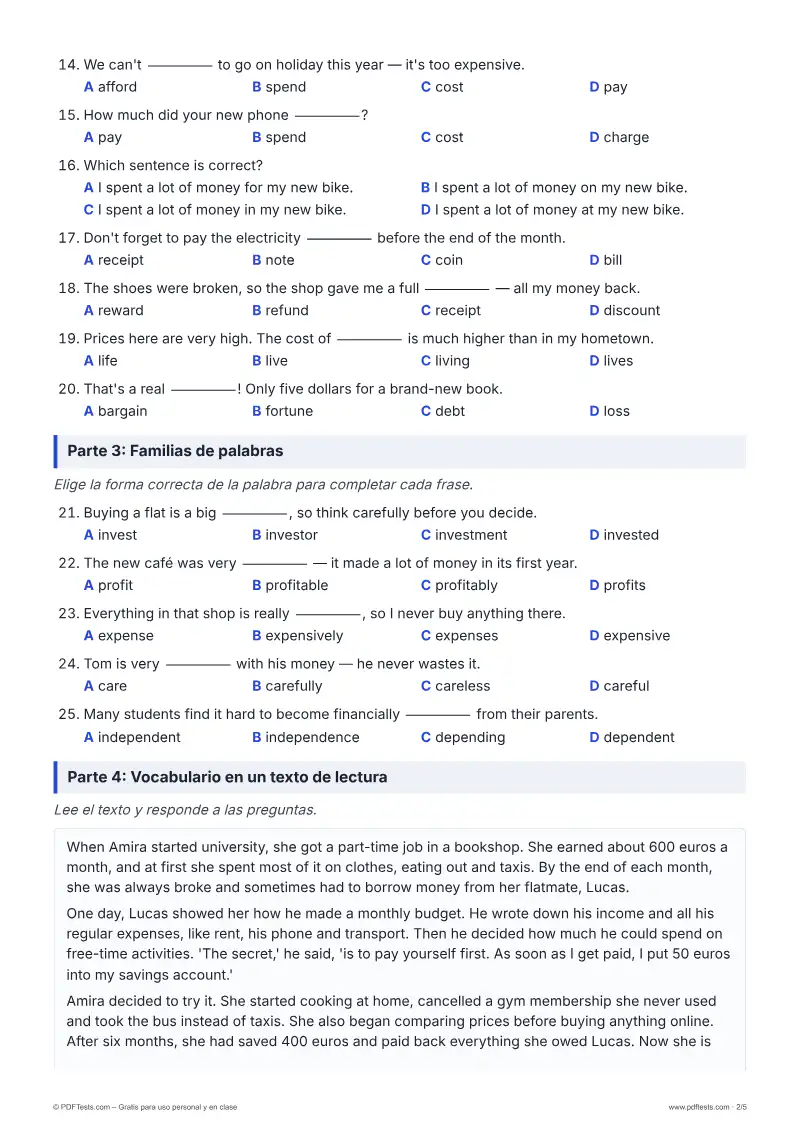
  1. I need to _____ some money from the cash machine before we go out.

  2. Could you _____ me ten pounds until Friday? I'll give it back then.

  3. Maria is _____ money for a new laptop. She puts some aside every week.

  4. We can't _____ to go on holiday this year — it's too expensive.

  5. How much did your new phone _____?

  6. Which sentence is correct?

  7. Don't forget to pay the electricity _____ before the end of the month.

  8. The shoes were broken, so the shop gave me a full _____ — all my money back.

  9. Prices here are very high. The cost of _____ is much higher than in my hometown.

  10. That's a real _____! Only five dollars for a brand-new book.

Parte 3: Familias de palabras

Elige la forma correcta de la palabra para completar cada frase.

  1. Buying a flat is a big _____, so think carefully before you decide.

  2. The new café was very _____ — it made a lot of money in its first year.

  3. Everything in that shop is really _____, so I never buy anything there.

  4. Tom is very _____ with his money — he never wastes it.

  5. Many students find it hard to become financially _____ from their parents.

Parte 4: Vocabulario en un texto de lectura

Lee el texto y responde a las preguntas.

When Amira started university, she got a part-time job in a bookshop. She earned about 600 euros a month, and at first she spent most of it on clothes, eating out and taxis. By the end of each month, she was always broke and sometimes had to borrow money from her flatmate, Lucas.

One day, Lucas showed her how he made a monthly budget. He wrote down his income and all his regular expenses, like rent, his phone and transport. Then he decided how much he could spend on free-time activities. 'The secret,' he said, 'is to pay yourself first. As soon as I get paid, I put 50 euros into my savings account.'

Amira decided to try it. She started cooking at home, cancelled a gym membership she never used and took the bus instead of taxis. She also began comparing prices before buying anything online. After six months, she had saved 400 euros and paid back everything she owed Lucas. Now she is saving up for a trip to Portugal next summer, and she no longer worries about money at the end of the month.

  1. In paragraph 1, the word 'broke' means:

  2. In paragraph 2, 'income' means:

  3. What does Lucas mean by 'pay yourself first'?

  4. Which of these things did Amira NOT do to spend less money?

  5. In the last paragraph, 'saving up for' a trip means:

¿Te ha resultado útil esta página?

Informar de un error

¿Has visto una respuesta incorrecta, una errata o una explicación poco clara? Avísanos y lo corregiremos.

Practica con una ficha: El dinero y las finanzas – Ficha 1

Vista previa

Sobre este examen

Este test de vocabulario de nivel B1 trata el inglés cotidiano relacionado con el dinero y las finanzas: el banco, las compras, el ahorro, los préstamos y el presupuesto. Trabaja el significado de las palabras, las colocaciones más frecuentes, las familias de palabras y el vocabulario dentro de un breve texto de lectura. Es ideal para alumnos de nivel intermedio, para repasar en clase o para estudiar por tu cuenta.

Temas

El banco y los pagosLas compras y los preciosAhorrar y pedir prestadoColocaciones con moneyFamilias de palabrasComprensión lectora

Cómo usar este examen

  1. Descarga el PDF e imprímelo, o haz el examen en línea más abajo.
  2. Responde todas las preguntas sin diccionario y sin prisas.
  3. Comprueba tus respuestas y apunta los temas que debes repasar.

Notas para el profesor

Utilice este test al terminar una unidad sobre el dinero o como prueba diagnóstica antes de empezarla. Se centra en confusiones habituales entre los alumnos hispanohablantes, como lend/borrow, cost/pay/spend, fare/fee/fine, receipt/recipe (falso amigo de «receta») y la preposición en 'spend money on' (no «in»). Como actividad de seguimiento, pida a los alumnos que redacten su propio presupuesto mensual con el vocabulario aprendido o que vuelvan a contar el texto de lectura con sus propias palabras.