PDFTests Originals

Arte y cultura – Test 1

B2 Intermedio alto VocabularioInglés

Este test de vocabulario de nivel B2 trata el léxico del arte y la cultura: teatro, música, pintura, museos, literatura y cine. Evalúa el significado de las palabras, las colocaciones, la formación de palabras y el vocabulario en contexto a partir de un texto de lectura. Es ideal para alumnos de nivel intermedio-alto, para quienes preparan exámenes oficiales y para profesores que necesitan un test listo para imprimir.

Preguntas
30
Tiempo
35 min
PDF
5 páginas
Soluciones
Incluidas
  • 100 % gratis
  • Sin registro
  • PDF A4 listo para imprimir
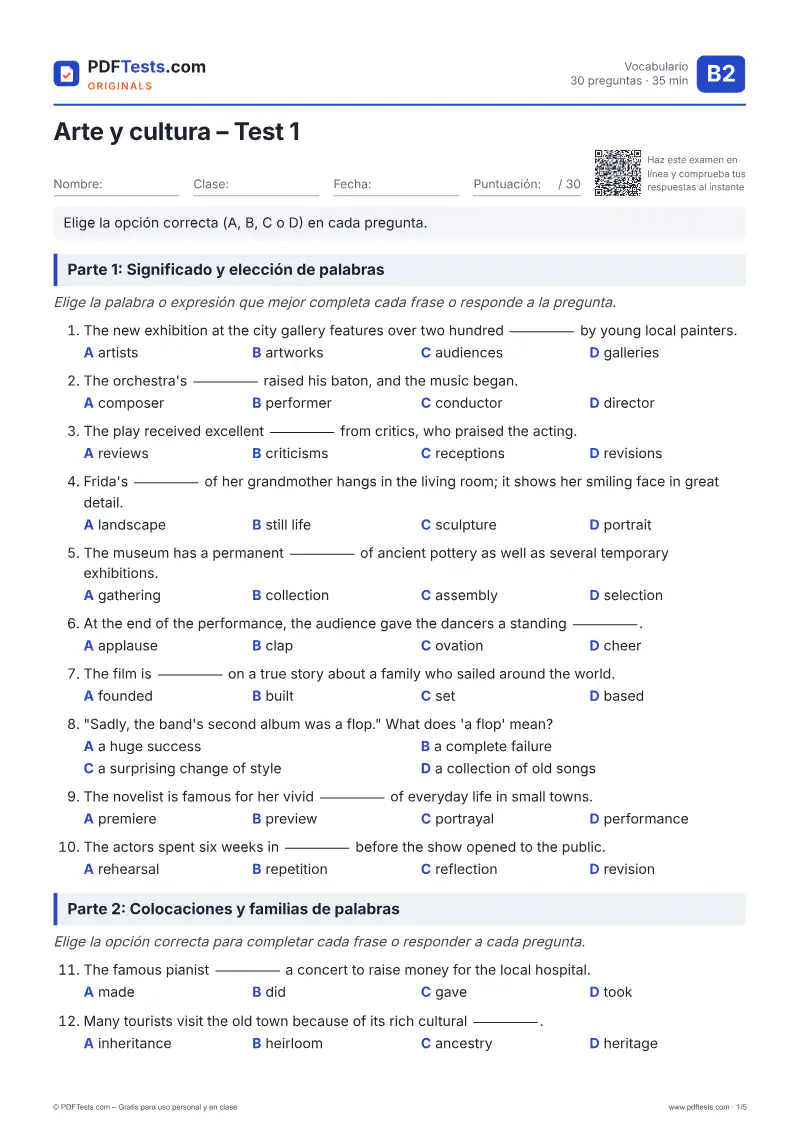
Vista previa de la página 1: Arte y cultura – Test 1 Abrir PDF

Haz el examen en línea

Elige la opción correcta (A, B, C o D) en cada pregunta. Elige tus respuestas y pulsa «Comprobar respuestas».

Parte 1: Significado y elección de palabras

Elige la palabra o expresión que mejor completa cada frase o responde a la pregunta.

  1. The new exhibition at the city gallery features over two hundred _____ by young local painters.

  2. The orchestra's _____ raised his baton, and the music began.

  3. The play received excellent _____ from critics, who praised the acting.

  4. Frida's _____ of her grandmother hangs in the living room; it shows her smiling face in great detail.

  5. The museum has a permanent _____ of ancient pottery as well as several temporary exhibitions.

  6. At the end of the performance, the audience gave the dancers a standing _____.

  7. The film is _____ on a true story about a family who sailed around the world.

  8. "Sadly, the band's second album was a flop." What does 'a flop' mean?

  9. The novelist is famous for her vivid _____ of everyday life in small towns.

  10. The actors spent six weeks in _____ before the show opened to the public.

Parte 2: Colocaciones y familias de palabras

Elige la opción correcta para completar cada frase o responder a cada pregunta.

  1. The famous pianist _____ a concert to raise money for the local hospital.

  2. Many tourists visit the old town because of its rich cultural _____.

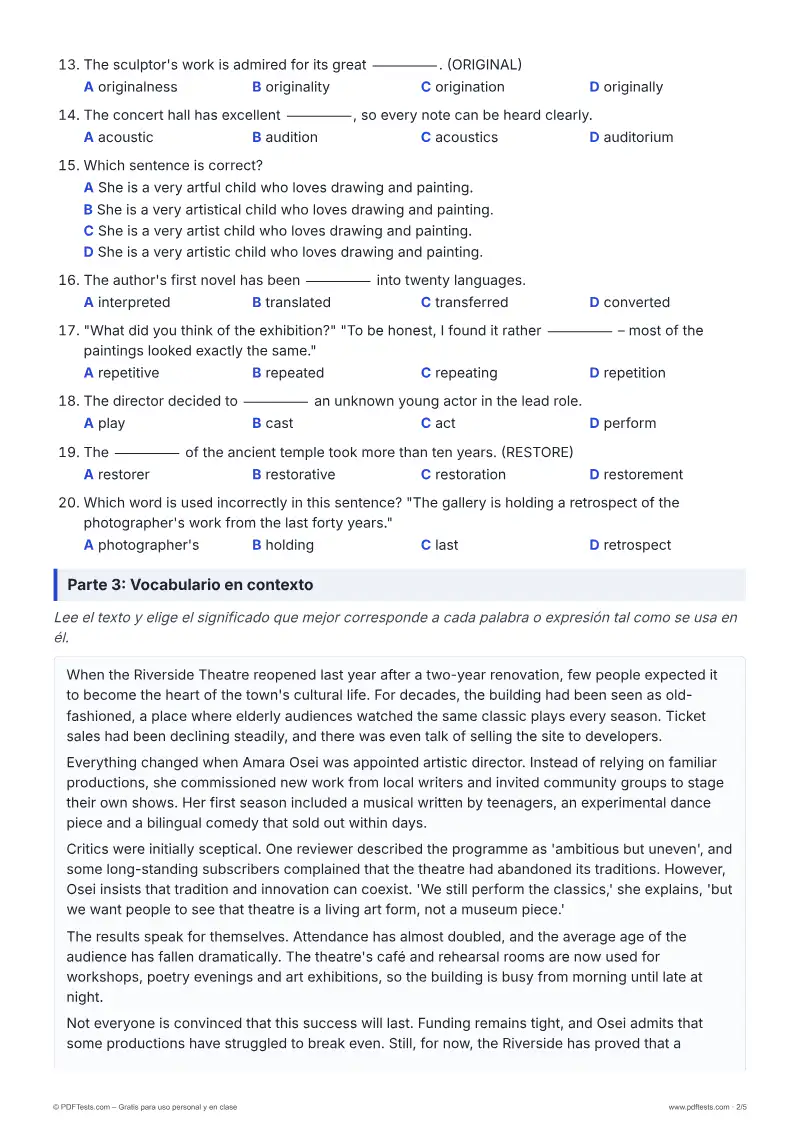
  3. The sculptor's work is admired for its great _____. (ORIGINAL)

  4. The concert hall has excellent _____, so every note can be heard clearly.

  5. Which sentence is correct?

  6. The author's first novel has been _____ into twenty languages.

  7. "What did you think of the exhibition?" "To be honest, I found it rather _____ – most of the paintings looked exactly the same."

  8. The director decided to _____ an unknown young actor in the lead role.

  9. The _____ of the ancient temple took more than ten years. (RESTORE)

  10. Which word is used incorrectly in this sentence? "The gallery is holding a retrospect of the photographer's work from the last forty years."

Parte 3: Vocabulario en contexto

Lee el texto y elige el significado que mejor corresponde a cada palabra o expresión tal como se usa en él.

When the Riverside Theatre reopened last year after a two-year renovation, few people expected it to become the heart of the town's cultural life. For decades, the building had been seen as old-fashioned, a place where elderly audiences watched the same classic plays every season. Ticket sales had been declining steadily, and there was even talk of selling the site to developers.

Everything changed when Amara Osei was appointed artistic director. Instead of relying on familiar productions, she commissioned new work from local writers and invited community groups to stage their own shows. Her first season included a musical written by teenagers, an experimental dance piece and a bilingual comedy that sold out within days.

Critics were initially sceptical. One reviewer described the programme as 'ambitious but uneven', and some long-standing subscribers complained that the theatre had abandoned its traditions. However, Osei insists that tradition and innovation can coexist. 'We still perform the classics,' she explains, 'but we want people to see that theatre is a living art form, not a museum piece.'

The results speak for themselves. Attendance has almost doubled, and the average age of the audience has fallen dramatically. The theatre's café and rehearsal rooms are now used for workshops, poetry evenings and art exhibitions, so the building is busy from morning until late at night.

Not everyone is convinced that this success will last. Funding remains tight, and Osei admits that some productions have struggled to break even. Still, for now, the Riverside has proved that a cultural institution can reinvent itself without losing its soul.

  1. In paragraph 1, ticket sales had been "declining steadily". This means they had been _____.

  2. In paragraph 2, Amara Osei "was appointed" artistic director. This means she was _____.

  3. Osei "commissioned new work from local writers". This means she _____.

  4. The bilingual comedy "sold out within days". This means that _____.

  5. "Critics were initially sceptical." The word 'sceptical' is closest in meaning to _____.

  6. One reviewer called the programme "ambitious but uneven". Here, 'uneven' means _____.

  7. Osei says tradition and innovation "can coexist". This means they can _____.

  8. Osei says theatre is "not a museum piece". She means theatre should not be _____.

  9. "The results speak for themselves." This means the results _____.

  10. Some productions "have struggled to break even". To 'break even' means to _____.

¿Te ha resultado útil esta página?

Informar de un error

¿Has visto una respuesta incorrecta, una errata o una explicación poco clara? Avísanos y lo corregiremos.

Practica con una ficha: Arte y cultura – Ficha 1

Vista previa

Sobre este examen

Este test de vocabulario de nivel B2 trata el léxico del arte y la cultura: teatro, música, pintura, museos, literatura y cine. Evalúa el significado de las palabras, las colocaciones, la formación de palabras y el vocabulario en contexto a partir de un texto de lectura. Es ideal para alumnos de nivel intermedio-alto, para quienes preparan exámenes oficiales y para profesores que necesitan un test listo para imprimir.

Temas

Teatro y artes escénicasMúsica y conciertosArtes visuales y museosLiteratura y cineColocaciones (collocations)Formación de palabras (word formation)Vocabulario en contexto

Cómo usar este examen

  1. Descarga el PDF e imprímelo, o haz el examen en línea más abajo.
  2. Responde todas las preguntas sin diccionario y sin prisas.
  3. Comprueba tus respuestas y apunta los temas que debes repasar.

Notas para el profesor

Utiliza este test al terminar una unidad sobre arte y cultura o como repaso antes de un examen de nivel B2. Se centra en errores frecuentes de los alumnos, como confundir palabras parecidas (portrait/portrayal, heritage/inheritance, artistic/artful), usar colocaciones incorrectas (make a concert, based on frente a set on) o elegir una forma equivocada de la palabra. La Parte 3 entrena la deducción del significado a partir del contexto. Como actividad de ampliación, los alumnos pueden escribir una breve reseña de una obra, un concierto o una exposición usando al menos diez palabras del test.