PDFTests Originals

Use of English B2 – Test 1

B2 Intermedio alto GramáticaInglés

Este test de Use of English de nivel B2, con formato de examen, consta de 36 preguntas de opción múltiple repartidas en cuatro partes: colocaciones y phrasal verbs en contexto, palabras gramaticales en un texto, formación de palabras y transformaciones con palabra clave. Es ideal para alumnos de nivel intermedio alto que preparan exámenes B2 y para profesores que buscan un test de práctica o de diagnóstico listo para usar.
Preguntas
36
Tiempo
45 min
PDF
6 páginas
Soluciones
Incluidas
  • 100 % gratis
  • Sin registro
  • PDF A4 listo para imprimir
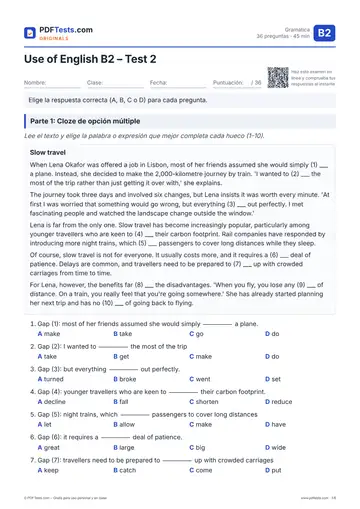
Vista previa de la página 1: Use of English B2 – Test 1 Abrir PDF
Use of English B1–C2 · todos los exámenes con formato de examen, tipos de tarea y consejos

Haz el examen en línea

Lee cada parte con atención y elige la opción correcta (A, B, C o D) en cada pregunta. Elige tus respuestas y pulsa «Comprobar respuestas».

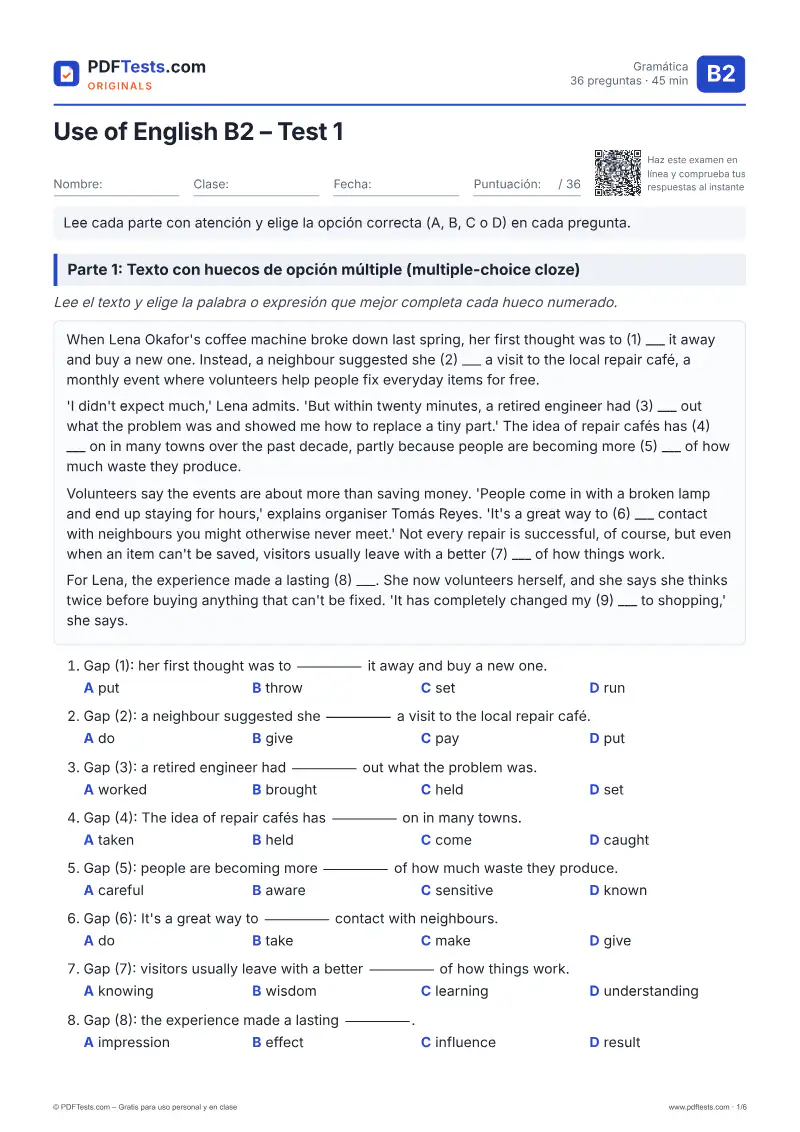
Parte 1: Texto con huecos de opción múltiple (multiple-choice cloze)

Lee el texto y elige la palabra o expresión que mejor completa cada hueco numerado.

When Lena Okafor's coffee machine broke down last spring, her first thought was to (1) ___ it away and buy a new one. Instead, a neighbour suggested she (2) ___ a visit to the local repair café, a monthly event where volunteers help people fix everyday items for free.

'I didn't expect much,' Lena admits. 'But within twenty minutes, a retired engineer had (3) ___ out what the problem was and showed me how to replace a tiny part.' The idea of repair cafés has (4) ___ on in many towns over the past decade, partly because people are becoming more (5) ___ of how much waste they produce.

Volunteers say the events are about more than saving money. 'People come in with a broken lamp and end up staying for hours,' explains organiser Tomás Reyes. 'It's a great way to (6) ___ contact with neighbours you might otherwise never meet.' Not every repair is successful, of course, but even when an item can't be saved, visitors usually leave with a better (7) ___ of how things work.

For Lena, the experience made a lasting (8) ___. She now volunteers herself, and she says she thinks twice before buying anything that can't be fixed. 'It has completely changed my (9) ___ to shopping,' she says.

  1. Gap (1): her first thought was to _____ it away and buy a new one.

  2. Gap (2): a neighbour suggested she _____ a visit to the local repair café.

  3. Gap (3): a retired engineer had _____ out what the problem was.

  4. Gap (4): The idea of repair cafés has _____ on in many towns.

  5. Gap (5): people are becoming more _____ of how much waste they produce.

  6. Gap (6): It's a great way to _____ contact with neighbours.

  7. Gap (7): visitors usually leave with a better _____ of how things work.

  8. Gap (8): the experience made a lasting _____.

  9. Gap (9): It has completely changed my _____ to shopping.

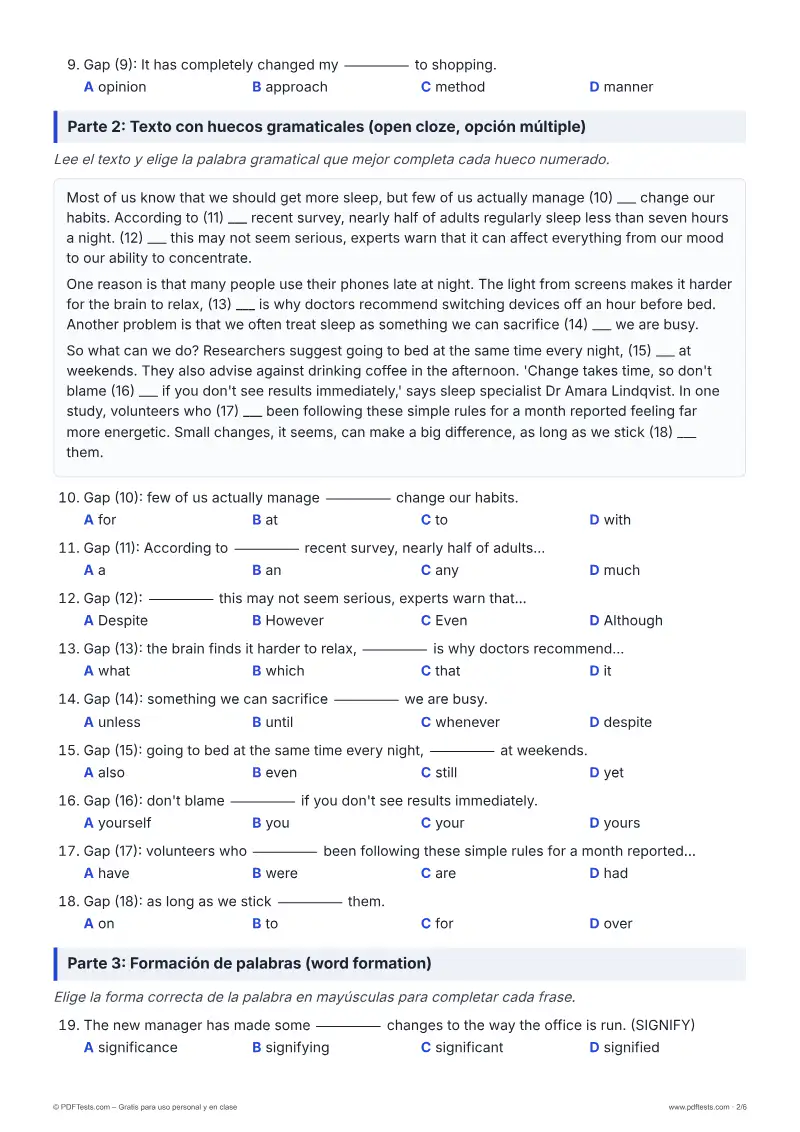
Parte 2: Texto con huecos gramaticales (open cloze, opción múltiple)

Lee el texto y elige la palabra gramatical que mejor completa cada hueco numerado.

Most of us know that we should get more sleep, but few of us actually manage (10) ___ change our habits. According to (11) ___ recent survey, nearly half of adults regularly sleep less than seven hours a night. (12) ___ this may not seem serious, experts warn that it can affect everything from our mood to our ability to concentrate.

One reason is that many people use their phones late at night. The light from screens makes it harder for the brain to relax, (13) ___ is why doctors recommend switching devices off an hour before bed. Another problem is that we often treat sleep as something we can sacrifice (14) ___ we are busy.

So what can we do? Researchers suggest going to bed at the same time every night, (15) ___ at weekends. They also advise against drinking coffee in the afternoon. 'Change takes time, so don't blame (16) ___ if you don't see results immediately,' says sleep specialist Dr Amara Lindqvist. In one study, volunteers who (17) ___ been following these simple rules for a month reported feeling far more energetic. Small changes, it seems, can make a big difference, as long as we stick (18) ___ them.

  1. Gap (10): few of us actually manage _____ change our habits.

  2. Gap (11): According to _____ recent survey, nearly half of adults...

  3. Gap (12): _____ this may not seem serious, experts warn that...

  4. Gap (13): the brain finds it harder to relax, _____ is why doctors recommend...

  5. Gap (14): something we can sacrifice _____ we are busy.

  6. Gap (15): going to bed at the same time every night, _____ at weekends.

  7. Gap (16): don't blame _____ if you don't see results immediately.

  8. Gap (17): volunteers who _____ been following these simple rules for a month reported...

  9. Gap (18): as long as we stick _____ them.

Parte 3: Formación de palabras (word formation)

Elige la forma correcta de la palabra en mayúsculas para completar cada frase.

  1. The new manager has made some _____ changes to the way the office is run. (SIGNIFY)

  2. Several customers complained about the _____ of the staff. (RUDE)

  3. It's completely _____ to expect everyone to finish the work by Friday. (REASON)

  4. The museum is closed for _____ until the end of June. (RENOVATE)

  5. She spoke so _____ that everyone in the room was convinced. (PERSUADE)

  6. There has been a _____ increase in the number of people cycling to work. (DRAMA)

  7. The _____ of the new bridge took nearly three years. (CONSTRUCT)

  8. I'm afraid your answer is _____, so please try again. (CORRECT)

  9. Having a pet can give children a sense of _____. (RESPONSIBLE)

Parte 4: Transformaciones con palabra clave (key word transformations)

Lee la primera frase y la palabra clave en mayúsculas. Elige la reformulación que mantiene el mismo significado, utiliza la palabra clave y es gramaticalmente correcta.

  1. I'm sure Daniel didn't take your keys. (CAN'T)

  2. It was the first time Priya had flown in a plane. (NEVER)

  3. People say the castle is over 800 years old. (SAID)

  4. I regret not studying harder for the exam. (WISH)

  5. Although it rained heavily, the match continued. (DESPITE)

  6. Someone is going to repair my laptop tomorrow. (HAVING)

  7. 'Did you lock the door?' Maria asked me. (WHETHER)

  8. It isn't necessary for you to bring any food. (HAVE)

  9. If you don't leave now, you'll miss the train. (UNLESS)

¿Te ha resultado útil esta página?

Informar de un error

¿Has visto una respuesta incorrecta, una errata o una explicación poco clara? Avísanos y lo corregiremos.

Practica con una ficha: Use of English B2: ficha 1

Vista previa

Sobre este examen

Este test de Use of English de nivel B2, con formato de examen, consta de 36 preguntas de opción múltiple repartidas en cuatro partes: colocaciones y phrasal verbs en contexto, palabras gramaticales en un texto, formación de palabras y transformaciones con palabra clave. Es ideal para alumnos de nivel intermedio alto que preparan exámenes B2 y para profesores que buscan un test de práctica o de diagnóstico listo para usar.

Temas

Colocaciones y expresiones fijasPhrasal verbsArtículos, preposiciones y conectoresPronombres relativos y reflexivosFormación de palabras (word formation)Verbos modales de deducciónVoz pasiva y estructuras causativasEstilo indirecto (reported speech) y deseos con «wish»

Cómo usar este examen

  1. Descarga el PDF e imprímelo, o haz el examen en línea más abajo.
  2. Responde todas las preguntas sin diccionario y sin prisas.
  3. Comprueba tus respuestas y apunta los temas que debes repasar.

Notas para el profesor

Puede usarse como simulacro de examen cronometrado o como prueba de diagnóstico al comienzo de un curso B2. Se centra en errores típicos del nivel intermedio alto, como las colocaciones verbo-sustantivo incorrectas (do/make/pay), el uso de 'despite' seguido de una oración, la falta de prefijos en la formación de palabras y el cambio de tiempos verbales mal hecho en el estilo indirecto. Después de corregir, pida a los alumnos que expliquen por qué cada distractor es incorrecto y que luego escriban sus propias transformaciones con las mismas palabras clave.